Suppose a bead is excavated far from the sea where its raw material is thought to have been collected. How much of its journey has been recovered? A material identification can establish an important connection, yet leave the number of journeys, traders and workshops entirely open.
Baltic amber makes that problem unusually tangible. It is attractive enough to be collected, worked and exchanged, while its chemistry can preserve evidence that appearance alone cannot supply. Follow a bead from resin to object to archaeological sample, and the story becomes more interesting than a single arrow labelled Amber Road.
A material already moved by nature
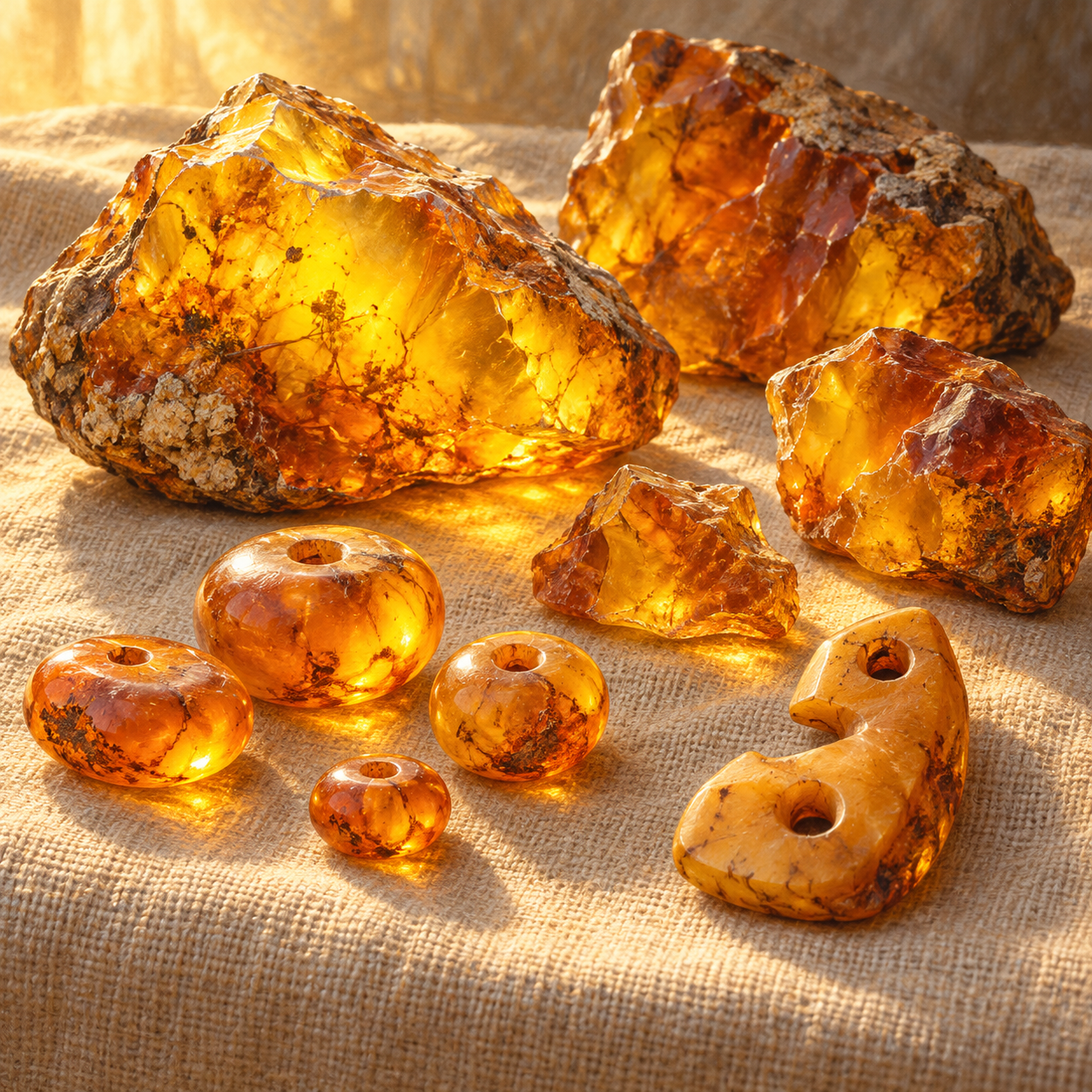
Amber is fossil resin. Getty's account identifies Baltic amber, also known as succinite, as a major Old World source. Its rich deposits include the region around the Samland peninsula near the southeastern Baltic. But the geological story involves redistribution by water and ice over long periods.
The place where resin formed, the deposit from which it weathered and the beach where a person collected it need not be identical. That distinction is easy to miss when “Baltic” appears as a compact label in a museum description. It names a material tradition and region, not a stamped collection address.
Before reconstructing human trade, therefore, we already have to consider natural movement. A sample's relationship to a recognised amber type can be strong even when its exact ancient collection place is unknown. Good sourcing reduces uncertainty without necessarily reducing it to one point on a map.
The object adds another journey
Getty's Bronze Age survey describes amber in beads, embellishments and other worked forms across the Mediterranean. At Mycenae, some burials contained substantial numbers of beads. The survey also notes Italian evidence, including Frattesina in the Po valley, for exchange involving both raw material and finished products.
That last distinction changes the story. A lump could travel to a workshop and become a bead there. A finished bead could travel further. An object could be restrung or reworked. Finding northern material in a southern burial does not tell us that one traveller carried it all the way from a Baltic shore.
There are consequently several kinds of history to recover: the resin's geological origin, a workshop's treatment of it, its circulation as an object and its eventual deposition. They can intersect without following one uninterrupted route. A bead is a compact object with a potentially complicated biography.
What the laboratory can see
Infrared spectroscopy examines how a material absorbs infrared radiation. Getty Conservation Institute researchers describe a characteristic feature in Baltic amber's spectrum and explain how analysis can help identify the material. They also studied selected objects using complementary chemical methods.
The investigators compared material from objects' interiors and weathered surfaces, and considered earlier conservation treatments. Those are practical matters, not merely laboratory fine print. A surface altered by burial, deterioration or treatment may not preserve exactly the same chemical information as the material within.
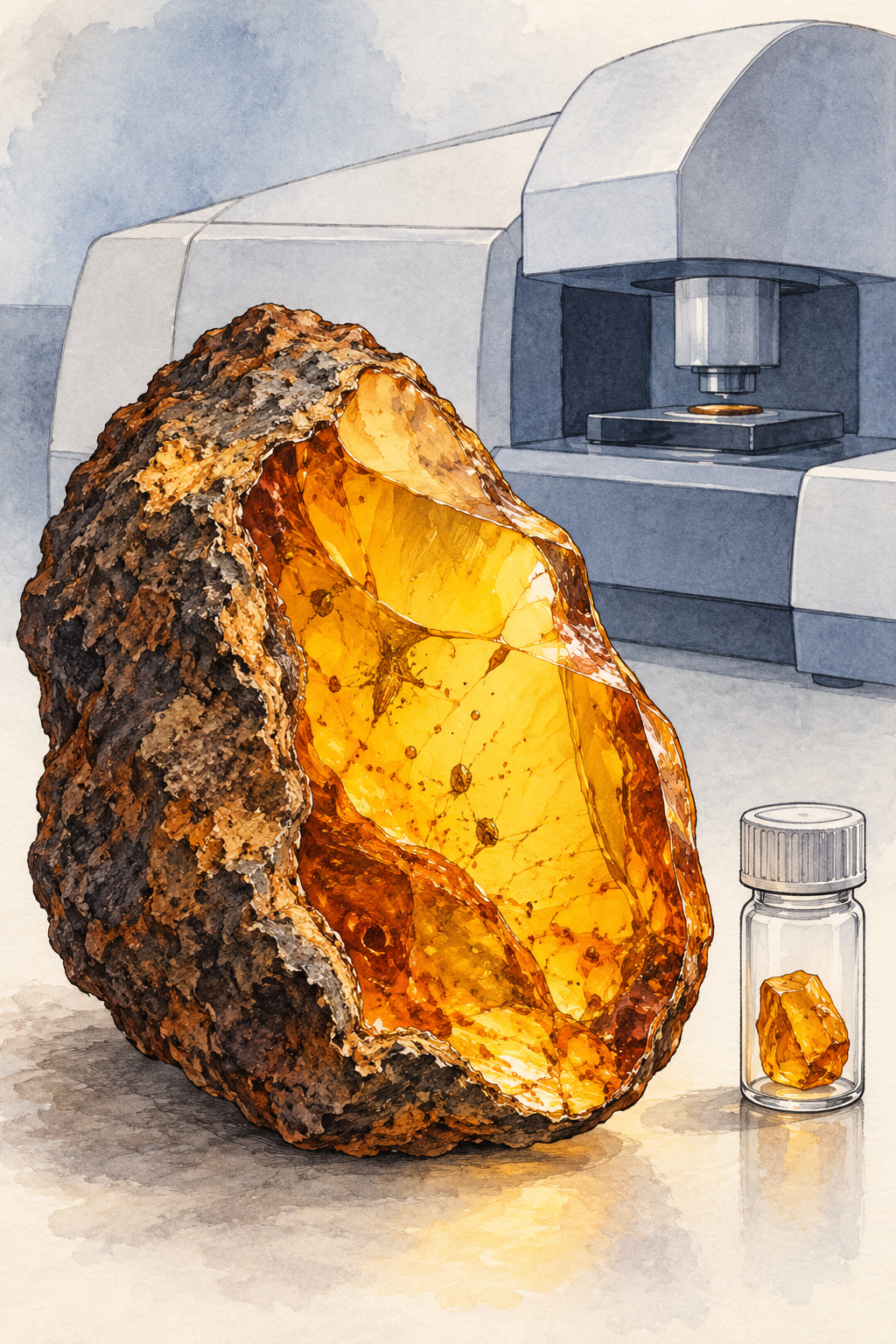
The illustration separates surface and interior as ideas; it is not a measured spectrum. For actual results, open the Getty technical essay's figures and tables. Start by identifying what was sampled and what was being compared before attempting to interpret the shapes of plotted lines.
Colour alone is an unreliable shortcut. Translucency, bubbles, inclusions and alteration can affect how amber looks. An appealing honey-coloured photograph is therefore weaker evidence for a source than an appropriate analysis connected to a documented object.
Build three possible biographies
Try this deliberately hypothetical exercise. An ancient bead found in Italy has been identified as Baltic amber. Its precise workshop is unknown. Which of the following accounts remains possible on those facts alone?
- Raw amber travelled south and was carved into the bead near its final place of use.
- A finished bead arrived through several exchanges and was incorporated into local jewellery.
- An older imported object was reworked into a bead before burial.
All three could fit the limited statement. Now ask what further evidence would help distinguish them. Workshop waste, unfinished objects, tool marks, the distribution of a distinctive form and securely dated contexts are possible lines of investigation. None needs to be assumed in advance.
| Proposed claim | Evidence to seek |
|---|---|
| The material belongs to a Baltic amber type | Documented analytical identification and suitable comparisons. |
| The bead was made locally | Manufacturing evidence connected to a workshop or local production sequence. |
| A particular route carried it | Chronologically compatible finds and additional evidence of connections along that route. |
The exercise is useful because it resists an attractive but unnecessary choice between a complete story and no knowledge at all. We can have confidence in one stage of the biography while leaving another unresolved.
Read a museum catalogue in two directions
Getty's online amber publication allows you to move between object entries, historical essays and technical analysis. Choose a worked object and first examine its form. Where is it pierced? What surfaces are carved? Does the catalogue describe damage or restoration that changes what can be seen?
Then follow the technical discussion back towards the material. Notice how the questions change. A carved figure may invite discussion of imagery and use, while an analytical sample addresses composition and alteration. One object can support both conversations without either replacing the other.
Return finally to the imagined journey. The familiar phrase Amber Road can help us recognise long-distance connections, but routes varied across place and time. A network of successive exchanges may explain a distribution better than one fixed highway. The small bead remains beautiful; careful analysis gives its beauty a history with room for both evidence and unanswered questions.




