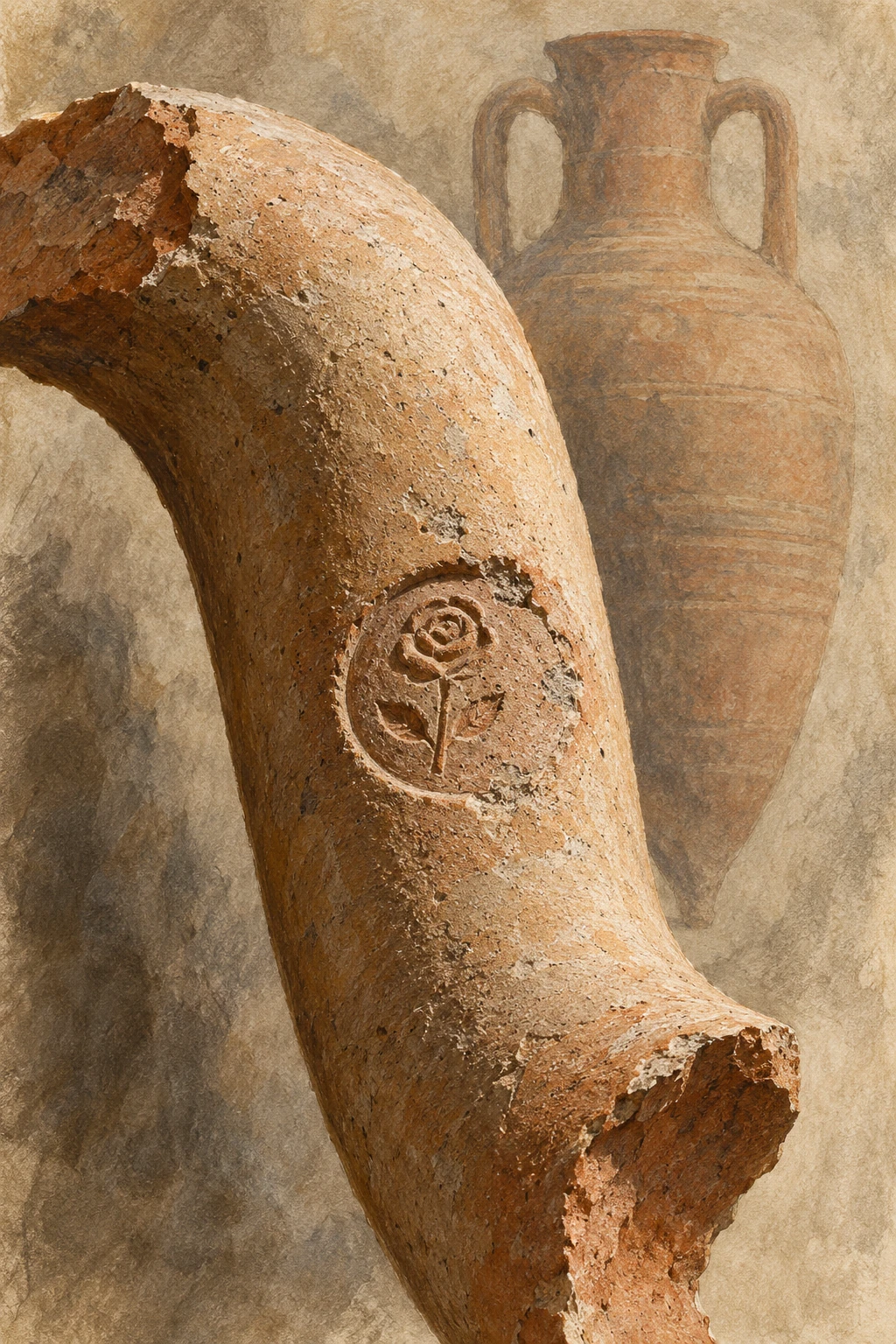
In a case of ancient pottery, a broken handle may look like the part that survived after the interesting object disappeared. Turn it toward the light and a small stamp can reverse that impression. A name, a symbol, or a month impressed into clay may make the fragment more informative than an unmarked complete jar.
Transport amphoras carried goods through Mediterranean trade networks. Their stamped handles can help researchers investigate production, chronology, and distribution. They are not universal ancient shipping labels. The meaning of a stamp depends on the particular system that produced it.
Read one example before making a rule
The Acropolis Museum’s Rhodian handle provides a concrete starting point. The museum dates it to 230–220 BCE and records its discovery on the south slope of the Acropolis in 1957. It interprets the stamp’s inscription as referring to the potter Kreon and the month Panamos.
That is already several layers of information: a surviving impression, a reading of letters, an interpretation of the names, and an archaeological findspot. A visitor seeing only the handle is seeing the material end of a much larger chain of scholarly comparison.
A British Museum example from Rhodes has a circular stamp with a rose symbol and the name Damokles. Its catalog records a production date of 176–174 BCE and a possible Alexandria findspot. The question mark attached to that findspot matters. It should remain a question mark when the object is retold in a lively story.
The stamp is made; the jar then has a life
A stamp marks a stage in production. The place where a fragment is later excavated belongs to a different stage: use, reuse, breakage, and deposition. The two locations can support a story of movement, but they do not tell us the exact time between manufacture and discard.
This is why archaeological context remains essential. A handle might enter a later deposit. A jar might be reused. A stamp date can contribute to dating a context without making every object nearby exactly contemporary with the jar’s manufacture. The right question is how the fragment got into that particular layer.
The American School of Classical Studies’ Agora collection brings together amphoras and stamps as evidence for the ancient economy. Its history also makes visible Virginia Grace’s long work developing and recording the material. A tiny impression becomes useful through an accumulated reference collection, not through an isolated flash of recognition.
Annual officials can give a narrow chronological handle
In an interview about his study of Thasian stamps, archaeologist Chavdar Tzochev explains how annually changing officials make some stamps particularly useful chronological indicators. He also describes a stamping system that formed part of state oversight, while warning that the larger system remains incompletely understood.
Thasian evidence should not be treated as a rule for every Rhodian, Knidian, or other stamp. The value of a comparative collection is that it preserves differences. An official’s name, a producer’s name, a place name, and a month are not interchangeable categories just because all appear as ancient letters in a small rectangle.
The interview also describes experimental die engraving. Reproducing a general picture was easier than duplicating an engraver’s detailed lettering. That observation helps explain why researchers examine the individual die as well as the text. Two impressions can have more in common than a shared name.
Follow a die across two fragments
The British Museum catalog notes that its Damokles stamp shares a die with an example from the Athenian Agora. This is an especially satisfying connection: two surviving impressions can be related through the tool that made them. It is a different claim from saying the amphoras traveled together or belonged to one merchant.
To practice the distinction, imagine making five impressions from one ordinary rubber stamp on five separate envelopes. The shared design relates the envelopes to a tool. It does not establish that the envelopes contained the same message, went to the same address, or were sent on the same day. The analogy is deliberately narrow, but it clarifies what a die link can establish.
Watch the boundary around the stamp as closely as its central sign. A partial mark can reflect limited space, an uneven impression, later breakage, or an incomplete photograph. Those alternatives affect whether two handles can be compared confidently. Before counting a missing letter as a different name, establish whether that portion of the surface actually survives.
A four-column reading card
When you meet a stamped handle online or in a museum, make a small card with four headings. Keep observation and interpretation in their own spaces.
| Surface | Reading | Context | Limits |
|---|---|---|---|
| What shape and marks are visible? | What letters or symbols do specialists identify? | Where and how was it found? | Which details are uncertain or missing? |
| Broken edge, worn center, partial frame | A personal name, month, or emblem, if supported | A documented excavation layer or a less secure old collection history | No contents analysis, no known carrier, or incomplete inscription |