
A straight post leans in a photograph taken from a moving train. A propeller seems to bend into disconnected blades. The easy explanation is “the camera was too slow,” but that phrase hides two different times. A row of pixels may have a very short exposure while the whole image still spans a longer sequence of moments.
Rolling shutter is the process that makes those moments coexist in one rectangular frame. Different rows begin collecting light at different times. If the subject or camera moves between them, the finished image assembles a shape that no single instant contained. The sensor has recorded a timetable as well as a view.
Short exposure does not mean simultaneous exposure
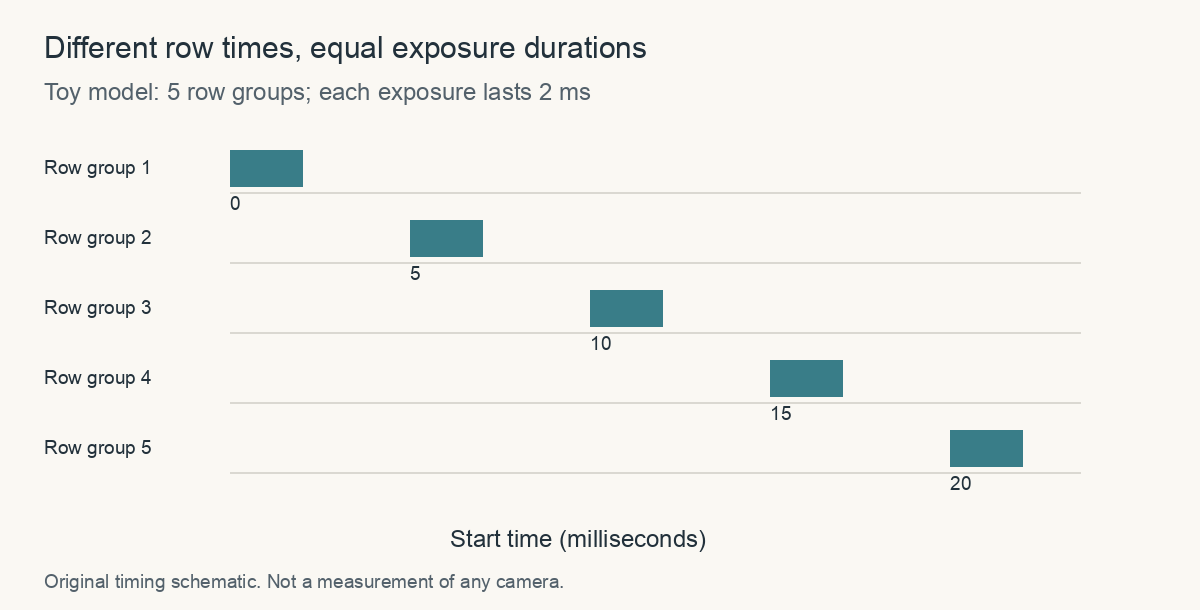
Basler's technical documentation describes the row-to-row temporal offset. In a conventional rolling sequence, the first row starts, then the next begins after a delay, and the process continues across the selected image region. Each row can have the same exposure duration while occupying a different interval on the clock.
Picture a person surveying a building through a narrow horizontal slot. They draw the roof first, the middle later and the foundations last. If the building moves sideways during the survey, the copied roof and foundations belong to different positions. Their drawing may be sharply rendered in every strip and still fail to represent one undistorted building.
By contrast, a global exposure aligns the integration interval across the image. That does not abolish motion blur: a moving object can still travel during a long exposure. It changes whether all image locations share the same interval. Blur within an interval and geometric displacement between intervals are different effects.
Build a frame out of times
Use a deliberately simple numerical example. Suppose the first row begins at 0 milliseconds and the last at 20 milliseconds. Every row exposes for 1 millisecond. An object moving sideways at 1,000 image pixels per second shifts 20 pixels between the first and last starting times, although it moves only one pixel during each row's individual exposure.
Those invented values are not a measurement of a phone. They show why changing the exposure from 1 millisecond to 0.5 millisecond does not automatically remove a 20-millisecond scan interval. The strips can become sharper while the assembled object's lean remains. To change the lean, one must also consider row timing and motion.
| Question | Time quantity to inspect |
|---|---|
| Why is a moving edge smeared? | How far it moves during each pixel's integration interval |
| Why do straight edges lean? | How far the scene shifts between row exposures |
| Why do successive frames differ? | How camera motion and acquisition timing vary from frame to frame |
The geometry is a research problem too
In Geometric Models of Rolling-Shutter Cameras, Marci Meingast, Christopher Geyer and Shankar Sastry developed projection equations that account for different camera motions. Their point was larger than a funny propeller image: treating a rolling frame as one instantaneous central projection can bias estimates of scene geometry and camera motion.
A photograph used for reconstruction is therefore a measurement whose acquisition model matters. The same visual artifact that makes a vacation image amusing can become a systematic error when software uses many such images to infer the shape of a room. The answer is not to call all distorted images useless, but to understand the timing assumptions of the method.
A shared pulse of light needs a shared window
There is a surprising way to separate the electronic exposure schedule from the light that actually contributes to the image. Different rows may be open over different intervals, yet share a shorter interval during which all are open together. A carefully controlled pulse within that overlap can illuminate them at the same time.

Basler's flash-window documentation defines this common interval for supported cameras. In a conventional rolling sequence, it begins when the final row starts exposure and ends when the first row finishes. It exists only if those events occur in that order.
Find the overlap on paper
Consider five fictional row groups starting at 0, 5, 10, 15 and 20 milliseconds. If each exposes for 25 milliseconds, their intervals are 0–25, 5–30, 10–35, 15–40 and 20–45. Which time range lies inside all five?
Check the common interval
It runs from 20 to 25 milliseconds, a five-millisecond overlap. A short pulse entirely inside it reaches every row during its exposure. If each row instead exposes for only three milliseconds, there is no common interval.
These invented times are a reading model, not settings for a camera or an instruction to flash a lamp at a spinning object. Real use depends on the supported sensor, synchronization and control of other illumination. Continuous ambient light can still contribute during the rest of each row's exposure.
A second Basler note on exposure-end events shows why even a timestamp's name needs checking. In the described older ace behavior, the event refers to the first row's readout rather than the completion of the whole image region. The note distinguishes that behavior from ace 2. One label cannot be interpreted identically across every model.
When reading a timing diagram, mark three things in different columns: electronic integration, illumination, and the reported event. Their intervals may overlap without being identical. The camera-and-fan illustration supplies context for the question, rather than an experimental result.
A photograph's history is therefore more than a shutter-speed number. The acquisition schedule decides when the material can respond; the lighting decides when useful photons arrive. Understanding both reveals why a clever measurement can change the effective moment without turning the sensor into a different kind of device.
Why use a rolling shutter at all?
Basler's engineering introduction explains why rolling designs can be useful for stationary or slowly moving inspection tasks. Sensor architecture affects sensitivity, noise, cost and readout. A design chosen for one application can be a good tradeoff even if it produces unwanted geometry in another.
Sony's account of its industrial sensors similarly discusses pixel design and column-parallel conversion as routes to low noise and sensitivity. Those are descriptions of particular technology families, not a universal ranking in which every rolling sensor outperforms every global sensor. The acquisition task defines which properties matter.
A camera does not merely decide which photons belong to a photograph. It decides when each part of that photograph happens. The leaning post is a visible trace of that hidden schedule. Once you know to look for it, “a picture of a moment” becomes a more interesting and more conditional phrase.
Sources and a closer look: Basler: electronic shutter timing; Meingast, Geyer and Sastry: rolling-shutter projection models; Basler: rolling-shutter camera design; Sony: industrial rolling-shutter technology.
Explore art, experiments and other unexpected connections at Incoprea.




