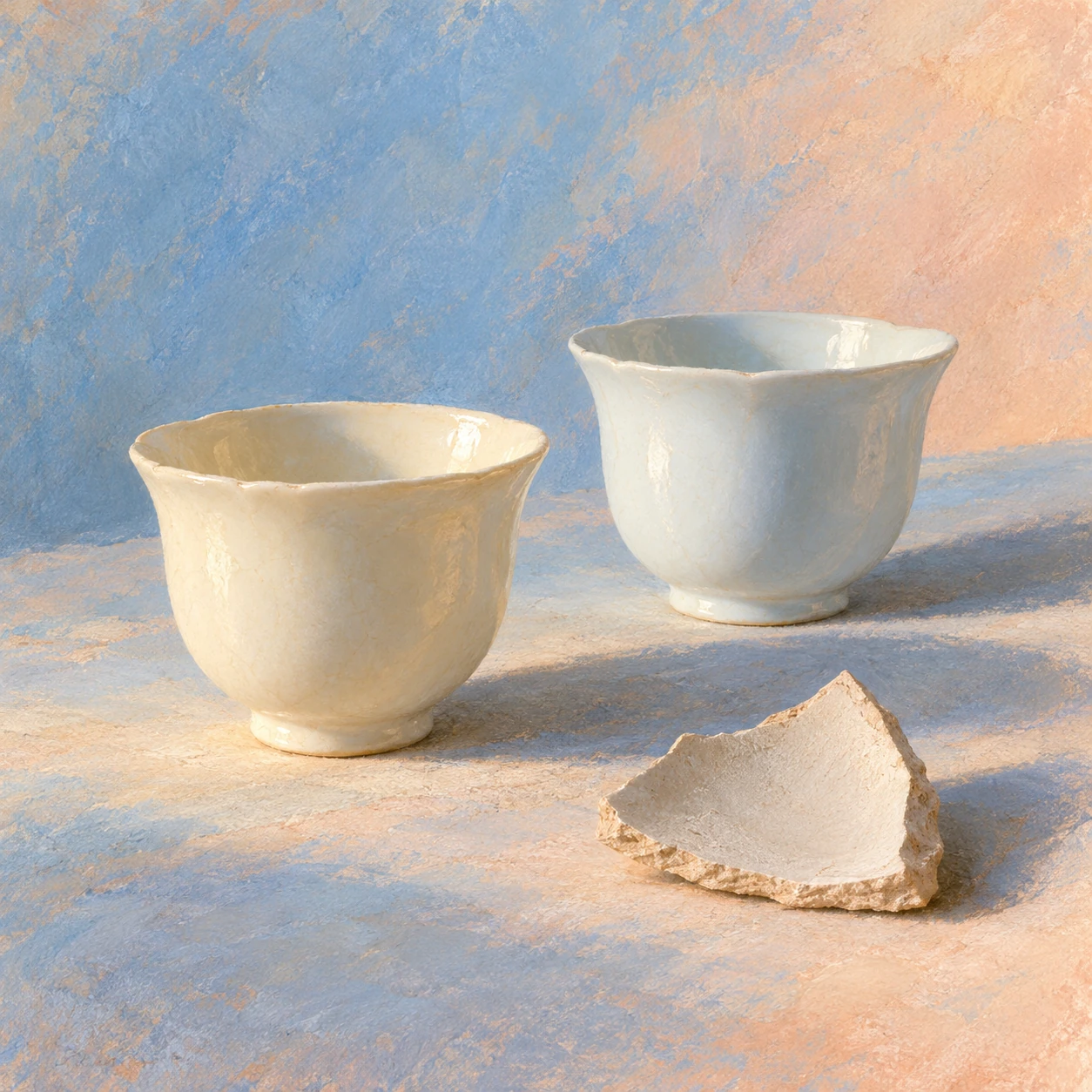
Imagine trying to copy a material by looking at its finished surface. You can see whiteness, translucency, a fine edge, and perhaps an elegant painted decoration. You cannot see the quarry, the washed clay, the kiln atmosphere, or all the failed pieces that came before it.
The European history of porcelain is partly a history of that gap between appearance and production. The labels “soft-paste” and “hard-paste” preserve different solutions to a demanding materials problem. They are not judgments about the artistic worth of the finished object.
A name for a body, not just a glaze
The V&A's ceramics guide connects hard-paste porcelain with its raw materials and high firing temperatures. Kaolin, or china clay, belongs to that story, along with a material that helps the body fuse. The fired ceramic can combine whiteness, translucency, strength, and low porosity.
Soft-paste bodies developed through other formulations as European makers sought effects associated with imported Asian porcelain. “Soft” does not mean a cup remains flexible after firing. It identifies a different ceramic family, with different behavior in manufacture. A material can require extraordinary care in the kiln and still become a highly finished luxury object.
There is a useful lesson here for reading any technical label: find out what the adjective modifies. The name may concern the unfired mixture, a manufacturing difficulty, the fired body, or a later classification. Familiar everyday meanings can take you in the wrong direction.
Sèvres did not change materials in a single clean leap
The Met's factory history places the start of the enterprise at Vincennes in 1740 and its move to Sèvres in 1756. Soft-paste production continued during the eighteenth century even after hard-paste porcelain entered the story. A new formulation did not instantly make an established repertoire disappear.
Calling a ceramic “porcelain” does not tell us which production problem its makers were solving. Compare the body with the decoration rather than assuming that either explains the other. Ask what kind of evidence would connect a particular formulation to a particular artistic result.
That history complicates a simple progress story. Makers were not only asking which body was strongest. They also needed forms, surfaces, colors, and decorative effects to work together. A formulation that suits one object or palette may create difficulties for another. Technical development and artistic intention were entangled.
The clay deposit was a beginning
A Metropolitan Museum Journal study of Sèvres plates describes the importance of kaolin discovered near Saint-Yrieix around 1768 and Pierre Joseph Macquer's hard-paste production in 1769. It also follows processing, shaping, and firing problems. Locating a necessary raw material did not supply a complete working factory.
Washing and preparing a material changes what reaches the potter. Shaping it into a plate presents another set of problems. Firing requires the body and surface to behave together. The study is especially useful where it admits that exact records of a forming method are absent. A plausible account based on object appearance remains an interpretation, not a recovered workshop instruction sheet.
| Question | Useful evidence |
|---|---|
| What does the object look like? | Color, translucency, surface, thickness, and decoration. |
| What is the body made from? | Documented recipes, material analysis, and production records. |
| How was this particular piece made? | Marks, joins, molds, archival evidence, and comparison with related objects. |
Try this distinction with two collection records rather than two cups at home. Compare the museum's named medium, date, factory, and dimensions. Then look at the photographs. Which differences can you actually see? Which depend on the record? Avoid scratch tests or heating experiments: the point is to learn from documentation, not to turn an object into a sample.
Porcelain becomes more interesting when “the secret” expands into a network of deposits, preparation, skills, equipment, and aesthetic choices. The finished white surface is not an absence of history. It is a place where much of that history has become difficult to see.
When reading a catalog, keep the material, maker, place, and date in separate columns. A factory attribution and a description of the ceramic body answer different questions. One may be revised without changing the other. That small habit prevents a label from becoming a single indivisible verdict.
Sources and further exploration
- V&A: An A–Z of Ceramics
- The Met: Royal Porcelain from the Twinight Collection
- The Met Journal: Hard-Paste Porcelain Plates from Sèvres
Explore all 80 new articles · Browse the complete illustrated collection
Continue exploring art, ideas, and unexpected connections at Incoprea.