A large sheet of ngatu can make the word “cloth” feel too small. It has a surface, a pattern, and a physical scale, but also a history of people working together, exchanging value, and marking occasions. Looking only at its decoration leaves most of the object unread.
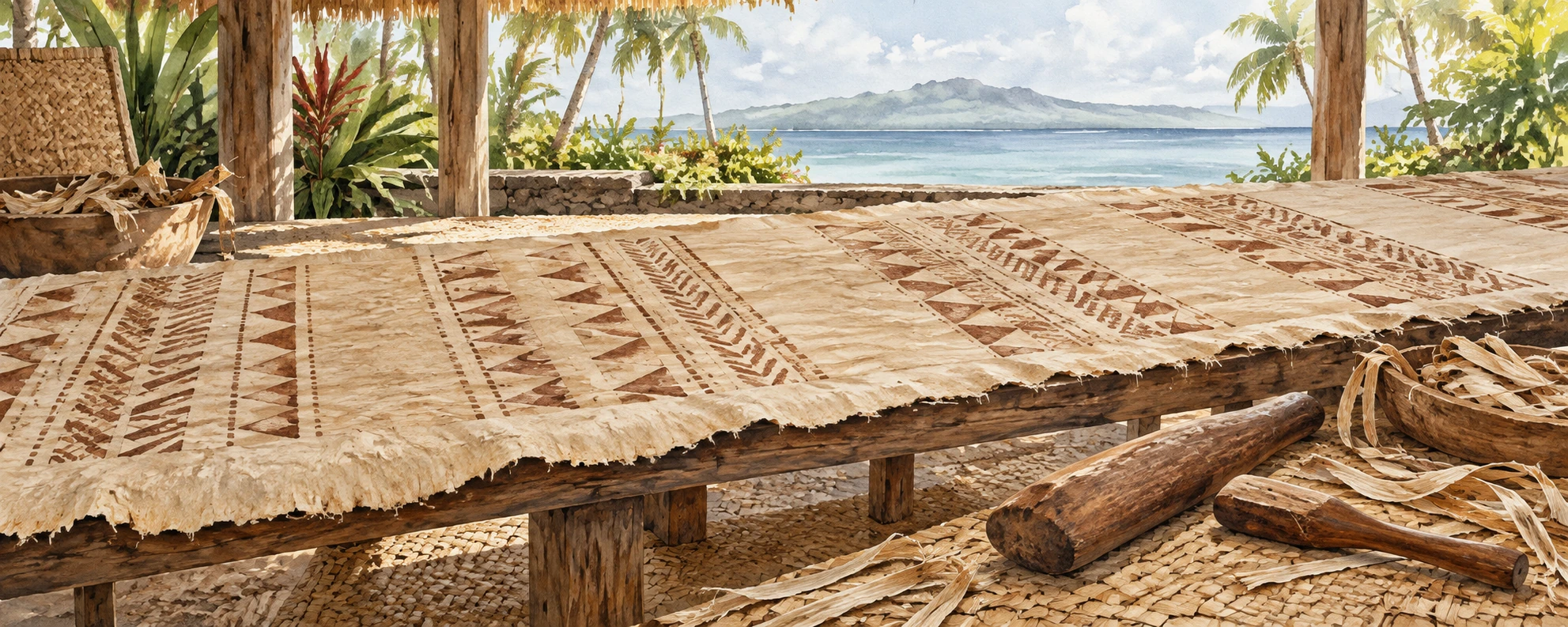
Ngatu is the Tongan name for decorated barkcloth. It is not made by weaving threads across one another. Te Papa's account begins with hiapo, the paper mulberry tree, and follows the separation and beating of its inner bark. Strips become wider sheets, which can be joined into a much larger surface.
Begin with the joins
When looking at a photograph, try to see the cloth as assembled material before reading it as a picture. Where might smaller sheets meet? How does the larger field accommodate repeated work? What happens at an edge? These questions make the material process visible without treating every irregularity as a defect.
The difference from weaving also changes the questions you ask. A woven textile invites attention to thread direction and interlacing. Barkcloth asks you to consider transformed fibers, overlapping or joined sheets, surface working, and the relationship between pattern and the support beneath it. Calling both “fabric” is convenient, but it should not flatten their making into the same operation.
It is equally important not to turn a Tongan description into a rule for all Pacific barkcloth. Te Papa identifies distinct regional names and practices, including ngatu in Tonga, siapo in Sāmoa, masi in Fiji, and kapa in Hawai‘i. The shared broad material does not make designs, techniques, ownership, or meanings interchangeable.
A cloth can have several public lives
One remarkable ngatu in Te Papa's collection was made for Queen Elizabeth II's visit to Tonga in 1953. It was later placed beneath Queen Sālote's coffin when her body returned to Tonga in 1965. The museum's 2010 installation account records a cloth more than 22 meters long and over 4 meters wide.
Those dimensions change your interpretation. A small crop on a screen can resemble a repeat pattern suitable for a decorative background. The full object is large enough to organize a space and demand coordinated handling. Its scale is part of the work, not a neutral container for the design.
The installation account describes the effort required to support and display it. That modern museum episode is another chapter in the cloth's history, separate from its original making and ceremonial use. A collection object continues to be moved, interpreted, and encountered; the museum label does not freeze its life at the date of manufacture.
Listen to a maker before assigning meanings
Sulieti Fieme‘a Burrows speaks about her ngatu practice in a Te Papa film recorded around the 2023 Tahiti wānanga. Her account connects learning from parents, preserving knowledge of older patterns, and passing that knowledge on. It offers a voice with authority grounded in making, rather than an outsider's general claim that the cloth simply “symbolizes community.”
When you watch, notice which parts of the story concern technique and which concern memory or relationships. Those categories may overlap, but they are not substitutes for one another. Knowing the physical action of beating bark does not tell you the full significance of a particular cloth. Recognizing ceremonial importance does not remove the technical skill involved.
A careful route through a barkcloth record
- Use the locally specific name supplied by the maker or collection.
- Record dimensions before judging the design from a screen-sized crop.
- Separate a documented motif name from your own visual association.
- Look for maker, place, date, occasion, and later use.
- If those details are absent, keep the absence visible.
A pattern can be admired without being copied into a supposedly universal vocabulary. The more useful question is what this particular object records and whom its record connects. Sometimes a collection page can answer that well. Sometimes the next necessary source is a living maker.
Ngatu rewards the effort to look at several scales at once: fiber, sheet, joined field, room, occasion, relationship. Its material presence grows richer when those scales remain connected.
Sources and further exploration
- Te Papa: Ngatu, tapa
- Te Papa: Tapa, barkcloth art in the Pacific
- Te Papa: Impressive Tongan tapa, 2010
- Te Papa: Sulieti Fieme‘a Burrows at the 2023 wānanga
Explore all 80 new articles · Browse the complete illustrated collection
Continue exploring art, ideas, and unexpected connections at Incoprea.




