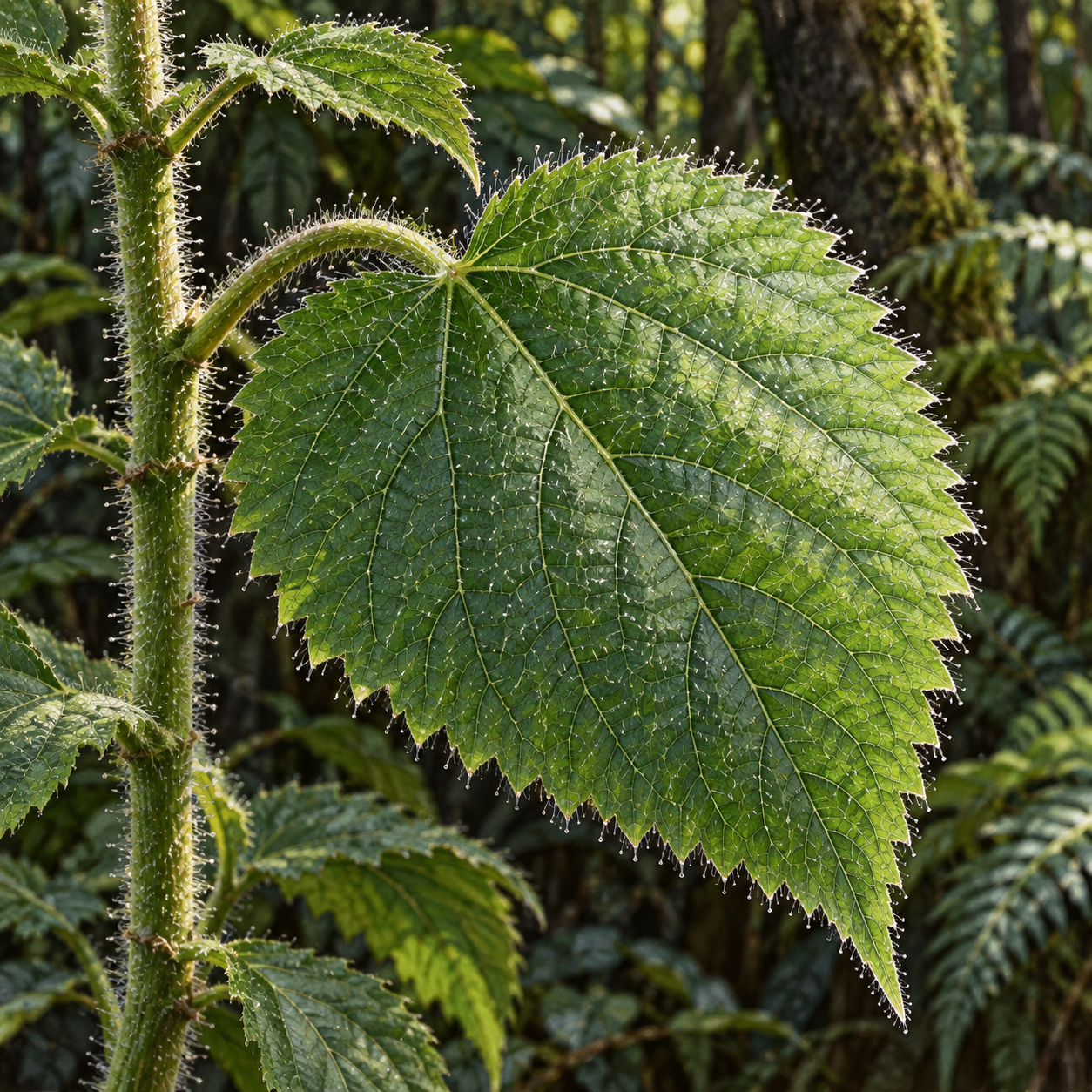
A broad green leaf can conceal a surprisingly elaborate defense. Gympie-gympie, Dendrocnide moroides, is one of Australia's stinging plants. Its toothed, heart-shaped leaves carry dense hairs capable of causing intense, persistent pain on contact.
The striking story is not a collection of horror anecdotes. Research on Australian stinging trees has revealed a family of protein toxins and an unexpectedly specific mechanism affecting nerve signaling. It is a case in which chemistry explains more than a dramatic nickname.
Hairs that deliver a chemical payload
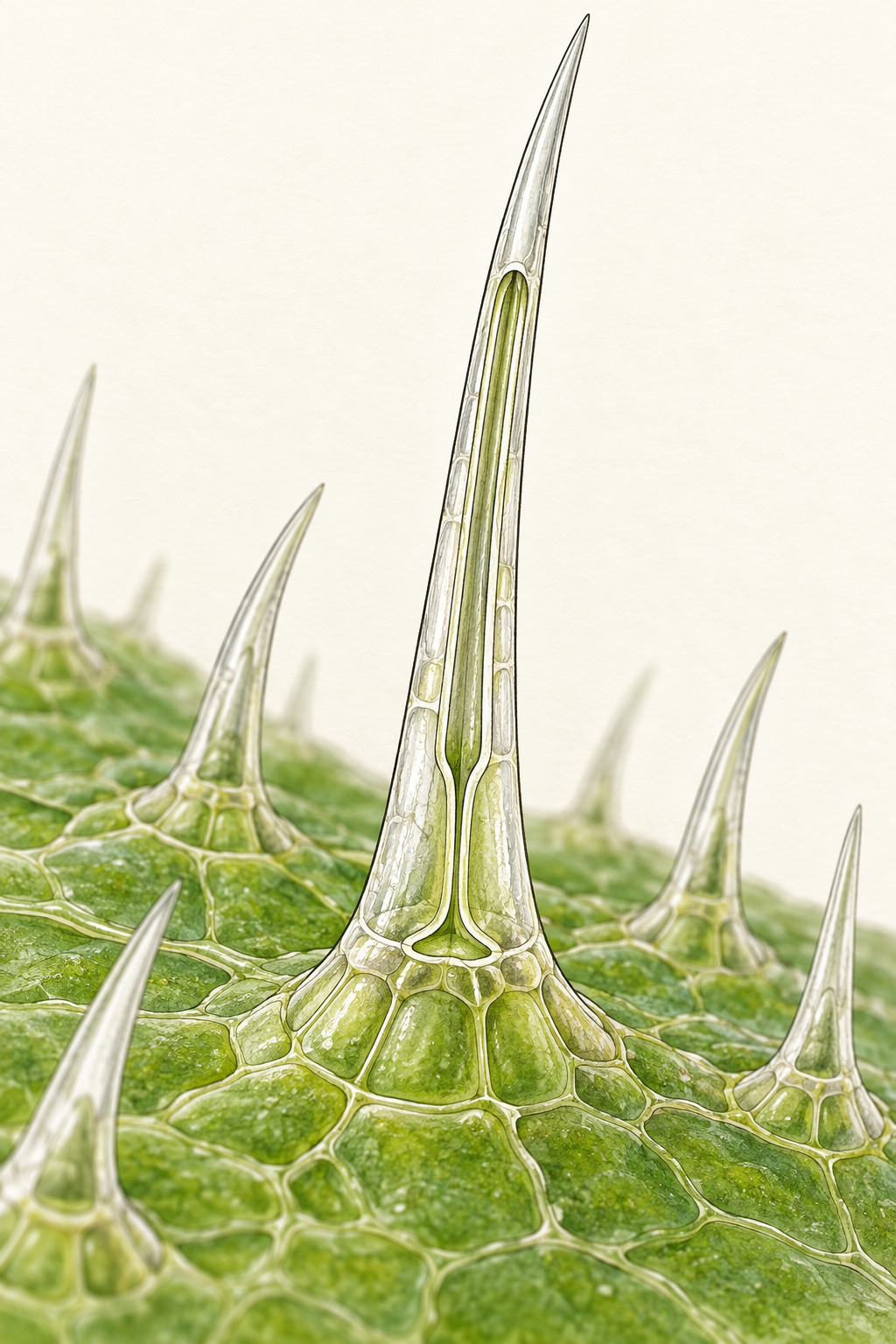
Stinging trees belong to the nettle family. Their fine structures, called trichomes, act as delivery devices rather than merely producing a rough leaf surface. Contact can introduce toxin-containing material into skin. The plant should be observed without handling it.
For researchers, that immediately separates two questions: how a substance is delivered, and what the substance does after delivery. A sharp structure can explain entry without fully explaining a prolonged biological effect.
Earlier candidate small molecules did not account satisfactorily for the characteristic severity and duration described in stinging-tree encounters. That gap encouraged scientists to look for additional active components.
A newly recognized toxin family
In 2020, University of Queensland researchers reported miniproteins they named gympietides. These plant toxins have folded structures resembling some toxins from spiders and cone snails. The comparison concerns molecular architecture and biological targets, rather than a claim that plants and animals produce identical venom.
Proteins are chains that fold into shapes. Their arrangement can determine how they interact with another molecule. A small toxin can therefore have a large effect if it changes the behavior of a crucial component in a cell.
In this case, researchers investigated sodium channels involved in sensory nerve activity. These channels help regulate electrical signaling. Understanding their interaction with toxins provides a more precise account than saying that the plant contains a strong irritant.
The importance of a partner protein
A 2023 study examined the role of TMEM233, a membrane-associated protein, in the action of a gympietide. The experiments showed that the toxin's effects on the studied sodium-channel system depended on this partner. The mechanism was more complicated than a toxin simply attaching directly to a channel.
Such results also show why different experimental systems can give different answers. A cell preparation missing a necessary component may fail to reproduce an effect seen elsewhere. The surrounding molecular context matters.
Work of this kind can guide further research into nerve signaling, but it is not evidence that a leaf or crude extract is a treatment. The scientific value comes from controlled experiments and a clearly identified mechanism.
Gympie-gympie thus offers a detailed example of plant defense: a delivery structure, active molecules and a specific cellular interaction. The dramatic sting draws attention. The more enduring curiosity is how evolution produces a system operating at scales far smaller than the leaf we see.
Sources: NSW Government: Gympie stinger profile · University of Queensland: discovery of gympietides · Jami and colleagues: TMEM233 and nerve-channel function
Explore more creative curiosities at Incoprea.




