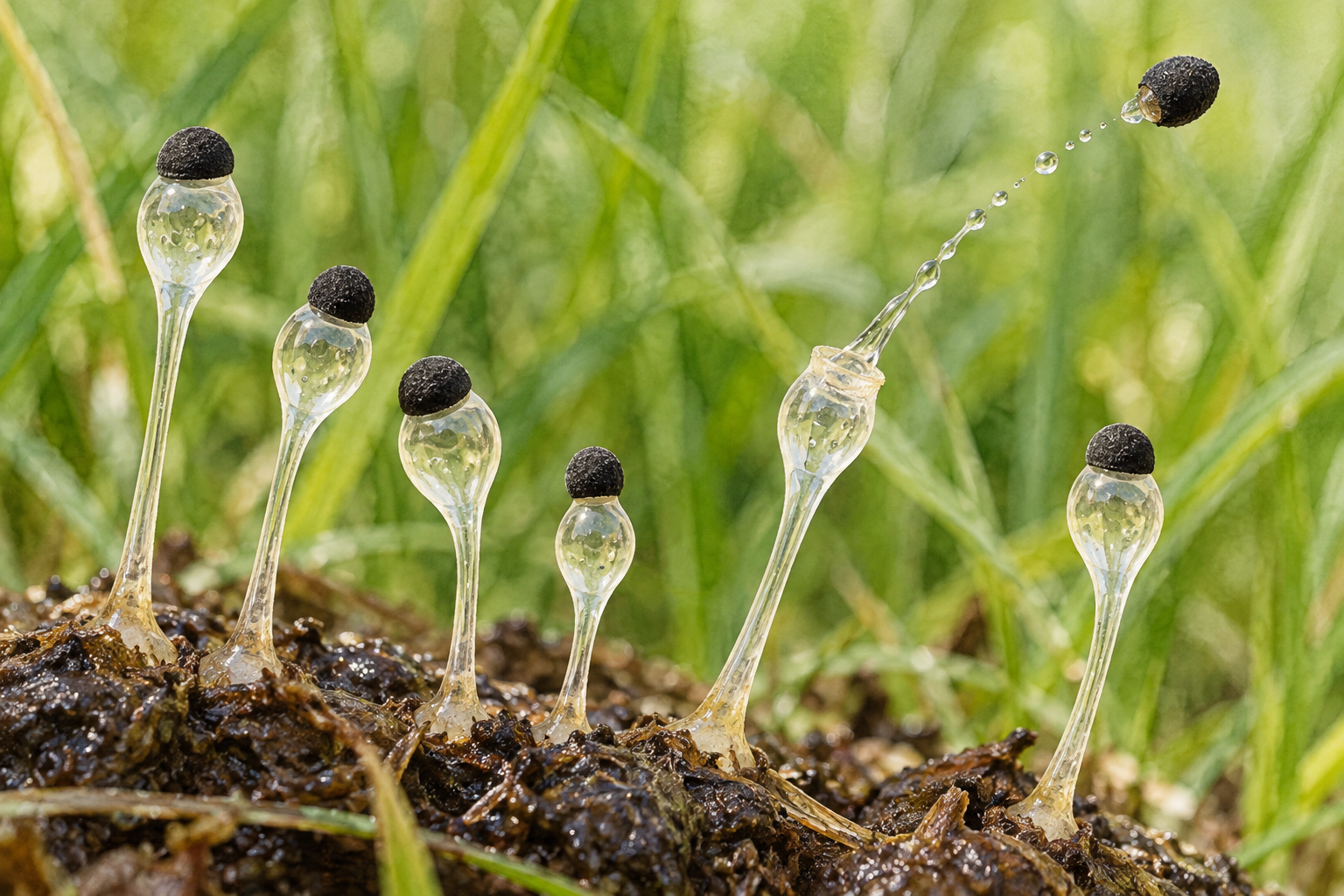
A tiny translucent stalk rises from dung, carrying a dark cap above a swollen bulb. It hardly looks like a launcher. Yet Pilobolus can propel that cap away as a spore-filled packet, using fluid pressure and a rapidly released burst of stored energy.
The fungus connects two worlds that rarely share a sentence: the mechanics of fast projectiles and the everyday ecology of grazing animals. Its launch is useful because the next part of its life cycle happens somewhere else.
A packet, rather than a puff
The dark structure is a sporangium containing spores. Beneath it sits a fluid-filled part of the stalk. When pressure is released, the packet is driven away with expelled fluid. This differs from a mushroom passively releasing individual spores into nearby air.
High-speed research by Levi Yafetto and colleagues recorded discharge in several fungi, including Pilobolus kleinii. Their images showed the packet propelled by a stream of liquid. Direct recordings let the team assess earlier estimates that had depended on models of projectile motion.
They also investigated the fluid's composition. Dissolved compounds contribute to pressure through osmotic effects. The impressive motion does not require a miniature muscle: fungal structure and water relations provide a different route to rapid movement.
Fast acceleration, short travel
Very small projectiles experience air resistance differently from large ones. A striking initial acceleration should not be confused with endless high speed or a vast range. Drag rapidly changes the motion after launch.
A systematic review of natural shooting mechanisms discusses how size affects these trajectories. Pilobolus sends out a larger packet than the individual spores launched by some other fungi. Comparing species therefore requires attention to the projectile itself, not only the launch speed.
| Quantity | What it tells us |
|---|---|
| Acceleration | How quickly velocity changes during launch |
| Speed | How fast the packet moves at a particular moment |
| Range | How far it travels before landing |
Why leave the dung?
The National Park Service describes a life cycle in which packets reach vegetation and spores can be swallowed by a grazing animal. After passage through the digestive tract, the fungus has a fresh dung substrate on which to grow. Launching away from its starting point helps connect those stages.
This is also why ecology matters to the mechanics. A burst that moves a packet onto surrounding herbage can be biologically important even when the distance seems modest to us.
Explore the real footage: The original research paper's Supporting Information includes Video S3, a high-speed recording of Pilobolus kleinii.
The most engaging part is the match between scale and task. A fluid-filled fungus has no need to resemble a cannon to solve a launch problem. Its small structure, short journey and grazing-animal cycle fit together into a working dispersal system.
Sources: Yafetto and colleagues: high-speed fungal discharge study · PLOS: systematic review of natural shooting mechanisms · National Park Service: Yellowstone's fungi
Explore more creative curiosities at Incoprea.




