Soil can look damp while remaining a broken landscape for a swimming bacterium. Water does not necessarily form one continuous pool between mineral grains. Air-filled gaps can interrupt the route. A fungal thread crossing that gap can change the geography.
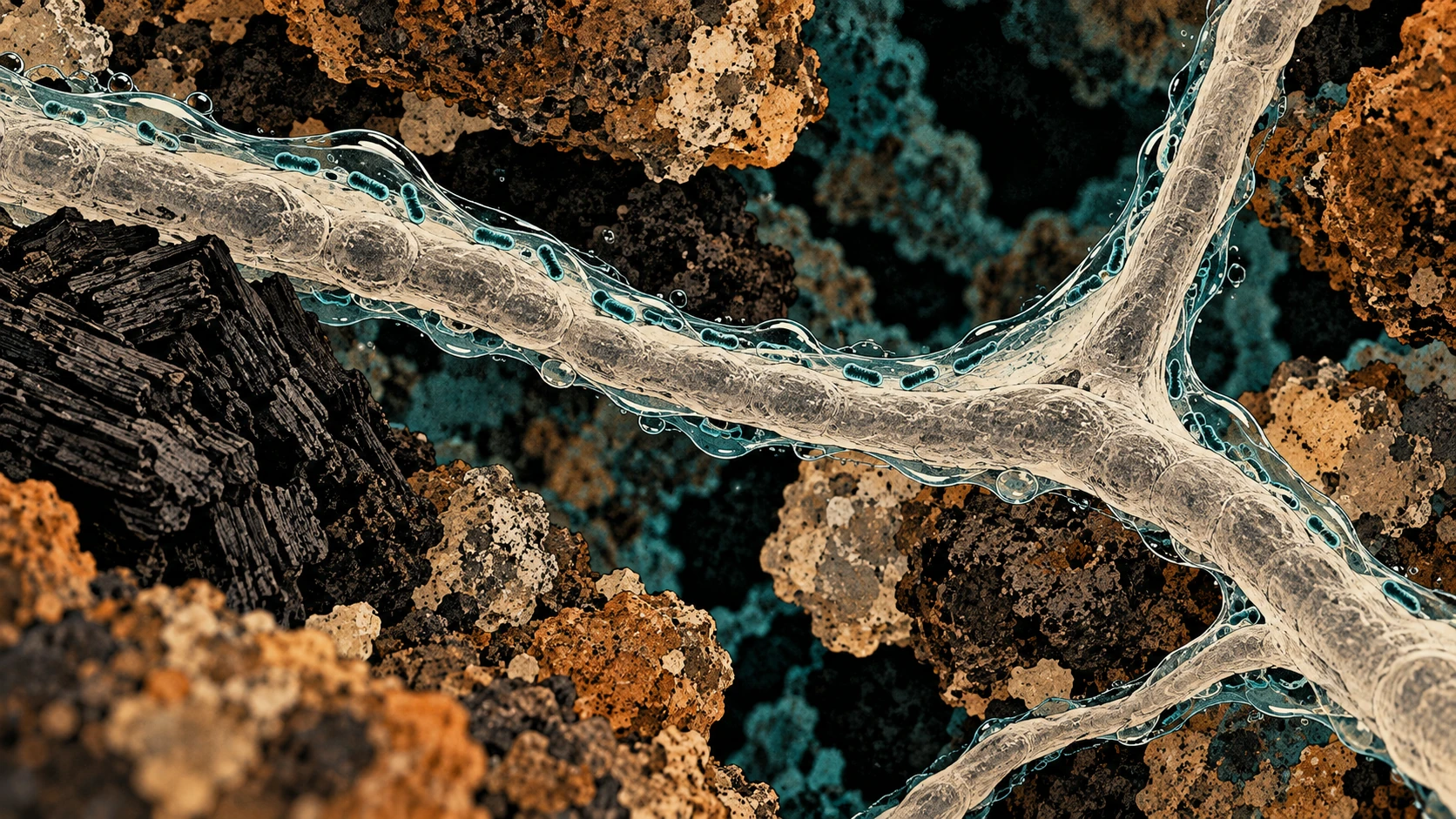
The phrase “fungal highway” describes bacterial dispersal associated with fungal hyphae. In an important version of the process, bacteria move through a thin water film along the fungal surface. The fungus supplies a connected route through a landscape that would otherwise be difficult to cross.
The picture is appealing, but it needs careful unpacking. It does not mean that every bacterium rides every fungus. It does not imply that bacteria are always carried inside the thread. Nor does the presence of two organisms in one soil sample demonstrate that one transported the other.
Make the obstacle small enough
Imagine a person describing a forest as continuous because trees cover the map. A small ground animal may instead encounter fences, streams and clearings that determine which route is possible. Scale changes what counts as a connected habitat. The same reasoning becomes more extreme for organisms moving within films of water.
A 2005 laboratory study tested selected bacteria with fungi in agar-surface and glass-bead systems. A motile bacterial strain dispersed especially effectively with a hydrophilic fungal partner. Nonmotile strains did not disperse with that fungus in the tested comparison. A hydrophobic fungus gave different outcomes depending on the experimental setting.
These details matter more than a single headline speed. The result depended on the organisms and on how the surrounding environment was constructed. The liquid-film explanation is a mechanism to investigate, not a permission to erase all of that specificity.
Build a route without building a miniature soil
The connectivity explorer below has five fictional wet patches. A and B are connected, and D and E are connected. Two optional bridges can connect B to C and C to D. An optional bypass joins A directly to D.
Connect the wet patches
An invented five-node network separates route connectivity from arrival and motility.
Switch bridges on and off. The tool reports whether an active route exists from A to E under its deliberately narrow rules. It also lets you turn the hypothetical swimmer's motility off. Nothing in the calculation is fitted to real hyphal growth or bacterial speed.
First connect B to C alone. You have increased the reachable habitat, but you have not connected the target. Next add C to D. A small additional connection changes the result for the entire route. Finally remove the first two bridges and activate the bypass. The same arrival can now arise through a different path.
This is why a destination sample alone cannot reconstruct a journey. Detecting bacteria at the target establishes presence. To identify the route, an experiment needs to constrain alternatives or observe movement directly. A model can help make that logical distinction without pretending to be a physical replica.
From selected pairs to organisms in actual soil
A 2015 study developed “fungal highway columns” to enrich fungi and potentially associated migrating bacteria from soil. The device separated an attractive medium from a target medium. Fungi could bridge the intervening structure. Researchers then tested isolated bacterial-fungal pairs for migration rather than assuming every co-isolated pair represented a working highway.
Most of the bacterial isolates with confirmed migration were motile, but not every motile bacterium used its potential partner. That is another useful interruption to an easy story. Having a means of locomotion and encountering a fungal surface do not guarantee dispersal under the test conditions.
The column is also a selective habitat. A nutrient medium rewards some organisms more than others. Fast-growing fungi can outcompete slower arrivals. The organisms recovered by the method therefore cannot automatically be treated as a census of everything capable of this interaction in the original soil.
What the inventory can and cannot count
A follow-up inventory in three forest soils used two culture media and molecular identification. The columns selected fungi in the genus Mortierella alongside a diverse bacterial community. The authors described potentially associated migrating bacteria, preserving the distinction between an enriched association and the direct demonstration of each organism's journey.
For a reader, “potentially associated” can look like timid language. Here it does real work. It states which step has been observed and which still requires a test. Removing that phrase would make the story simpler by making it less accurate.
Consider two possible follow-ups. One could film a marked bacterium moving along a known hypha under controlled conditions. Another could measure how a fungal network changes the rate at which a target resource is reached in intact soil. The first would sharpen the route mechanism; the second would sharpen its ecological consequence. Neither would make the other unnecessary.
Useful roads, uneven consequences
Reaching a place can matter only if something useful happens afterward. Early highway work investigated pollutant-degrading bacteria, raising the possibility that dispersal could improve access to otherwise separated material. Turning that possibility into a reliable field method requires attention to the organisms, moisture and resources involved.
The highway metaphor should therefore end with questions rather than a universal soil treatment. Which organism gains access? What does it do there? Does the fungus benefit, pay a cost or simply provide a surface? Those outcomes need not be identical across partnerships.
A handful of earth is not merely a crowd of species. It is a set of routes, interruptions and temporary connections. The fungal-highway story makes that hidden geography visible, while the experiments show why arriving at the same destination does not always mean taking the same road.
Sources and further reading: Taking the fungal highway (2005); Exploiting the fungal highway (2015); An in situ inventory of fungi and associated migrating bacteria (2017).
Explore all 80 new articles · Browse the complete illustrated collection
Explore more art, ideas, and independent projects at Incoprea.




