Think of pollination and a bee is likely to enter the picture. Put the flower underwater and the animal often disappears from our explanation. The sea supplies currents, so it seems reasonable to let water do all the transporting. A turtlegrass meadow complicates that picture.
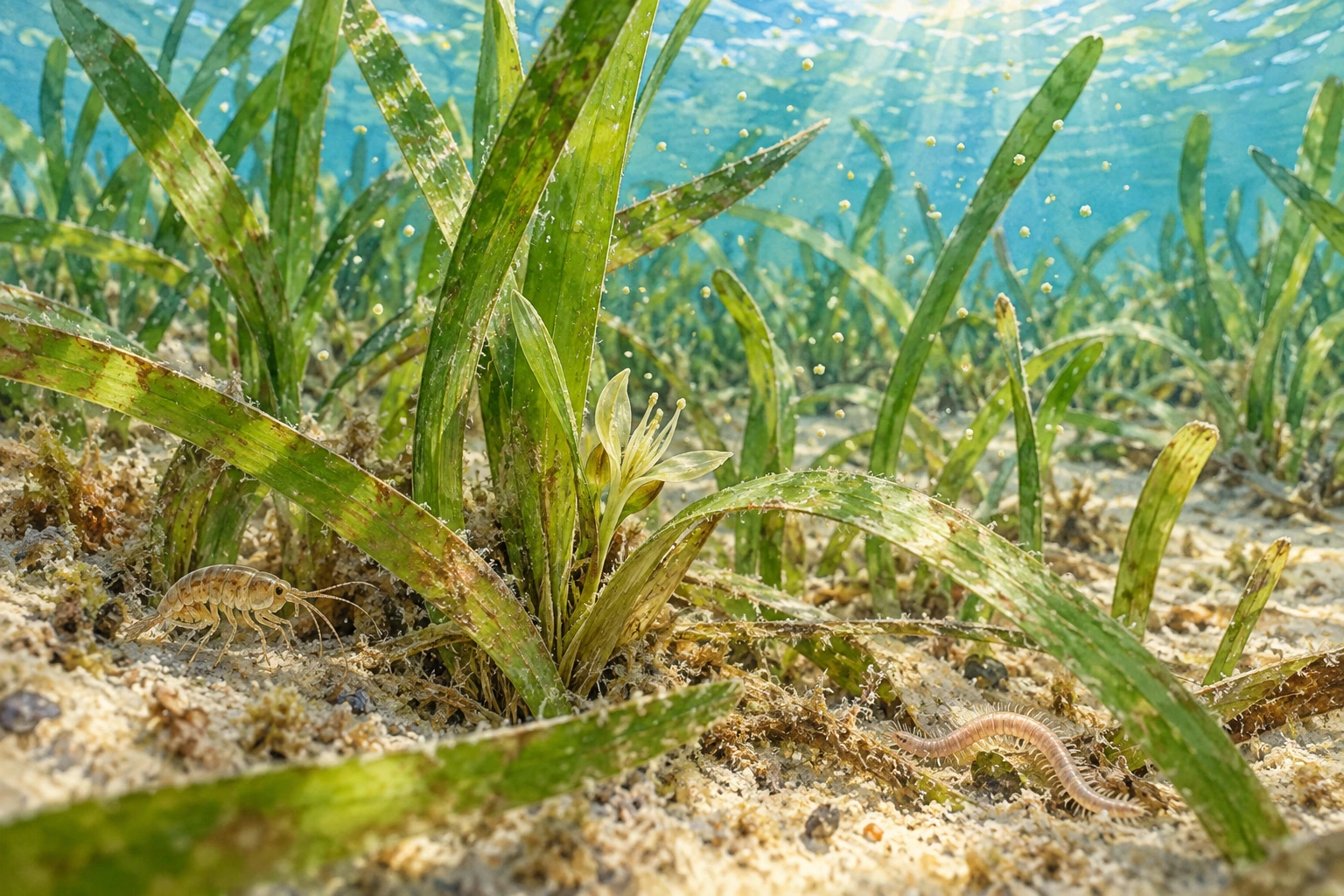
Thalassia testudinum is a flowering marine plant. Its flowers operate close to the seabed, among small crustaceans, worms and other animals. Some of those visitors encounter pollen as food. That creates the possibility of a second role: carrying pollen onward.
The meadow has a night shift
A 2008 field study followed male and female flower buds through day and night. Male flower opening and pollen release were synchronized in the evening. Fish consumed some male flowers during the observations. Reproduction here involves timing in a community, rather than a flower releasing material into empty water.
The timing gives a useful way to imagine the habitat. The meadow you see in daylight is one phase of an ongoing process. A small, briefly available pollen resource can overlap with the activity of animals that are easy to overlook during an ordinary daytime visit.
In 2012 observations, researchers examined small invertebrates visiting flowers at night. Crustaceans visited pollen-bearing male flowers more than male flowers without pollen. Some animals carried pollen embedded in sticky mucilage on their body parts. The finding suggested a route by which a feeding visit could become a transport service.
A visitor still has to complete the journey
Pollen attached to an animal is an intriguing intermediate stage. It does not, alone, demonstrate useful delivery. The animal must reach a receptive female flower, deposit pollen in a suitable place and contribute to the next reproductive step.
The 2016 experiments followed that chain in controlled mesocosms. Invertebrates transported pollen between flowers, deposited it on stigmas and enabled pollen germination and tube formation. Pollination could occur without water movement in the experimental setting.
The researchers did not discard water as a principal pollen vector in nature. Instead, they proposed a mixed system. Flow can move pollen and animals, while small animals can also contribute transport. The term “zoobenthophily” describes animal-mediated pollination near the seabed.
That combination is the real surprise. Biology often adds a pathway without abolishing the pathway we already knew. “Animals can contribute” is a stronger and more useful conclusion than an unsupported claim that currents have become irrelevant.
Sort the clues before naming the service
The downloadable comparison below follows four steps: visiting, picking up, delivering and initiating pollen growth. It provides a place to note what an observation establishes, and what remains unresolved. A second column asks how water movement could contribute at the same stage.
Follow the pollination chain
A printable evidence map separates visits, pickup, deposition and pollen growth, with a parallel water-transport column.
Try placing these statements in the chain: an animal eats from a male flower; pollen sticks to its surface; pollen appears on a female stigma after its visit; a pollen tube forms. The statements are related, but each answers a different question. A compelling scene becomes a stronger explanation when the links are kept visible.
Leave a gap wherever an observation is missing. A chain with one empty box is more useful than a smooth account that silently invents the link. You can then ask for the particular evidence that would fill it, whether that means tracking a visitor or examining a receptive flower after contact.
Then ask what an animal-exclusion experiment would require in flowing water. An enclosure that also changes the current could alter pollen delivery for two reasons at once. This is why controls are part of the natural-history story, not merely paperwork after the discovery.
There is no need to turn every seagrass invertebrate into a helpful pollinator. Some eat resources, some transport them, and the consequences can depend on context. The studied system gives a particular demonstrated case rather than a universal label for a whole meadow community.
The next underwater flower is worth imagining as a meeting place. Water surrounds it, but the water contains lives with their own movements and meals. In turtlegrass, those small encounters can become part of the plant's reproductive journey.
Sources and further reading: Synchronized anthesis and predation on pollen in Thalassia testudinum (2008); Meso-fauna foraging on seagrass pollen may serve in marine zoophilous pollination (2012); Experimental evidence of pollination in marine flowers by invertebrate fauna (2016).
Explore all 80 new articles · Browse the complete illustrated collection
Explore more art, ideas, and independent projects at Incoprea.