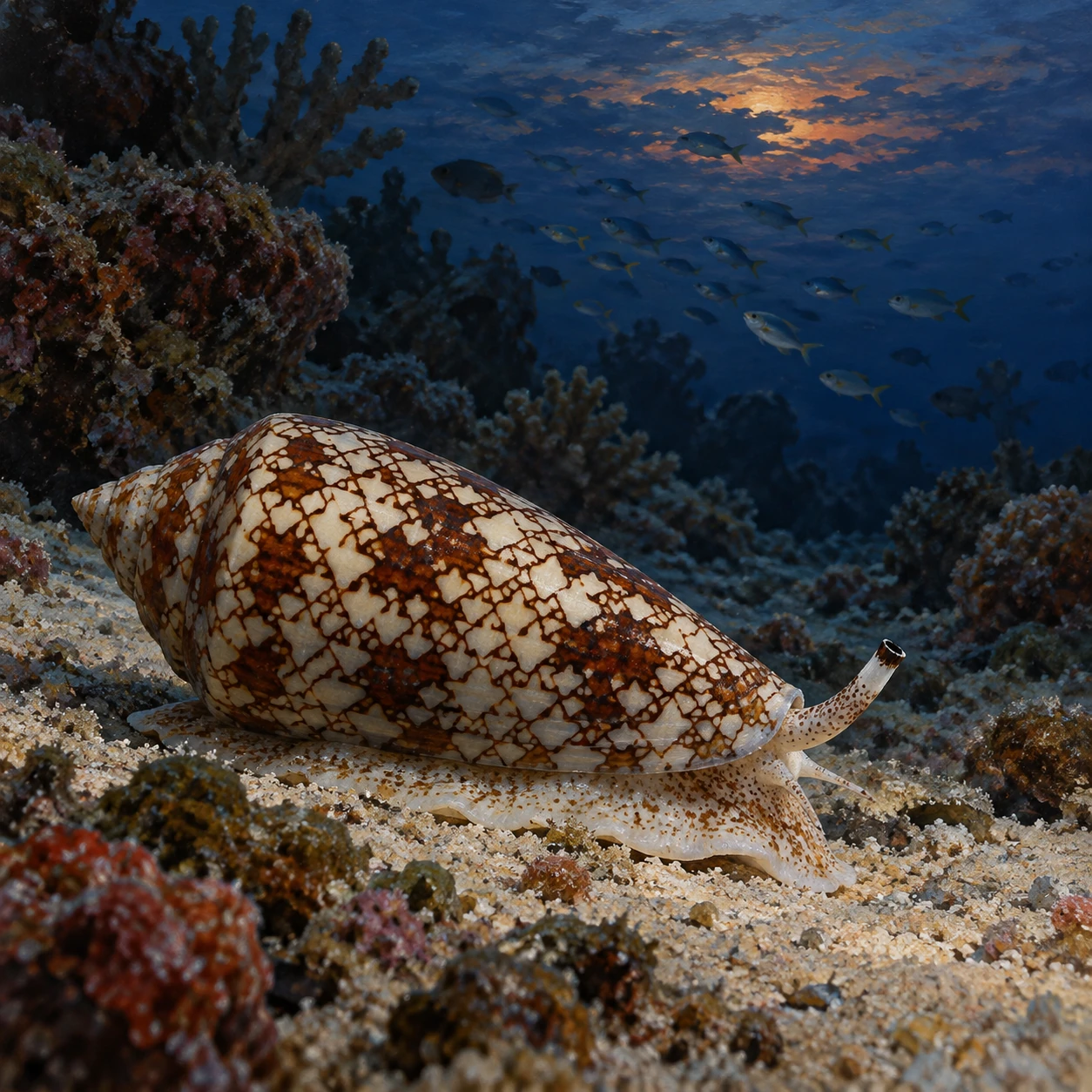
The geography cone snail moves slowly enough to make its fish prey seem impossibly quick. Speed is only one way to win that encounter. The snail's venom includes molecules that interfere with the prey's physiology, and one of the most surprising belongs to a familiar family: insulin.
The surprise is not that a snail has insulin-related signaling. Such molecules occur widely in animals. It is that a specialized version can be directed outward at another animal. A molecule used to coordinate life inside one body has been recruited into a very different biological relationship.
A signal aimed at the prey
In 2015 research on Conus geographus, scientists identified a fish-like insulin in the venom system. Tests with fish showed reduced blood glucose and impaired swimming associated with the specialized insulin. The work supported its contribution to a chemical strategy for subduing prey.
The molecule belongs to a mixture. Calling insulin “the venom” would erase the other components and the coordinated hunting behavior. Similarly, demonstrating a component's activity under experimental conditions does not measure every detail of its concentration and delivery during a wild encounter.
For a reader, this is a useful shift from naming toxins to asking what they target. A prey animal relies on molecular signals to regulate its own body. A predator can exploit that dependence by producing a molecule that interacts with the same signaling machinery.
Two jobs, two evolutionary patterns
A 2016 comparative study distinguished conventional signaling insulins from venom insulins across cone snails. The inward-directed signaling form was relatively conserved. The venom family was much more diverse, with patterns consistent with adaptation to interactions involving other species.
Not every cone snail expressed the same venom-insulin set. Some species had multiple versions, and some tested fish-hunting lineages did not show the same expression. “Cone snails use insulin” is therefore too broad unless the species and context are supplied.
The comparison also explains why a gene duplication can be important without making duplication itself a complete origin story. Copies can acquire different expression and face different selective pressures. Establishing the historical sequence requires comparative evidence, rather than simply naming a plausible route.
A short molecule can still interact with a receptor
Later structural and functional work examined minimized venom insulins and their interactions with vertebrate insulin receptors. The molecules offer a way to ask which structural features are essential for activity and which can vary. That is an experimental question about molecular recognition.
Such findings can inspire biomedical research. They are not evidence that snail venom is a ready treatment for a person. Receptor activity, an experimental lead and a clinically established medicine are distinct stages. The natural-history result remains fascinating on its own terms.
Build the explanation from the target backward
Try this three-line exercise. Write “prey receptor” at the right side of a page. To its left, write “molecule that can interact with it.” Farther left, write “predator's production and delivery.” Now add a separate line underneath: “prey's own normal regulation.”
The same receptor can sit at the intersection of those lines, but the consequences and source of the signal differ. This makes the concept easier to follow without memorizing a peptide sequence. It also reveals what an experiment must distinguish: a molecule's presence, its biochemical activity and its contribution to a successful hunt.
Add a question mark at every arrow for which you have only an assumption. A diagram can look complete because its boxes are neatly connected. The value of this one lies in showing which connection was measured and which still needs an experiment. That is where a molecular story becomes testable.
Finish by listing what a shell photograph cannot tell you. It cannot reveal which venom genes are expressed, how a receptor responds or what happens to a fish's physiology. The beautiful shell is the visible edge of an interaction occurring at a very different scale.
The slow snail is thus an invitation to reconsider the contest. The most important distance may be the fit between a signaling molecule and a receptor, rather than the gap a predator can close in a burst of speed.
Sources and further reading: Specialized insulin is used for chemical warfare by fish-hunting cone snails (2015); Venom insulins diversify rapidly and track prey taxa (2016); Fish-hunting cone snail venoms are a rich source of minimized ligands (2019).
Explore all 80 new articles · Browse the complete illustrated collection
Explore more art, ideas, and independent projects at Incoprea.