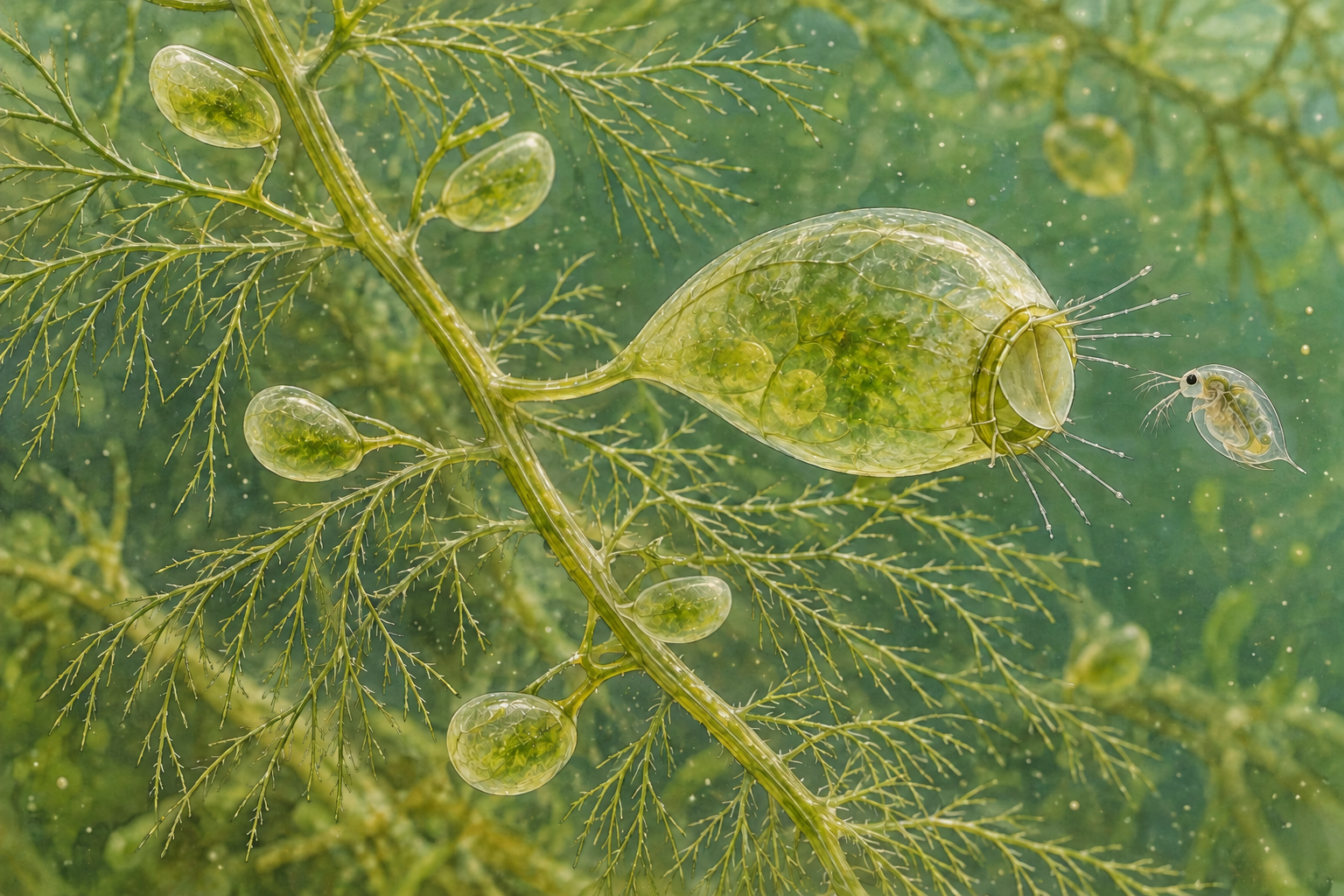
The most misleading thing about an aquatic bladderwort trap is how little seems to be happening. A tiny chamber sits among the plant’s submerged branches. Water surrounds it. A small animal approaches. Then the animal is inside. At ordinary speed, the decisive action can be too fast to follow, so the plant seems to have skipped the explanation.
The explanation began before the encounter. A bladderwort prepares a pressure difference and stores elastic energy in its trap. The visible capture releases that preparation. Once you separate the slow work from the fast event, this little plant becomes an unusually clear lesson in how a living structure can act quickly without building the entire action from scratch at the last moment.
A water-filled chamber, already prepared
Bladderworts belong to the genus Utricularia. Kew describes branching structures bearing bladder traps, found submerged in water or beneath the surface of wet soil. The aquatic trap discussed here is a small chamber with a flexible entrance door. It differs from both a pitcher plant’s open pitfall and the paired closing lobes of a Venus flytrap. Carnivorous plants have evolved several ways to obtain nutrients from prey; they do not all use the same mechanism. Kew’s comparison of carnivorous plants gives that wider context.
The chamber contains water even when it is ready to fire. Water removal lowers the pressure inside and draws the flexible trap walls inward. Calling this a “partial vacuum” can be helpful, provided we do not imagine an empty bubble waiting for water. The important feature is a pressure difference across a water-filled structure, with the walls held in a deformed state.
When triggered, the door changes shape and opens. The trap body relaxes, water rushes inward, and nearby prey can be carried along. Digestion and nutrient uptake follow. The rapid capture uses energy stored during preparation; the plant then has to prepare again. “Fast predator” describes one part of its cycle, not the speed of every process in its life.
The camera reveals more than a swinging door
In 2011, Olivier Vincent and colleagues used high-speed recordings to investigate three aquatic species. They observed a change in the trapdoor’s curvature through buckling and recovery, rather than a rigid little door swinging on an ordinary hinge. In their studied traps, suction itself could take less than a millisecond. Door opening, closure, and resetting had different durations. Their paper shows the recordings as sequential figures.
It is tempting to take the shortest number and attach it to everything: the fastest plant, the fastest meal, the fastest complete reset. That loses the very sequence the experiment uncovered. A timing becomes useful only when it names its event. The same is true in everyday life. The time a camera shutter stays open is not the time needed to set up the photograph, save the file, and prepare for another exposure.
There is a second trap in the word “suction.” It can sound as though the prey is being pulled by a force produced at the animal itself. The pressure difference moves the water, and the prey moves with that flow. Thinking about the surrounding fluid makes the plant’s mechanics much easier to follow.
Could your camera catch it?
Imagine a hypothetical event lasting exactly one millisecond. This is a round-number exercise, not a claim that every bladderwort capture lasts that long. Compare three recording rates. The interval between frames is one second divided by the number of frames recorded per second.
| Recording rate | Time between frames | Intervals per 1 ms |
|---|---|---|
| 25 frames per second | 40 milliseconds | 0.025 |
| 1,000 frames per second | 1 millisecond | 1 |
| 15,000 frames per second | About 0.067 millisecond | 15 |
Which recording would let you investigate changes during the event, rather than merely show a before-and-after view? Consider another question too: if the entire event fits between two frames, has the camera proved that nothing happened?
Open the reasoning
The 15,000-frame recording provides the smallest gaps and the best opportunity to resolve stages within the hypothetical millisecond. At 25 frames per second, the event could occur entirely between exposures. Exactly what appears still depends on timing, exposure length, lighting, and the visibility of the structure. Frame rate gives an opportunity to observe; it does not guarantee a useful image.
The 2011 team recorded at rates up to 15,000 frames per second. Looking at their figures after doing the calculation gives those images a new meaning. Each frame is a sample of time, and the gaps are part of the evidence too.
A fast trap meets a fast animal
A later study examined Utricularia australis capturing the water flea Ceriodaphnia dubia. The Freiburg research group used high-speed video to compare capture with the prey’s possible escape response. Its account reports that the trapping process occurred too quickly for the water flea to attempt an escape during capture. This result concerns a particular plant, prey, and experimental investigation; it does not turn every encounter into a guaranteed meal. Freiburg’s research account links the original studies.
The prey’s presence is important to the question. A door can move quickly without producing effective capture. Investigating a feeding mechanism means examining the fluid motion and the animal caught in it, as well as the plant’s changing shape. That is why a beautiful close-up of a trap and an experiment on capture behaviour tell us different things.
One genus, more than one design
Comparative work reported in 2017 examined trap form and function across 19 bladderwort species. The researchers found differences in entrance structures and door movements. They also reported that Utricularia multifida did not show the firing and deflation observed in the suction traps they tested, suggesting a passive trapping mechanism. The finding is a reminder to keep a familiar diagram attached to the species it actually represents. Read the trap-diversity study.
Even an accurate explanation can become inaccurate when extended too far. The aquatic suction trap is an excellent story in its own right. It does not need to stand in for every bladderwort habitat, every entrance shape, or every strategy within the genus. Variation gives researchers more useful questions than a single universal superlative would.
The observer who changed her mind
The history has a small but revealing human detail. Oxford’s account describes Charles Darwin’s correspondence with the American naturalist Mary Treat. Darwin initially thought prey pushed into the trap. Treat first agreed, then further observation led her to favour suction and to recognize the importance of sensitive hairs near the entrance. Darwin cited her work in Insectivorous Plants. Read Oxford’s history of the plant and its investigators.
The worthwhile part is the revision. A plausible account changed when close attention revealed a better one. Modern high-speed imaging continues that process with tools earlier observers lacked. A quiet pond has not become less mysterious because we can explain one tiny trap. It has become more detailed: a prepared chamber, a changing door, a pulse of water, an animal carried inward, and a slow return to readiness.




