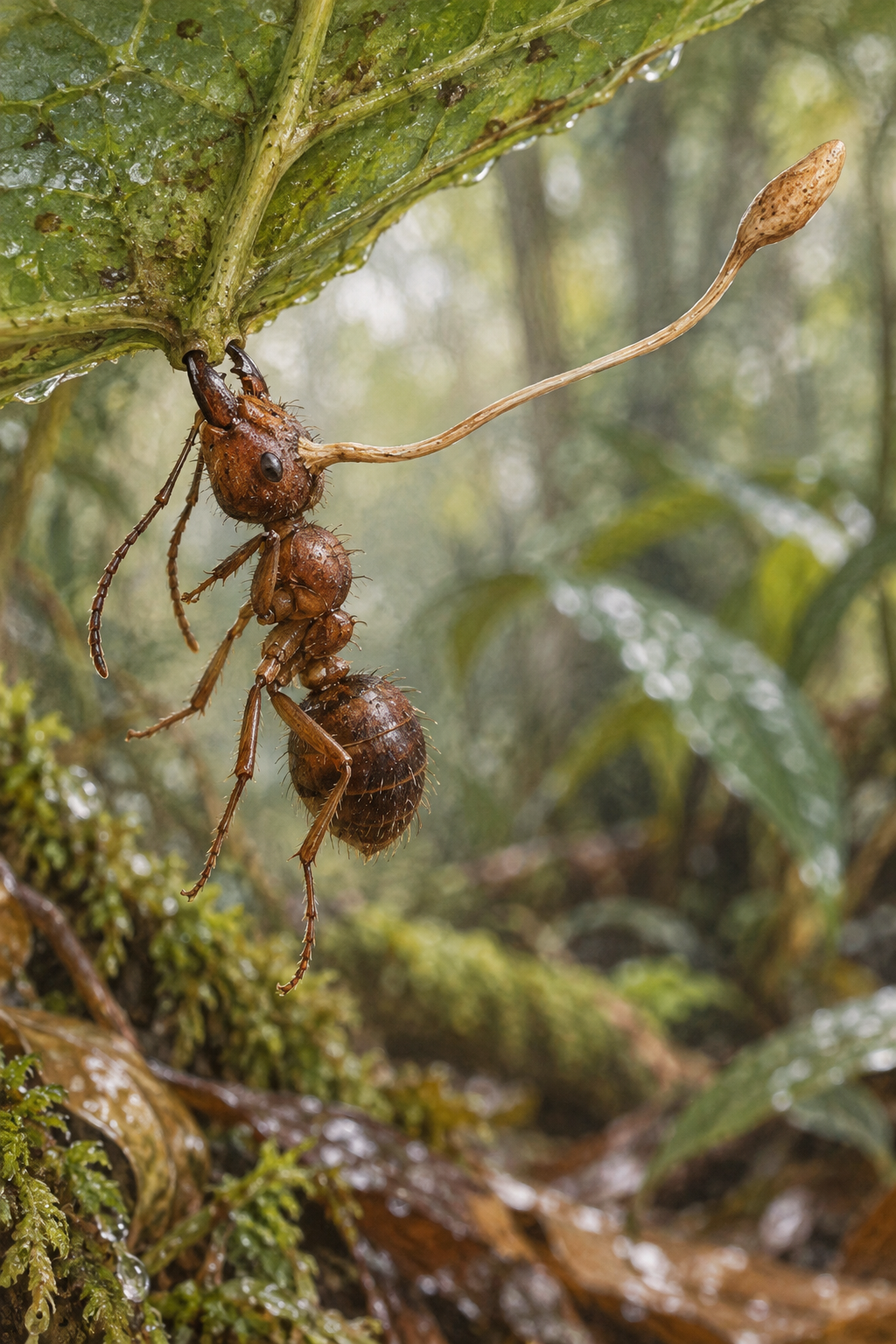
An ant grips vegetation with its jaws and stays there after death. Later, a fungal structure emerges from the body and releases spores. The scene has earned certain Ophiocordyceps fungi the name zombie-ant fungi. It is an arresting nickname, but the actual biology is more specific and more puzzling than a simple story about taking over a brain.
A change of behavior serves the parasite
In well-studied carpenter-ant systems, infected workers leave normal activity, move onto vegetation and perform a final bite. The resulting position can provide a suitable place for the fungus to develop and disperse infectious spores.
These are specialized relationships involving particular fungi and hosts. Ophiocordyceps unilateralis is often used as a convenient name, but researchers also discuss a complex of related species. The details can differ among hosts and environments, so one spectacular observation should not become a universal script.
Calling the ant a zombie is a metaphor for altered behavior. It is not a scientific description of what the ant experiences. The visible outcome can be documented much more confidently than an imagined inner state.
The brain was not filled with fungus
A 2017 study used detailed microscopy and image analysis to examine infected ants. Fungal cells were widespread in the body and associated with muscles, including those controlling the jaws. The investigators did not find fungal cells inside the brain at the studied stage.
That result corrected a common picture of the infection. It did not show that the brain was unaffected. Chemical signals can alter tissue without fungal cells physically occupying it. Penn State's account explicitly notes that the brain's role and the coordination of the behavior required further research.
The finding is therefore more subtle than a switch from brain control to a completely understood muscle puppet. Changes in muscles, chemicals, physiology and neural function are pieces of a mechanism that scientists are still working to connect.
A three-dimensional reconstruction is a map, not a command recording
The 2017 team examined tissues at a crucial stage, when the ant fixes itself to vegetation by biting. Their microscopy built a spatial account of where fungal cells were and how they associated with host tissues. This adds much more detail than a photograph of a stalk emerging from a dead ant.
Serial imaging works by relating many successive sections rather than interpreting one lucky slice. A structure that looks isolated in one plane may connect with other structures outside it. Reconstructing the volume can therefore reveal relationships that a two-dimensional section alone conceals.
The map still does not record a message telling the ant to climb or bite. Location, tissue damage, chemical action and behavior are different levels of explanation. A fungal network near a muscle supplies evidence relevant to a mechanism; establishing exactly how behavior changes requires additional tests.
The comparison with a generalist fungal pathogen was useful for the same reason. Some effects could belong to infection and illness broadly, while others might be associated with the specialized manipulator. A change becomes more informative when researchers ask whether an appropriate comparison organism produces it too. The dramatic endpoint is the start of that comparison, rather than a replacement for it.
Infecting is not the same as manipulating
A separate set of experiments reported in 2014 found that the studied fungus could infect and kill some non-target ants without producing the characteristic manipulated behavior. Experiments with ant brain tissues also found different patterns of chemical production in the presence of different host species.
That distinction is striking. Causing disease and producing a particular behavioral sequence are not interchangeable abilities. A parasite's effects depend on the host and the relationship between them, rather than on one all-purpose command chemical.
Arrange the evidence in time
Make a short sequence: infection, altered activity, final attachment, death, external fruiting-body growth and spore release. A familiar photograph often shows only the later stages. It cannot by itself reveal whether a particular chemical changed before the bite, whether a tissue was affected during the behavior or what occurred earlier in the colony.
The brain-tissue experiments simplified a different question: which chemicals did the fungus produce in the presence of tissues from different hosts? Isolated tissue can make that chemical comparison tractable, but it does not perform an ant's complete behavior. Linking the result back to the whole organism is a further step.
These distinctions make the nickname easier to use without allowing it to take over the explanation. “Zombie” points to an uncanny observed outcome. The scientific investigation asks which host, which stage, which tissue and which comparison establish the process. It becomes a story of relationships across cells, organs and behavior, with uncertainty located in specific unanswered connections.
Sources and further reading: Penn State: the 2017 imaging study · Host-specific chemical and infection experiments · NIGMS interview with the researchers