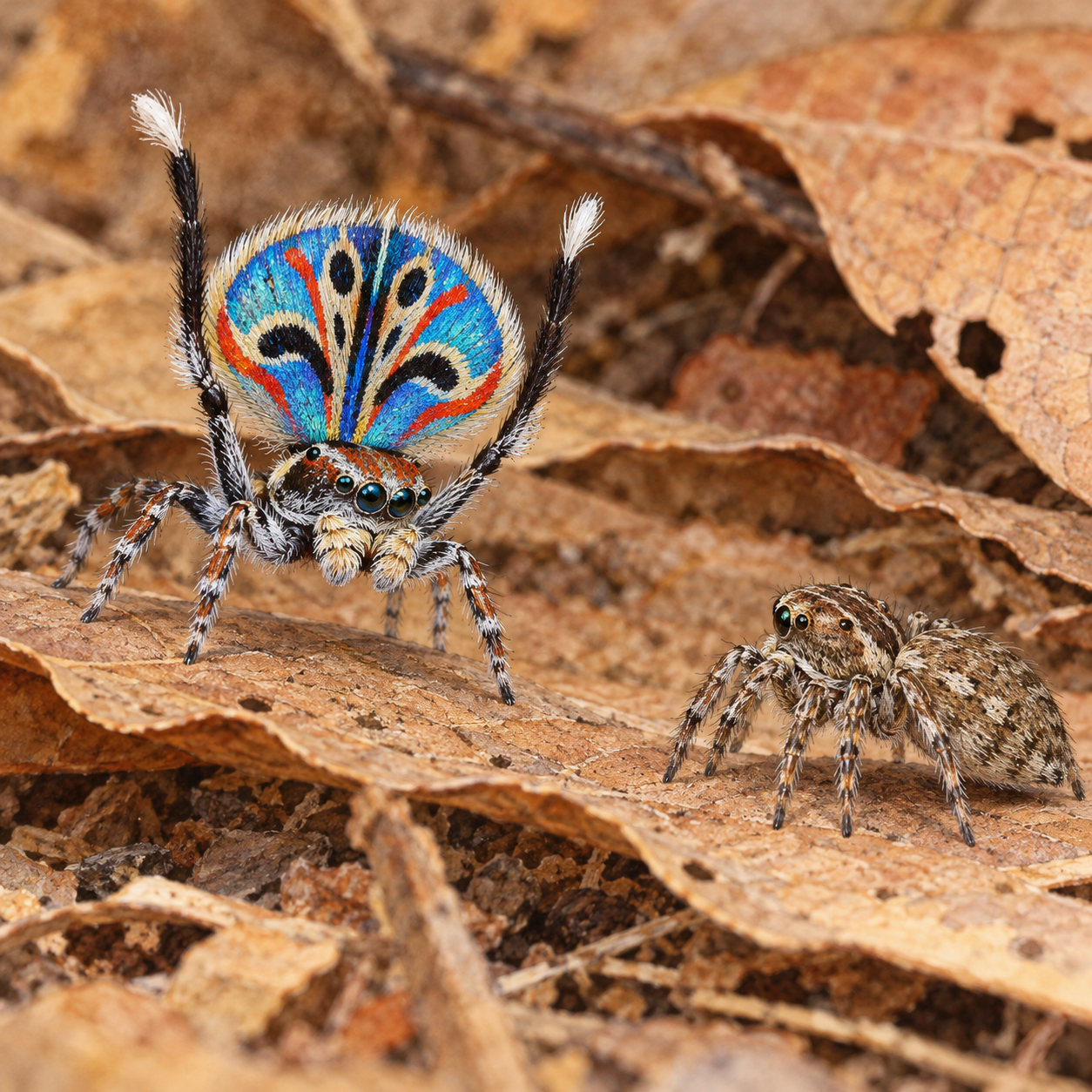
A male peacock spider raises a colorful abdominal fan, waves his legs, and shuffles in front of a female. Magnified video makes the display look like a miniature stage performance. Much of the exchange, however, happens through a channel that a silent clip can leave out.
In Maratus volans, researchers have measured vibrations accompanying the visible display. The animal's performance is multimodal: movement and color work alongside signals transmitted through the surface beneath it.
The fan is an abdomen, rather than feathers
Peacock spiders are small Australian jumping spiders. In displaying males, folded flaps associated with the abdomen open into a fan-like shape. A raised third pair of legs helps frame and accompany the movement.
The resemblance to a peacock gives the spiders their common name, but their apparatus is an arachnid's body. Their colors, proportions, and display details vary among species. A striking male in one photograph should not stand in for every member of the group.
Museums Victoria's account of peacock-spider research emphasizes how much observers have learned by paying close attention to these tiny animals. A spectacle can be common at its own scale and still remain easy for a much larger viewer to overlook.
Vibrations add another channel
In a 2011 study, scientists combined ordinary and high-speed video with laser vibrometry, a method for measuring tiny movements. They documented vibrational signals as well as visual behavior during courtship in M. volans.
A vibration through a leaf or other substrate is different from airborne sound recorded by a nearby microphone. To understand what the female receives, researchers need measurements suited to the medium carrying the signal.
The study also distinguishes describing a signal from demonstrating its exact function. Several ideas can explain multimodal communication: different components might convey different information, reinforce one another, or become useful under different conditions. Identifying the display's parts is a foundation for testing those alternatives.
A performance for the intended audience
Human viewers tend to notice saturated colors and movements that resemble dancing. A female spider may attend to combinations of timing, motion, and vibration that our first impression does not capture.
The same caution applies when we call a performance successful. A conspicuous display is an attempt to communicate, not a guarantee of mating. Studying the receiver's behavior is as important as admiring the sender's ornaments.
The peacock spider is therefore more than a bright curiosity. It is a manageable example of a broader problem in animal communication: how several kinds of information arrive together, and how the receiving animal evaluates them.
Watch the visible dance, then imagine the substrate carrying a second sequence of signals. The little performance becomes richer when the stage itself is part of the conversation.
See or hear more: Explore the study's supporting courtship videos.
Sources and further reading: Girard and colleagues: Multi-Modal Courtship in Maratus volans; Museums Victoria: Peacock-spider research; Australian Museum: Peacock-spider natural history.
Explore more creative work at Incoprea.




