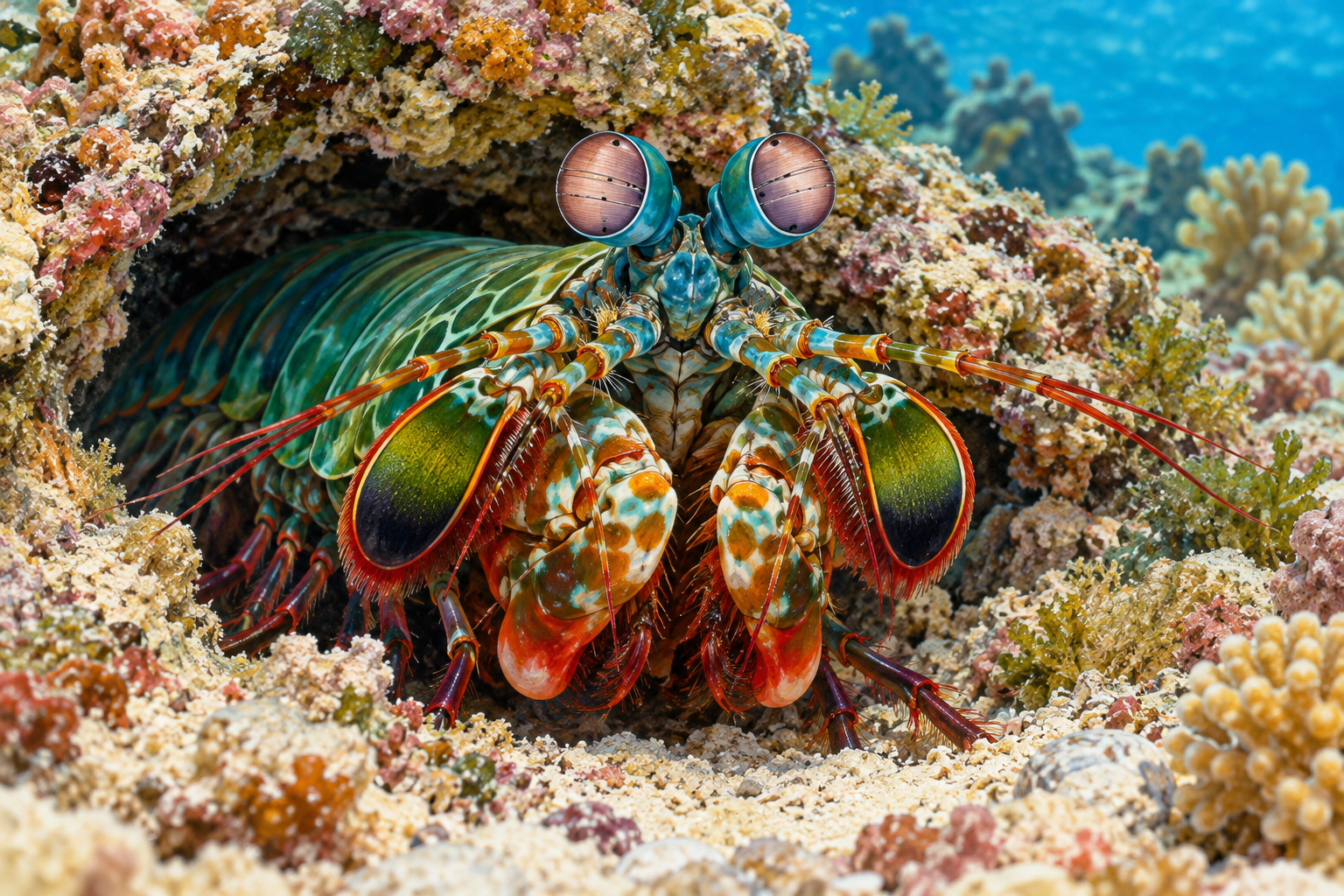
A mantis shrimp's eyes sit on movable stalks, giving the animal a conspicuous, watchful appearance. Their deeper peculiarity lies in what they can detect. In studied species, light carries information about polarization as well as brightness and wavelength.
We usually describe a scene through its colors. Polarization adds another property: the orientation and behavior of a light wave's oscillations. A surface or underwater object can differ from its surroundings in this property even when our unaided eyes do not readily notice the distinction.
An eye with built-in optical machinery
Mantis shrimp have compound eyes, made of many small visual units. Specialized structures in some species allow them to distinguish polarized light. Certain cells even perform a function comparable to an optical quarter-wave plate, converting between linear and circular polarization.
In linearly polarized light, the oscillation has a preferred orientation. In circular polarization, its direction rotates as the wave travels. The descriptions concern a physical property of light, rather than a visible spiral drawn through the water.
A 2009 Bristol-led study examined a biological quarter-wave retarder that worked across a broad range of visible wavelengths. The result interested optical engineers because artificial devices often have a narrower useful range. The animal achieves the effect with organized biological material.
Moving the eye changes the information
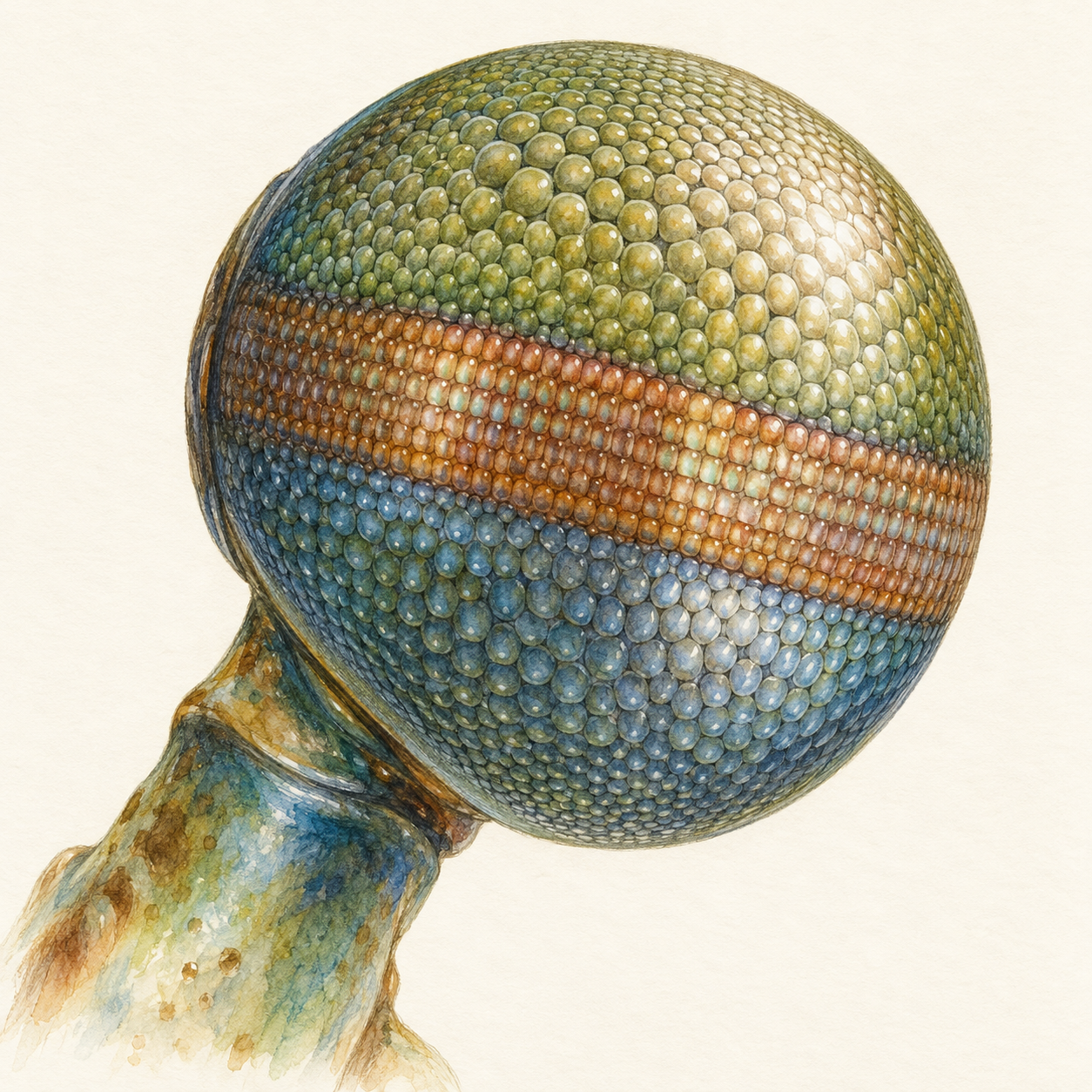
Eye movement is also part of the system. Research reported by the University of Bristol in 2016 showed that mantis shrimp can roll their eyes to improve polarization contrast. Orientation matters when a detector is sensitive to the direction of a signal.
The eye therefore does more than point at a target. It can change how an object stands out against its surroundings. That is an example of active sensing: an animal moves its sensory equipment in ways that improve the information it receives.
It helps explain why comparing vision systems with a single ranking can mislead. Different eyes emphasize different information and different practical tasks. A count of receptor types alone does not tell us that one animal sees every detail more accurately than another.
A useful sense with open questions
Researchers have considered roles for polarization in communication and finding objects underwater. Some mantis shrimp body regions produce polarized signals, offering a possible communication channel that other animals may not detect in the same way.
The precise benefits vary with species and context, and early work on circular polarization explicitly left aspects of its ecological purpose unresolved. Demonstrating a sensory capacity and explaining why it evolved are related but separate achievements.
The intriguing conclusion is enough: an underwater scene contains patterns that human observers can overlook, and a small crustacean has evolved machinery to extract them. Its mobile eyes remind us that a familiar-looking reef can be a different informational world for the animals living there.
Sources and further reading: Bristol: Mantis shrimp optical machinery; Bristol: Mantis shrimp roll their eyes; Bristol: Mantis shrimp eye movements.
Explore more creative work at Incoprea.




