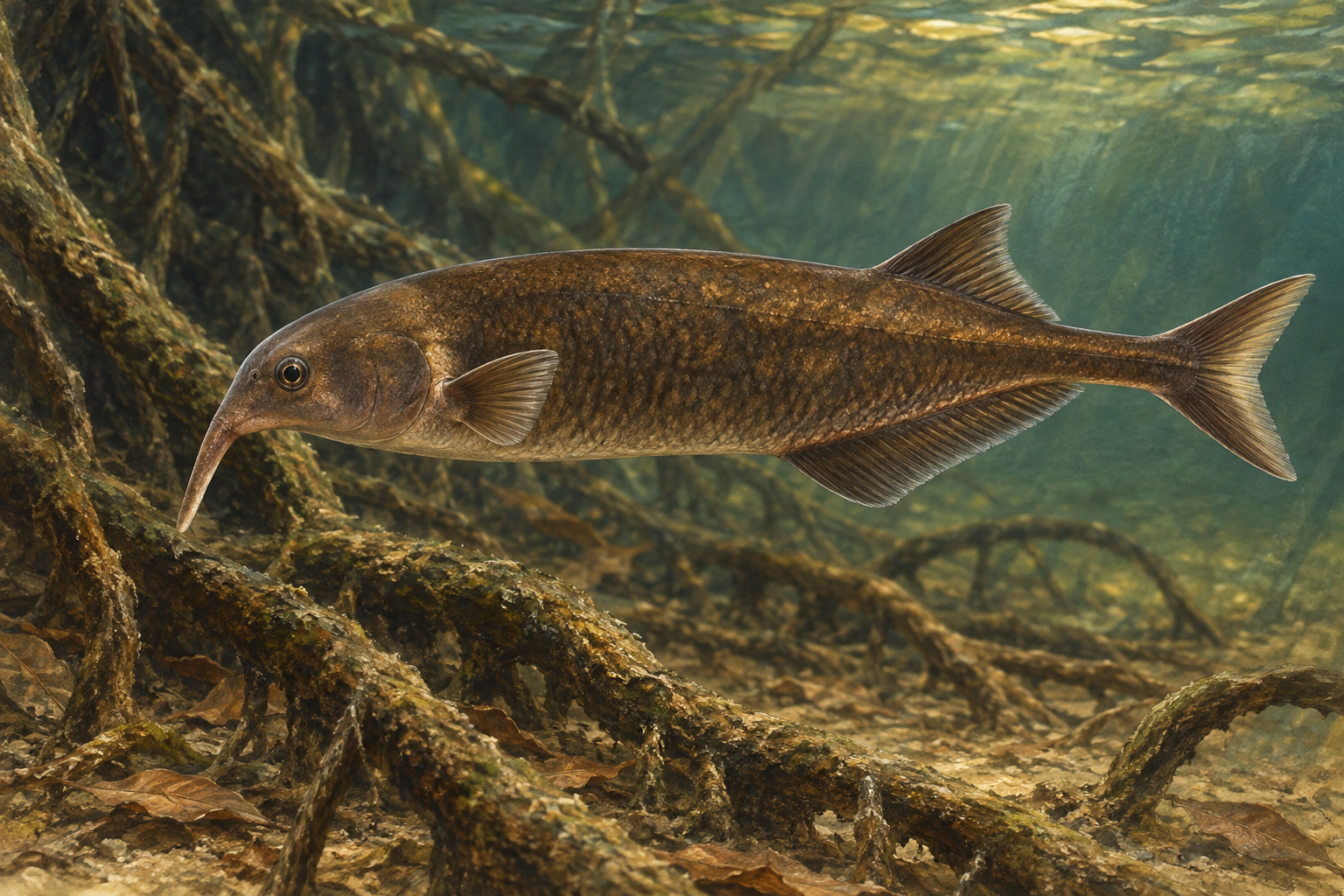
In dark freshwater, a fish can learn about nearby objects without needing a clear visual outline. Weakly electric fish generate small electrical signals and detect how those signals change around them. Their surroundings become a pattern of disturbances in a field.
This ability is called active electrolocation. The word “active” matters: the animal supplies a probing signal, rather than only waiting for information to arrive from an outside source.
The skin receives an electric image
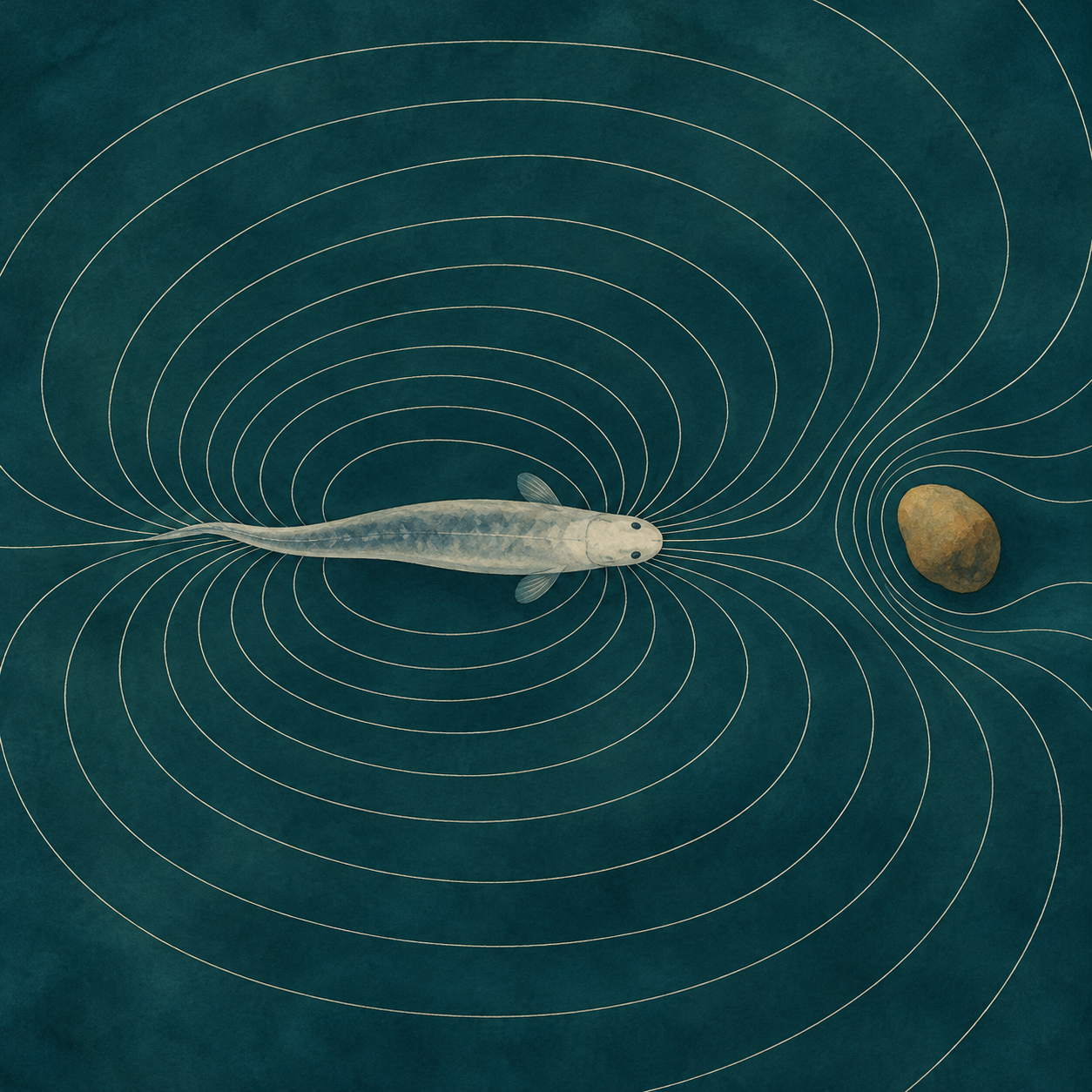
Objects with electrical properties different from the surrounding water alter the fish's field. Electroreceptors in the skin detect the resulting changes. An object's distance, size, shape, and material influence the pattern received at the body.
The pattern is sometimes called an electric image. That term does not mean a miniature picture is projected onto a screen inside the fish. It describes a spatial distribution of sensory information that the nervous system can use.
A 1998 study showed that tested weakly electric fish could judge object distance under controlled conditions. Certain shapes, particularly spheres, also produced predictable errors. The animal's ability was impressive and measurable, with limits that helped researchers infer the mechanism.
An electric image can be ambiguous
Imagine judging the size of an object from a shadow while its distance from the lamp is unknown. Different arrangements can produce similar shadows. The electric-fish problem is different in physics, but it shares the need to distinguish an object's properties from the conditions under which the signal was formed.
A nearby object and a larger, more distant object need not produce the same response, yet several properties influence the pattern simultaneously. The fish has to extract useful relationships from that mixture. This is why predictable errors in a controlled distance task are valuable: they reveal which cues might be driving the estimate.
Follow the field-distortion illustration from object to skin, rather than imagining a beam that takes a conventional photograph. The receiving surface is distributed across the animal. A change in one region's signal must be interpreted in relation to other regions, the fish's own emitted pulse and its position.
Movement supplies a way to obtain additional relationships. A fish that shifts position can compare changing input from the same surroundings. In a dim setting, gathering another sample can be more useful than remaining still and waiting for a stronger visual outline. The knifefish's shimmy therefore belongs to the sensing process itself.
Movement improves the evidence
Changing position provides new samples of the environment. Research described by Johns Hopkins in 2023 found that electric knifefish shimmied more frequently in darkness while locating and maintaining shelter.
The rapid movements helped the fish actively gather information when visual cues were limited. In the light, the animals still moved but shifted their pattern of activity. Sensing and movement were parts of the same task.
This is familiar in other forms: an animal sniffs repeatedly, a person changes viewpoint, or a hand explores an unfamiliar shape. Additional samples can make an ambiguous signal more useful. The electric fish performs that process with a sensory channel we rarely imagine.
Another fish can help illuminate the world
A 2024 Nature study added a social possibility. Modeling, neural recordings, and behavioral experiments indicated that the African elephantnose fish, Gnathonemus petersii, could use electrical pulses from other fish of its species to improve electrolocation.
In the studied conditions, those shared signals extended useful sensing range and helped discrimination. The result goes beyond a fish communicating that another fish is present: a neighbor's signal can contribute information about surrounding objects.
Different weakly electric species use different signal patterns and live under different conditions. Findings in elephantnose fish or knifefish should therefore retain their species and experimental context, rather than becoming a universal rule for every electric fish.
A neighbor can change the illumination, not just send a message
The collective-sensing study examined a pulse-type African elephantnose fish. Its central question was whether another fish's electrical emission could improve information about objects. Detecting a neighbor's identity or presence would be social communication; obtaining an additional electric image of the environment is a different benefit.
The researchers linked field simulations with neural and behavioral tests. An artificial mimic of a conspecific pulse helped vary the added signal under controlled conditions. This is stronger evidence than watching two fish stay near each other and assuming that their senses must have improved.
The arrangement matters. The same neighboring source will illuminate an object differently depending on position and orientation. An advantage found in one geometry is not a universal doubling of perception everywhere around the animal. It is a change in the available signal that can be measured for particular locations and tasks.
Use a three-part checklist while reading the paper: what did the physical model predict, what did neural recordings detect, and what did behavior demonstrate? Agreement among those levels connects an attractive idea to a mechanism. It still leaves questions about ecological use in natural habitats. The best part of this discovery is that a neighbor can become part of the sensing environment without needing to describe the object to the receiving fish in words or gestures.
Sources and further reading: Electric fish measure distance in the dark · Johns Hopkins: Electric-fish movement and sensing · Nature: Collective sensing in electric fish · Pedraja and Sawtell: Full author manuscript of Collective Sensing in Electric Fish




