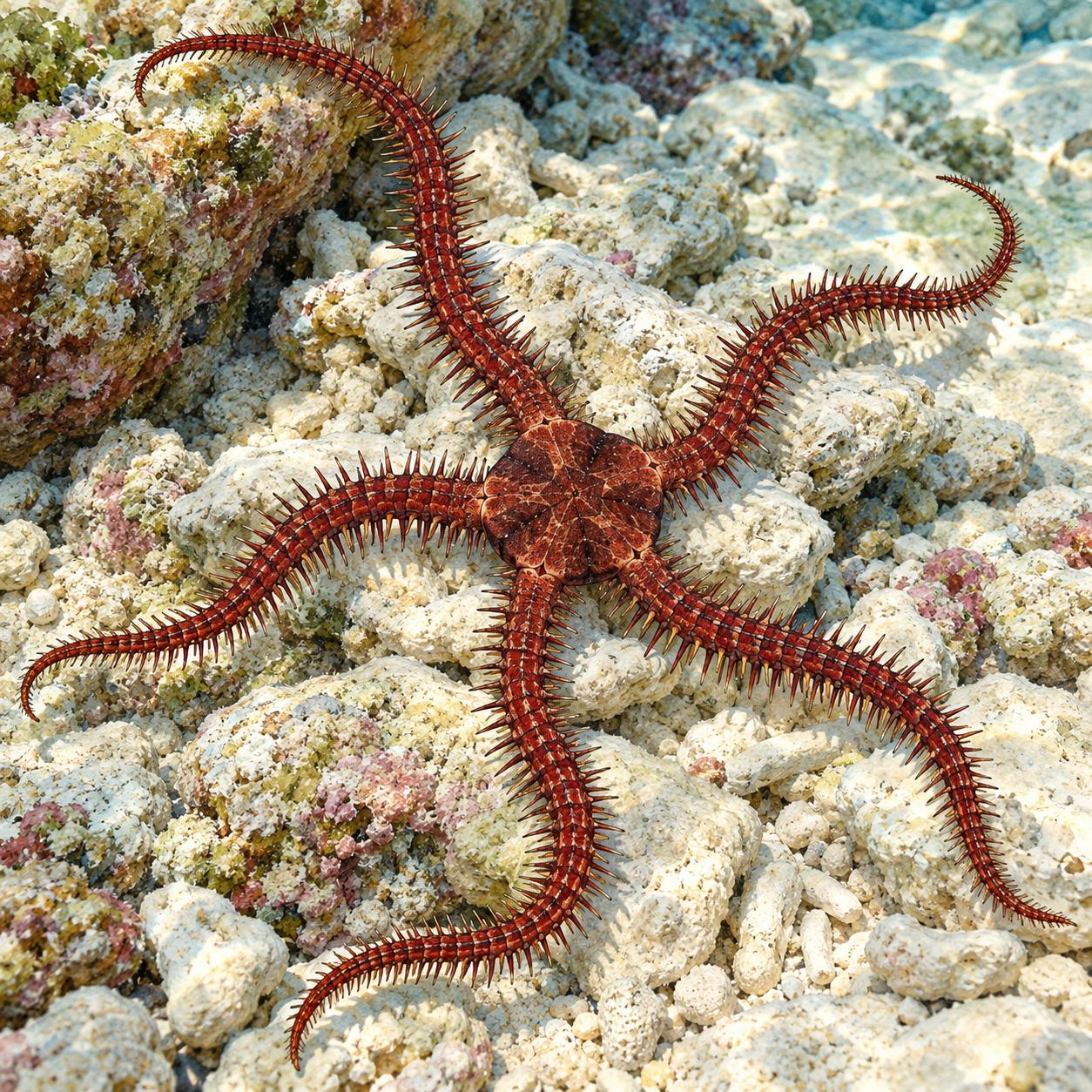
A red brittle star moves through a reef with five slender arms, yet it has no familiar pair of eyes. That does not mean it is blind to every useful feature of its surroundings. Research on a Caribbean species has shown that light-sensitive cells spread across the body can contribute to spatial vision.
The distinction is important. Detecting that light has become brighter is not the same as distinguishing where something is. Researchers had to test the animal's behavior to discover whether its distributed sensors could provide information about visual patterns.
From light detection to spatial information
The species discussed in the research was called Ophiocoma wendtii; more recent work uses Ophiomastix wendtii. It changes color between a dark reddish-brown daytime appearance and a paler state at night. Its body is covered with numerous putative photoreceptors.
In experiments reported in 2020, the animals responded to visual stimuli in ways that supported spatial vision. Their responses were coarser than the detailed images humans resolve. A distributed visual system does not imply that the animal sees a sharp, human-like picture of the reef.
For an animal searching for shelter, a coarse distinction can still be useful. Locating a dark area or a suitable refuge may matter more than recognizing intricate details. What counts as useful vision depends on the behavior it serves.
Color changes the view
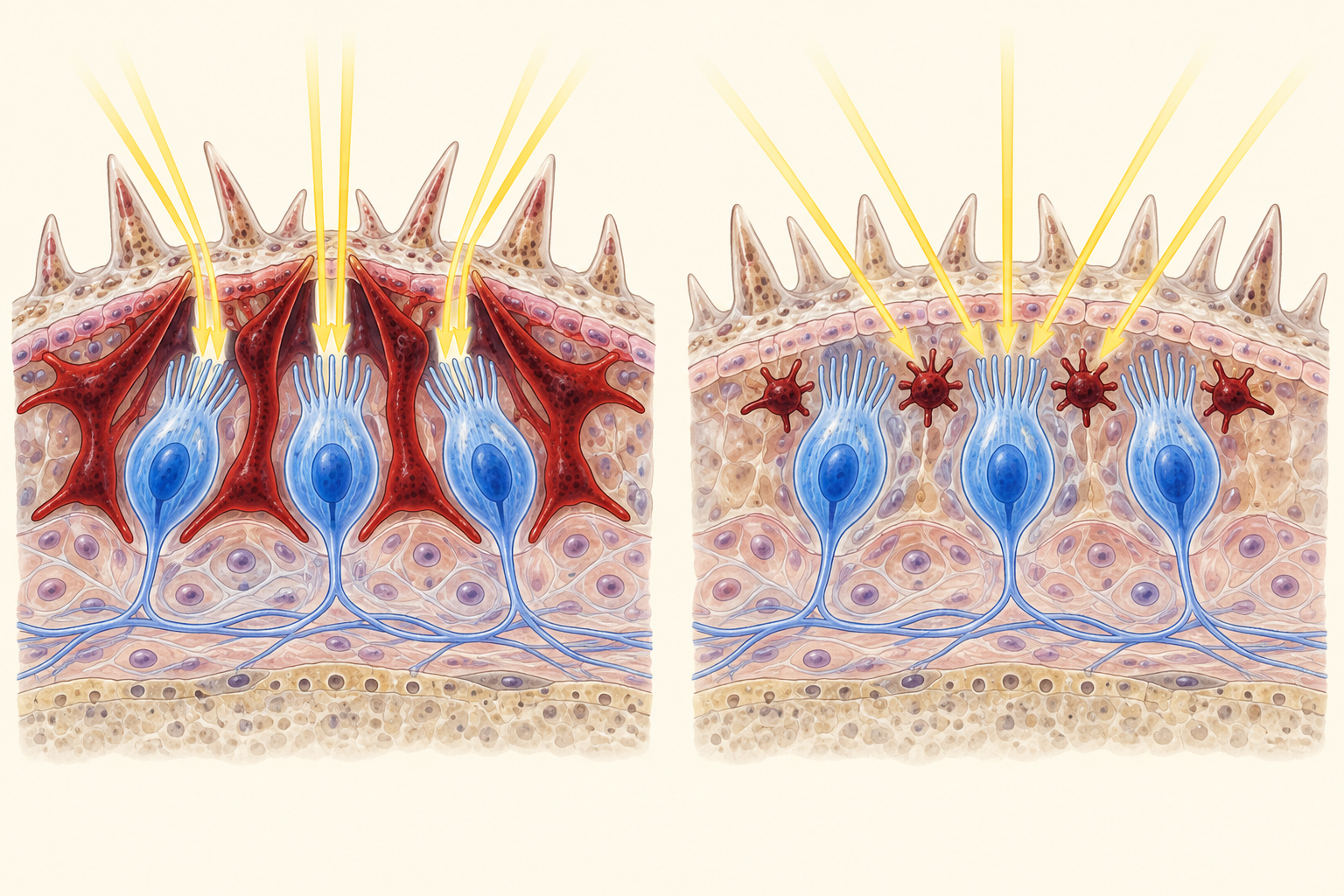
The researchers connected visual performance with pigment cells called chromatophores. When pigment is expanded, it can screen light-sensitive cells from some directions. This restricts their fields of view and helps directional information emerge from the distributed network.
In the pale state, contracted pigment provides less screening. The studied animals lost the demonstrated spatial response under those conditions, even though being unable to perform that visual task does not mean every ability to sense light vanished.
The supporting diagram simplifies the idea into two panels. The real tissue is not a row of identical little cameras. What matters is that pigment around a light-sensitive cell can change the angles from which light reaches it, altering the information available to the animal.
Why the crystal-eye story changed
Older explanations proposed that small calcite structures in the skeleton acted as microlenses connected to underlying nerves. The idea became a striking example of an animal using its body as an eye. Later anatomical research found that the photoreceptor network was independent of those supposed lenses and did not support their proposed optical role.
This is a good case of a memorable explanation being revised by better evidence. The animal's unusual response to light remained real, but the mechanism required a different account.
Follow-up work continues to examine what this form of vision can achieve and how it functions in the animal's environment. The fascinating claim is already substantial without calling every skeletal crystal an eyeball: an animal lacking discrete eyes can combine distributed receptors, pigment and behavior to obtain useful information about space.
Sources and further reading: Oxford Museum: Color-changing brittle stars can see; Whole-body photoreceptor networks independent of lenses; Extraocular vision and chromatophore movement: original paper; Follow-up: Run and hide, visual performance.
Explore more creative discoveries at Incoprea.




