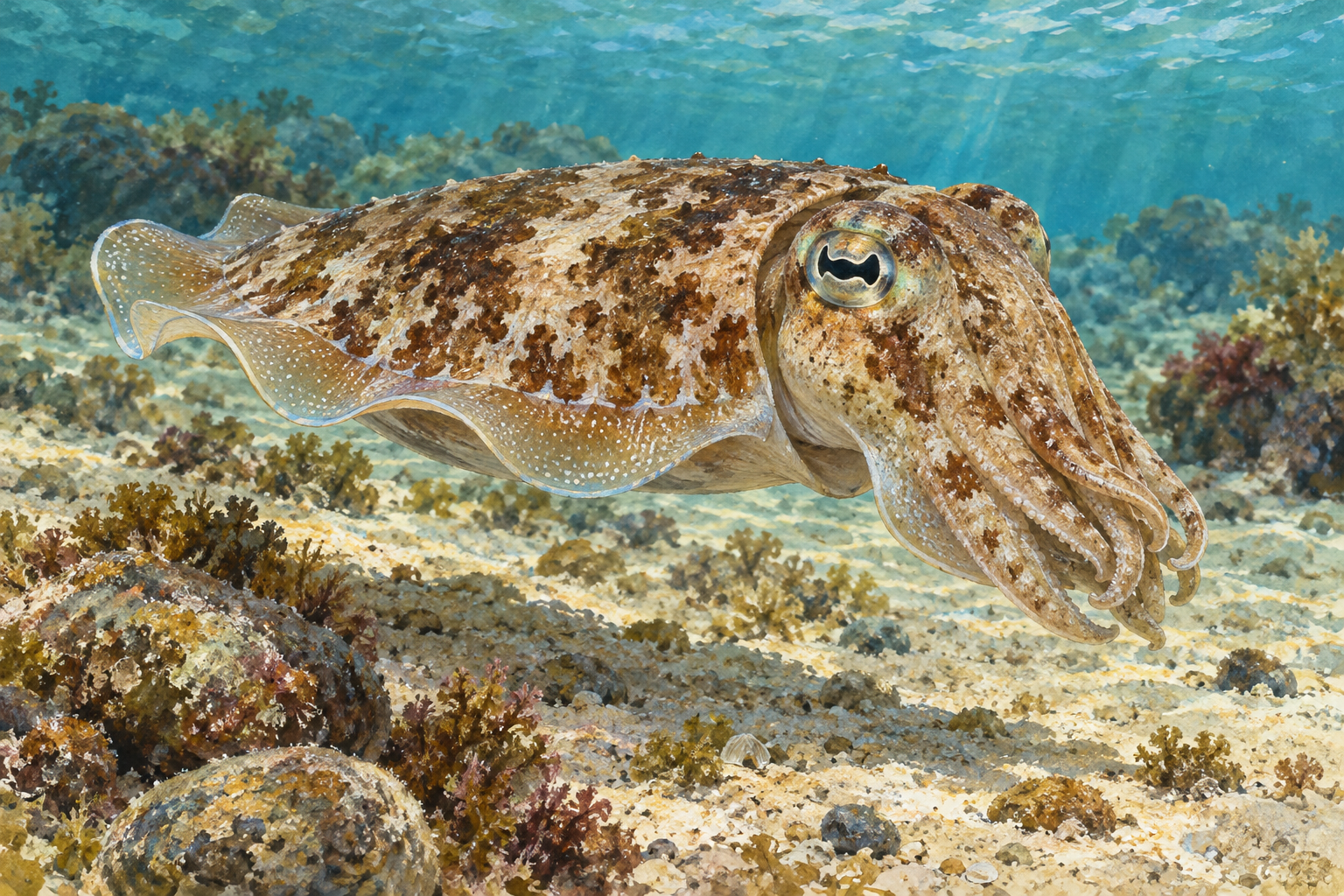
A cuttlefish can shift from a pale mottled appearance to strong dark markings while it hovers above the seabed. The transformation can look like an animation playing across its body. A central part of the effect is a set of skin organs called chromatophores.
Calling them pixels is a helpful analogy, provided we remember that each is living tissue. Muscles, nerves, elastic material and pigment work together to change how much colored surface is exposed.
A tiny sac that spreads into a disk
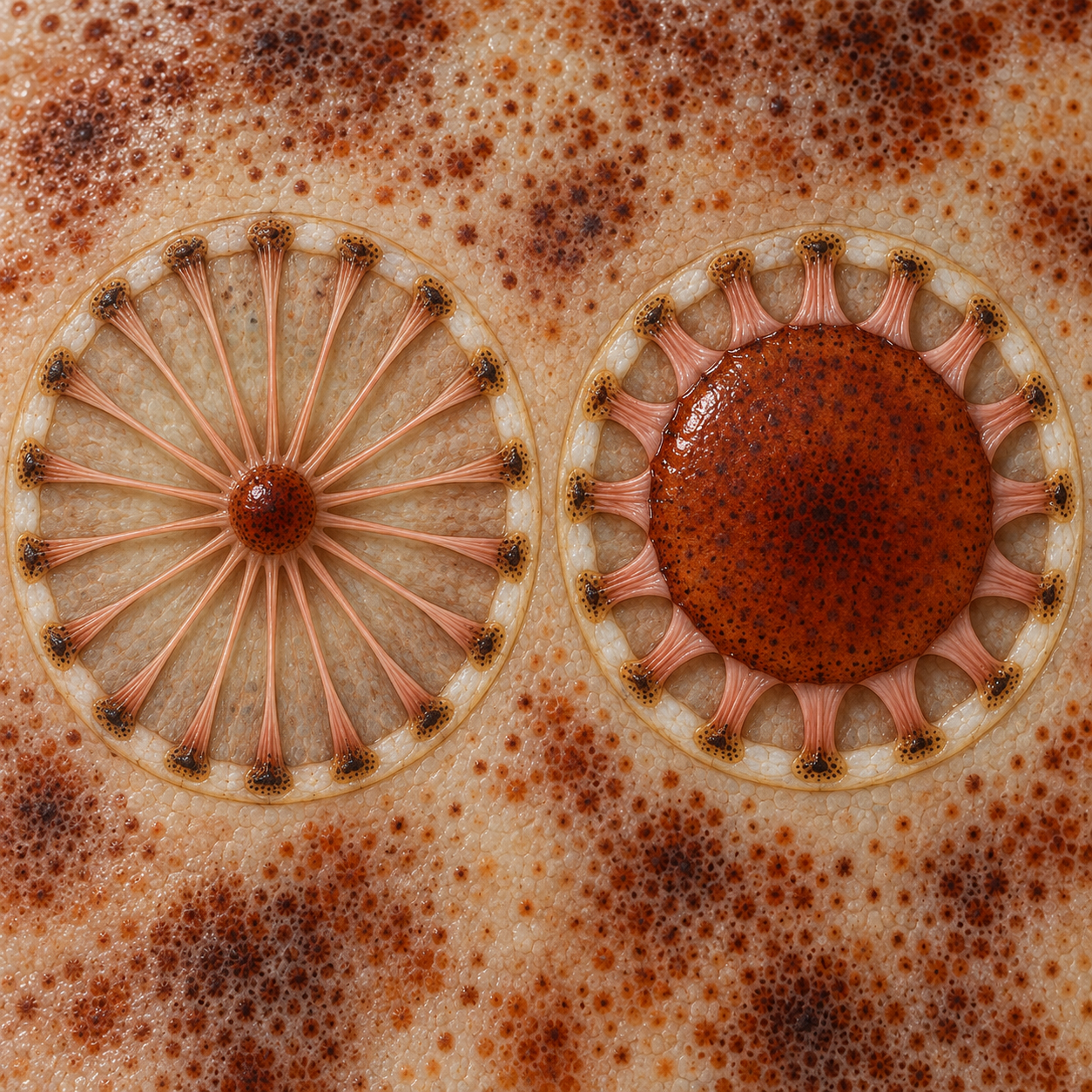
A cephalopod chromatophore contains an elastic pigment sac connected to muscles arranged radially around it. When those muscles contract, they pull the sac outward, spreading it into a broad colored disk. When the muscles relax, the sac retracts and its visible colored area becomes much smaller.
The pigment does not have to be manufactured afresh for every quick change. Mechanical expansion and contraction can expose or hide existing color. Coordinating many such organs creates patches, bands and complex body patterns.
These muscles are controlled through the nervous system. A cephalopod can therefore alter its appearance rapidly as it responds to its surroundings or other animals. The pattern is part of behavior, rather than simply a passive change in the chemistry of its skin.
More than one way to make color
Chromatophores are important, but they are not the whole optical system. Cephalopod skin also includes reflective structures. Iridophores produce iridescent effects through microscopic organization, while leucophores can contribute pale or white reflection. The combination gives the animal more possibilities than a layer of pigment alone.
The division is not always as tidy as an introductory diagram suggests. A 2019 study of squid chromatophore organs reported structural coloration associated with the organs themselves, including reflectin proteins in cells around pigment sacs. The researchers found that pigmentary and reflective effects could be intertwined.
This matters when interpreting a shimmering blue or changing sheen. It may depend on how light is reflected, including the viewing angle, rather than on a blue pigment expanding in exactly the same way as a brown one. Species and tissues differ, so a result from one squid should not automatically be treated as the precise mechanism of every octopus display.
Camouflage is a whole-body performance
Color and pattern can help an animal blend with its setting, interrupt its outline or communicate. Some cephalopods also change posture and skin texture. Cuttlefish papillae, for example, are muscular structures that can make the surface appear more three-dimensional. They are distinct from the pigment organs.
The supporting illustration isolates one mechanism: a small sac expands when radial muscles shorten. It leaves out much of the biological complexity so the direction of movement is clear.
For the real movement, MBL's research page includes microscopy videos of squid skin. Watch the changing outlines as well as the sparkle. The display becomes even more remarkable when you realize that both tiny mechanical movements and carefully organized optical materials contribute to the animal's appearance.
Sources and further reading: MBL: Squid skin coloration strategies; Dynamic pigmentary and structural coloration within chromatophore organs; MBL: How cuttlefish change skin texture.
Explore more creative discoveries at Incoprea.




