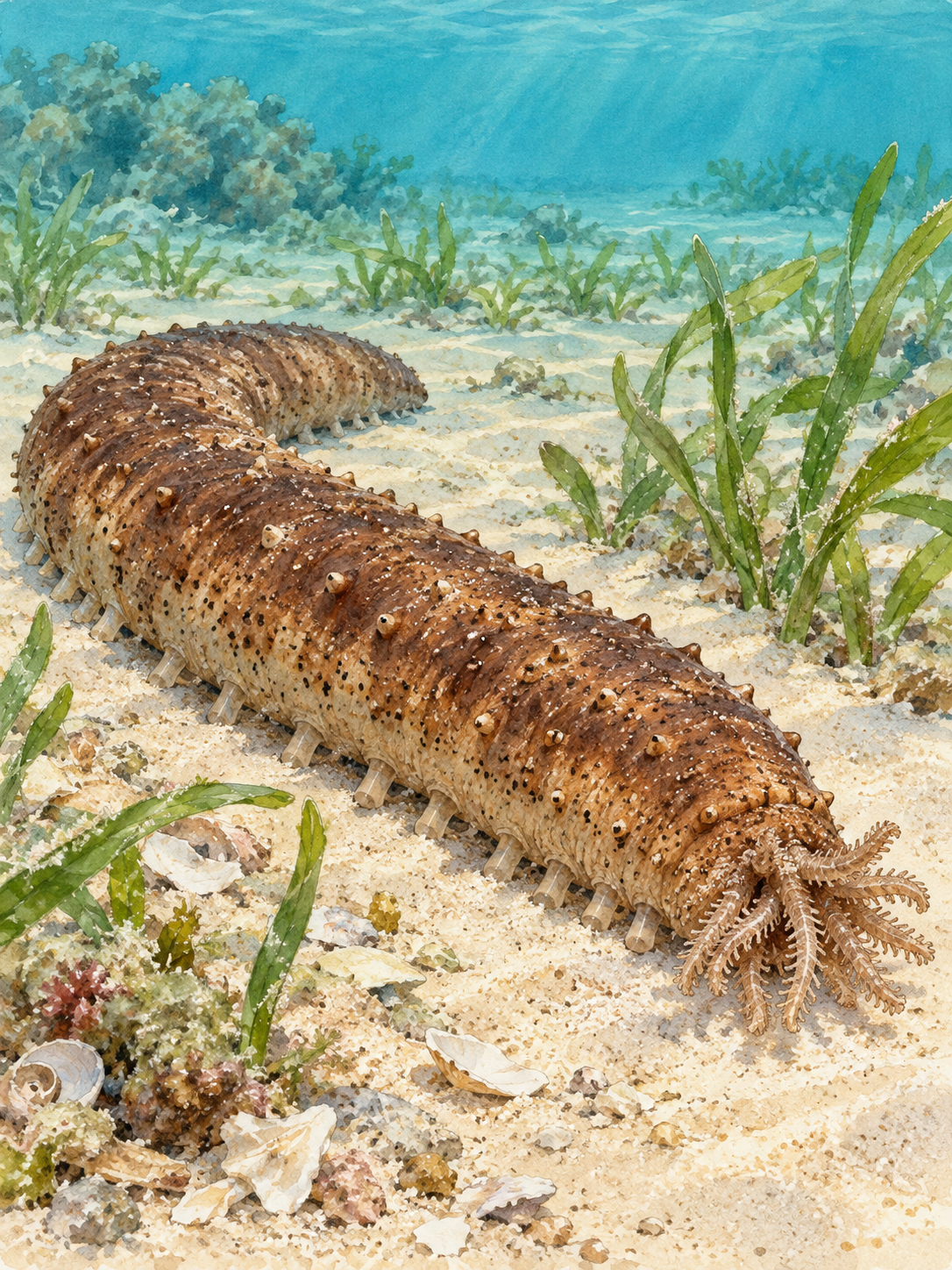
A sea cucumber can look like one of the simplest animals on the seabed: an elongated body, short tube feet, and feeding tentacles at one end. Some species possess a much less obvious ability. After losing internal organs through evisceration, they can rebuild the missing structures.
The claim sounds extravagant because a digestive tract is a complicated working system. Replacing it requires more than filling an empty space with tissue. Cells must organize a tube, lining, muscles, and associated structures so feeding can work again.
Organ loss varies among species
Evisceration is the release of particular internal organs through an opening or rupture. In different sea cucumbers it can occur toward the front or through the rear cloacal region. The triggers, tissues lost, and subsequent recovery are not identical across species.
Some observations involve defense or stress; other species show evisceration associated with seasonal conditions. It is therefore misleading to reduce every case to an animal deliberately throwing out all its organs at a predator.
Researchers identify the species, the route of organ loss, and the remaining tissues before comparing regeneration. Those details explain why two dramatic-looking examples may involve different biological processes.
Existing tissue provides a starting point
A 2019 study examined digestive-tract regeneration in the anterior-eviscerating sea cucumber Eupentacta quinquesemita. It investigated how remaining tissues reorganized and how an epithelial digestive tube formed during recovery.
Other work on Holothuria glaberrima has followed changes in cells and extracellular material during intestinal regeneration. The mesentery, a tissue normally associated with holding the intestine, becomes an important site of remodeling and growth.
Some cells change their state or role, while new structures develop through coordinated processes. The replacement is assembled from living tissue that remains in the animal, rather than an intact spare intestine waiting to be unfolded.
| Question | Why it matters |
|---|---|
| Which species? | Regenerative patterns differ |
| What tissue remains? | It supplies the rebuilding context |
| What stage of recovery? | A growing structure is not yet a fully functioning tract |
A complex animal behind a simple outline
Research follows regeneration at defined times and uses tissue sections, molecular measurements, and other methods to identify what changes. An outwardly normal-looking body alone cannot demonstrate that every internal function has recovered.
The process also entails constraints. An animal rebuilding digestive structures has to survive the interval and restore an organized, useful system. A capacity for regeneration is not the same as having no cost from injury.
Sea cucumbers offer researchers a way to investigate how existing adult tissues can participate in constructing an organ again. Their evolutionary distance from humans makes them a source of biological questions, rather than a direct promise of a medical procedure.
The creature's modest appearance conceals a major organizational feat. Its body can respond to loss by rebuilding a route through which nourishment will once more pass.
Sources and further reading: Digestive-tract regeneration in Eupentacta quinquesemita; Cellular mechanisms of intestine regeneration; Review of intestinal regeneration in holothurians.
Explore more creative work at Incoprea.




