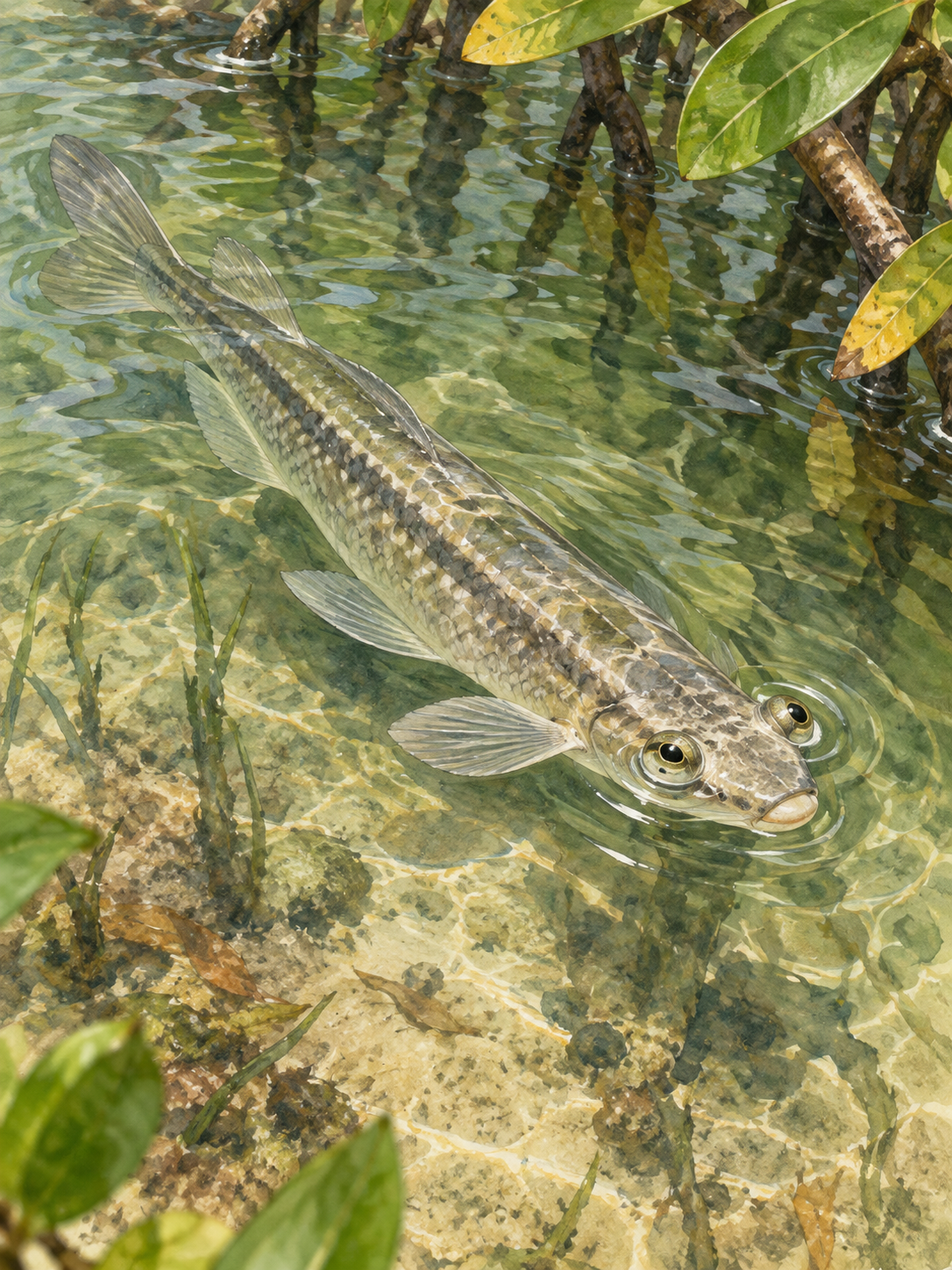
A fish cruising at the surface has a peculiar problem. Above it is a bright aerial world; below it is an underwater world that changes both the path and the color of light. Anableps, commonly called the four-eyed fish, addresses that boundary with eyes that look unusually high on its head.
The name invites the wrong picture. There are two eyes, not four independent eyeballs. Each has divided openings and specialized regions that allow it to receive light from above and below the surface at the same time. The interesting multiplication happens inside a familiar pair.
One eye, two optical neighborhoods
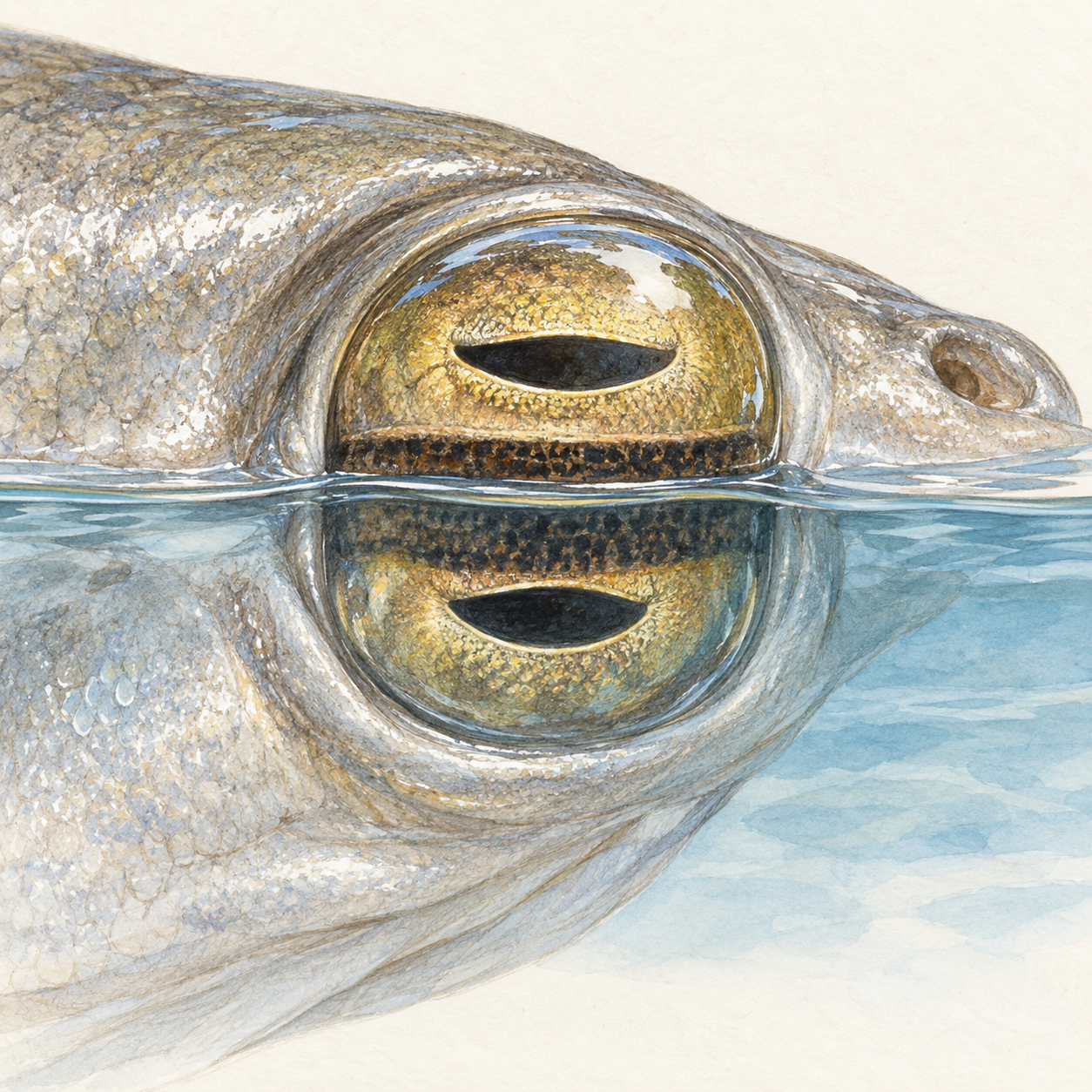
A pigmented strip crosses each eye, separating an upper pupil from a lower one. When the fish holds its usual position at the waterline, the upper region looks into air while the lower region remains submerged. Light entering through these routes passes through a single specialized lens.
Air and water impose different optical demands. A transparent curved surface bends light strongly when it meets air, but behaves differently when surrounded by water. Research comparing the two corneal regions found differences in curvature, cell-layer thickness and composition. The upper and lower surfaces are therefore more than two windows cut into an otherwise uniform eye.
The retina also divides the work
The retina is the light-sensitive tissue at the back of the eye. A primary study mapped the expression of opsins, proteins involved in detecting different wavelengths. Several opsin types occurred throughout the retina, while others were concentrated in particular regions receiving aerial or aquatic light.
That does not mean each half sees only one color, or that scientists can reconstruct the fish's visual experience from a gene map alone. It shows that the two regions are biologically organized differently. Water filters the light reaching the lower view; the air-facing view encounters another mixture. The sensory equipment reflects that uneven world.
A boundary becomes a habitat
Developmental research adds another layer. The conspicuous adult eye is built through changes in the skull, cornea, pupil and retina as the young fish develops. Differences in retinal organization begin during development, rather than being simply painted onto an ordinary eye by exposure to air.
Think of the waterline as the fish's working position. Its body can remain in the water while its visual system samples two surroundings. Maintaining that position matters: divided optics are useful because the animal lives at an interface where those divisions line up with different environments.
Anableps is a reminder that evolution can reshape an existing structure without adding a whole new organ. The nickname makes the animal sound like a four-camera invention. The actual arrangement is subtler: two eyes, with parts tuned to different jobs, meeting exactly where two worlds touch.
Sources and further reading: Primary study of retinal opsin expression; Primary research on eye development; Comparative study of aerial and aquatic corneas.
Explore more creative work at Incoprea.




