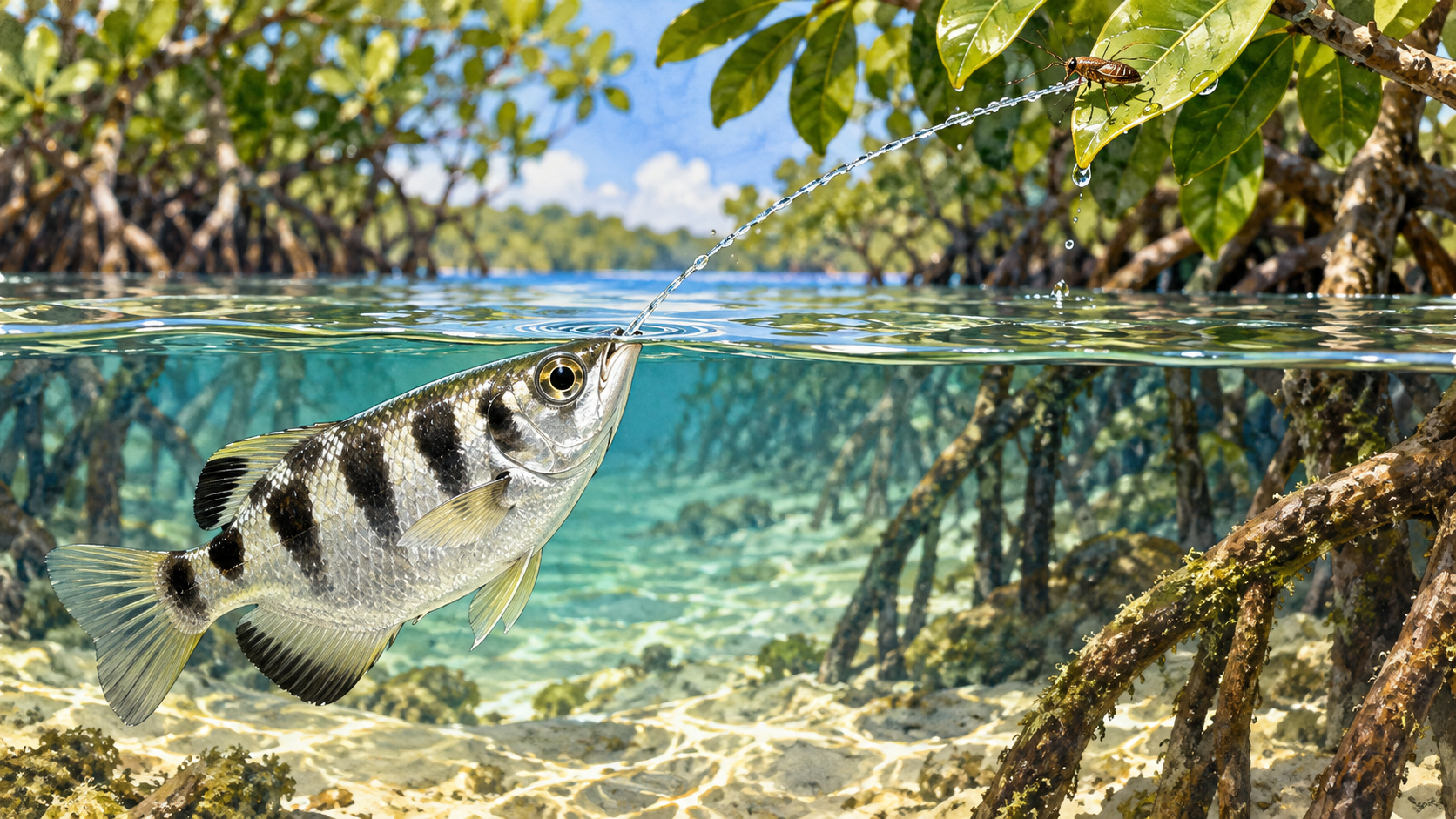
An insect rests on a leaf above tropical water. Below it, an archerfish brings its mouth to the surface and sends up a jet that can knock the insect down. The trick demands more than a strong spit: the fish views its target through an optical boundary.
Light changes direction as it crosses between air and water. This refraction alters the underwater view of an aerial object. The fish must connect that distorted view with a movement that places water at the target's actual location.
The image is not the target itself
The difficulty depends on viewing position and the angle of the light. A target above water can appear shifted, and its apparent dimensions can change. Aiming and judging whether a meal is worth pursuing are therefore related visual problems.
Research on archerfish has shown that they can learn to compensate for complex optical distortions when judging the size of aerial prey. That result describes an animal extracting useful information across a boundary, rather than calculating a physics equation in the way a human student would.
Scientists distinguish several contributors to shooting: inherited capacities, experience, body posture, and ongoing adjustments. Success does not establish that one simple explanation accounts for every part of the behavior.
The jet is shaped for the job
Once the fish has selected a target, water must deliver enough force at the right distance. A 2014 Current Biology study showed that archerfish actively adjust the hydrodynamic properties of their jets in relation to target distance.
Subtle changes during release influence how the water stream develops. The jet's front and later portions do not have to behave identically. Researchers have investigated how this timing helps the water mass coalesce near the target.
That makes the mouth part of a controlled fluid-delivery system. The visible stream is the result of a sequence of movements, rather than a rigid projectile leaving the animal unchanged.
| Challenge | Useful ability |
|---|---|
| Aerial target seen underwater | Compensation for optical distortion |
| Different target distances | Control of jet formation |
| Changed physical conditions | Adjustment through experience |
Learning helps maintain the skill
A more recent study tested motor adaptation by disturbing shots with airflow above the water. The fish adjusted to the altered physical conditions. The experiment did not reproduce every natural challenge, but it showed that shooting behavior can respond to a changing relationship between action and outcome.
This is a useful distinction between a fixed performance and a calibrating system. A fish has to operate in water levels, distances, and environmental conditions that can vary. Learning and feedback can help keep a remarkable ability useful.
The archerfish's shot unites vision, fluid physics, and movement. The animal sees through one medium, sends another medium into the air, and acts on a target that is neither where nor quite how it first appears.
Sources and further reading: Archerfish learn to compensate for optical distortions; Archerfish actively control jet hydrodynamics; Motor adaptation in archerfish shooting.
Explore more creative work at Incoprea.




