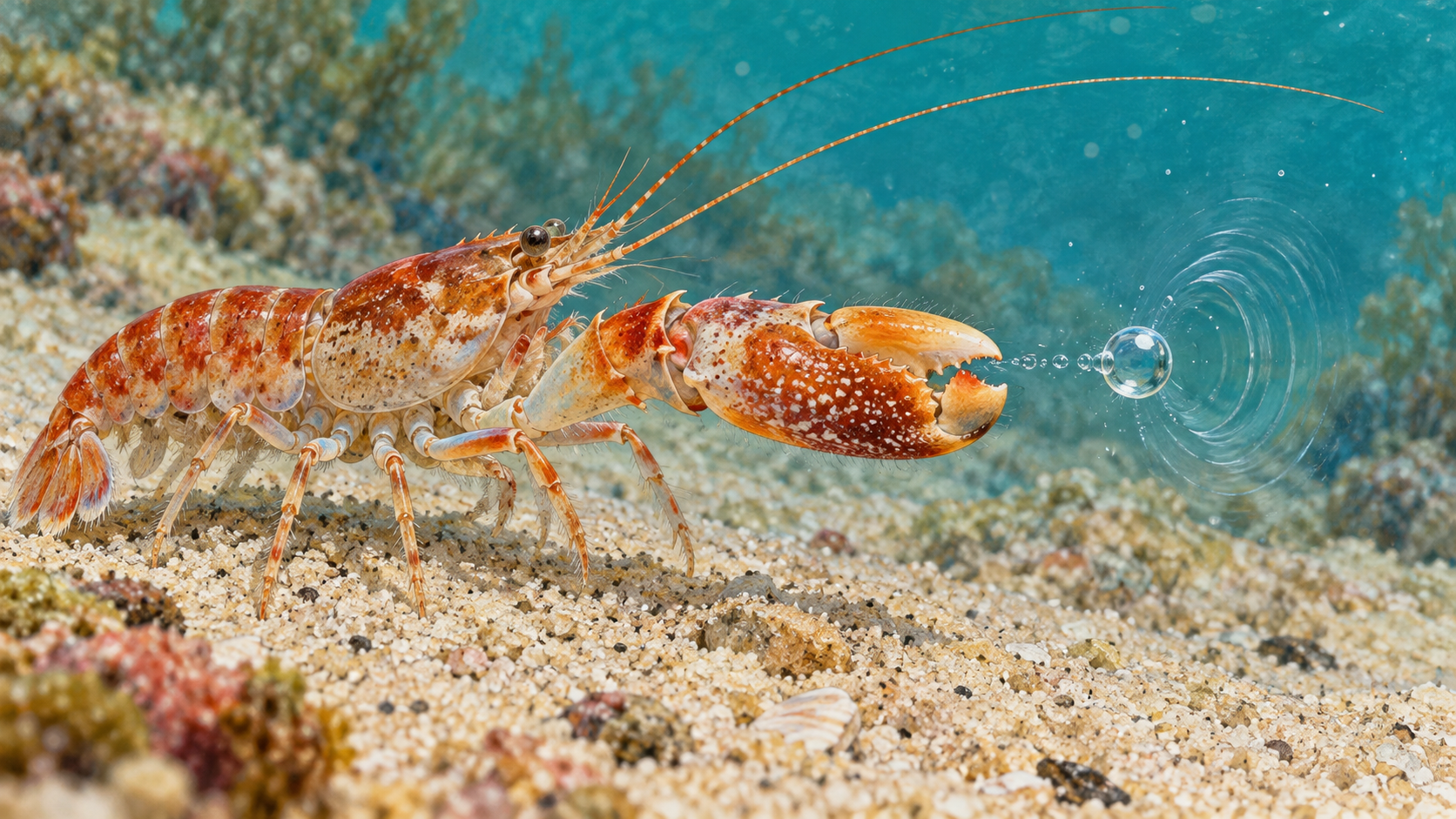
A pistol shrimp carries an oversized claw, but the remarkable part of its attack happens just beyond that claw. Its famous snap comes from a bubble collapsing in the water. The animal briefly turns ordinary seawater into a violent physical event.
That is a more interesting trick than simply pinching hard. The shrimp's claw acts as a fast water-moving device, and the surrounding fluid supplies the rest of the mechanism. To understand its weapon, it helps to follow one bubble through its extremely short life.
First the claw, then the cavity
When a snapping shrimp closes its specialized claw, it expels a narrow, fast jet of water. The rapid flow lowers local pressure enough to create a cavity filled largely with water vapor. This is cavitation: a liquid can form vapor bubbles because pressure drops, even when the whole surrounding liquid is nowhere near boiling.
The cavity expands and then meets the pressure of the surrounding water. It collapses rapidly. High-speed observations by researchers including Michel Versluis and Detlef Lohse showed that the principal snapping sound coincides with this collapse, rather than simply with the two parts of the claw striking one another.
The difference is easy to miss if you listen without watching at the right speed. The sequence happens too quickly for unaided eyes to separate the claw movement from the fluid event it triggers.
A flash too brief to be a lantern
In further experiments, researchers detected a very short flash of light during bubble collapse. Their 2001 Nature paper called it “shrimpoluminescence,” drawing a comparison with sonoluminescence, in which violently collapsing bubbles emit light.
This is not the same process as a firefly's chemical glow. The shrimp is not using a luminous organ, and it does not cruise around with a bright headlight. The flash accompanies an extreme, localized bubble event. The spectacle is primarily revealed by experimental instruments, not by a shrimp lighting up an aquarium for observers.
That is also why comparisons with the temperature of a star can mislead. Conditions inferred inside a tiny collapsing bubble are not the temperature of the shrimp or its surroundings. Scale and duration are essential parts of any claim about this phenomenon.
Small animals, serious fluid physics
The collapsing cavity produces a pressure pulse useful at close range. Snapping shrimp use their specialized claws in encounters involving prey and other shrimp; the physics explains how a small animal can create an outsized acoustic disturbance.
Cavitation is familiar to engineers because it can damage pumps and propellers. In the shrimp, a process that machinery designers often try to avoid has become part of a biological tool. Nature's version is compact, repeatable, and built into a living appendage.
The next time someone describes a pistol shrimp as firing a bubble, picture the complete sequence: a claw drives a jet, the jet makes a vapor cavity, and surrounding water crushes that cavity. The ocean itself delivers the snap.
Sources and further reading: Nature: Snapping shrimp make flashing bubbles; Versluis and colleagues: On the sound of snapping shrimp; Lohse: Cavitation and bubble dynamics.
Explore more creative work at Incoprea.