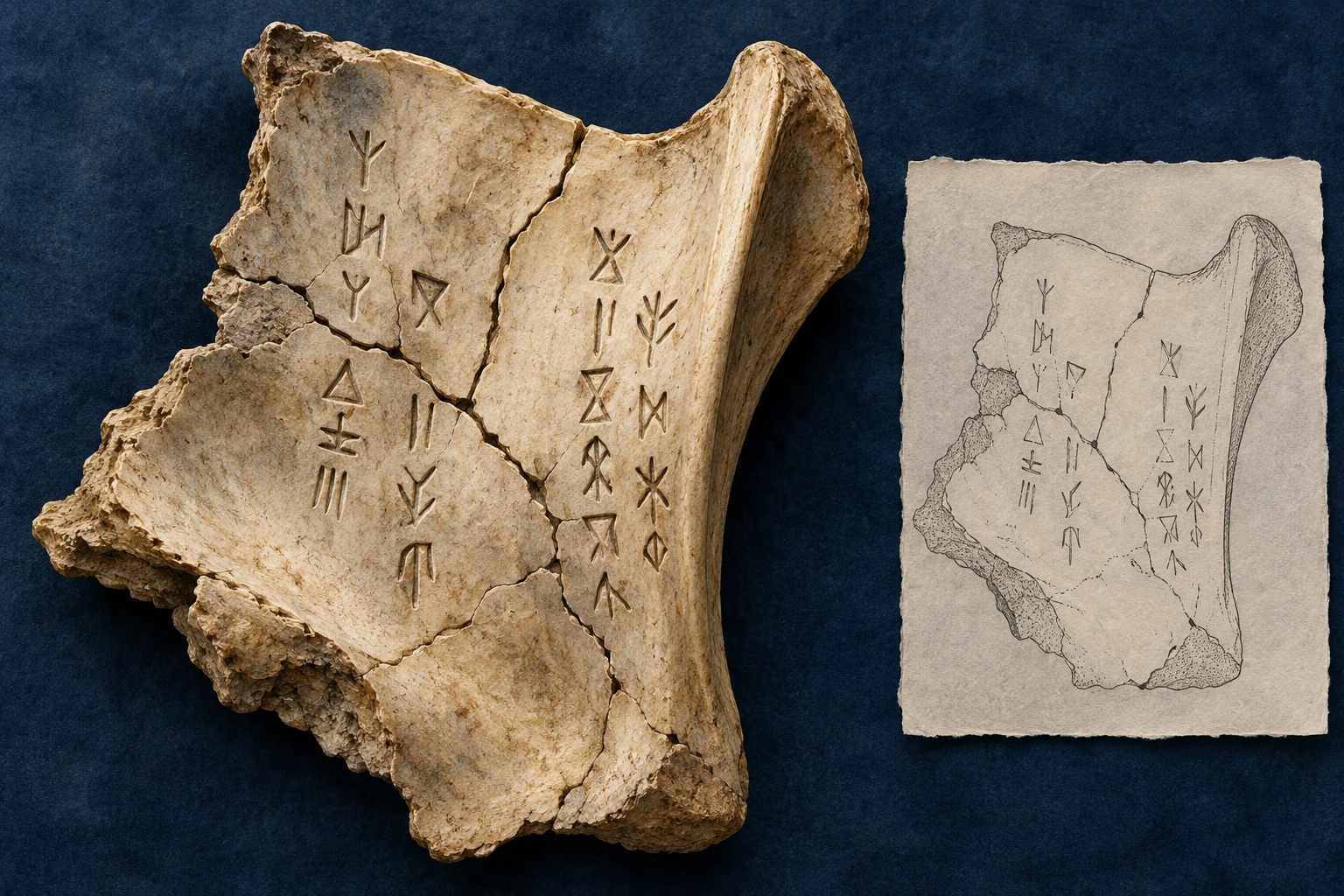
An oracle bone can carry two kinds of lines that are easy to confuse in a small photograph. Some are fractures. Others were deliberately cut as writing. Both belong to the object’s history, but they did different jobs. Begin by separating them, and the fragment becomes more than an evocative relic of prediction: it becomes evidence of preparation, ritual action, record keeping, and later interpretation.
Shang-period diviners used cattle shoulder blades and turtle plastrons in procedures involving heat and the reading of cracks. Inscriptions could record the subject and interpretation of a divination. The Penn Museum’s object guide places that practice in a royal context, concerned with political, social, and personal matters. It describes the cracks as a means through which diviners believed they received supernatural guidance.
The crack is not the sentence
That distinction is the first reading skill. A fracture does not turn into a written character merely because both are visible on the same surface. Nor does every surviving written passage include a complete question, prediction, and subsequent outcome. Breakage, omission, and the kind of record being made affect what remains.
Before asking for a translation, ask what the image shows. Is it the inscribed face, the reverse, a rubbing, a tracing, a modern reconstruction, or a photograph of a cast? Do the caption and catalog number identify the same object? Can you see where the fragment ends, rather than where an illustration has merely been cropped?
The Met’s oracle bone 67.43.16, for example, has an object record identifying inscribed bone, Shang attribution, and dimensions of 12.7 by 23.5 centimeters. Those modest facts give the image a material scale and an institutional identity. They do not by themselves provide a translation or establish that every visible mark is ancient writing.
A misplaced fragment and a careful refusal
In a 2001 first-person research account, scholar Victor H. Mair describes examining an oracle-bone fragment found among Penn’s cuneiform tablets. The object’s location in a museum drawer was a modern problem, not evidence of a Bronze Age journey from China to Mesopotamia. Registration records helped investigate its collection history.
Mair also discusses another fragment, 49-14-7B, only 1.4 by 1 centimeter. Too little of its inscription survived for him to offer a reading. That refusal is useful evidence of method: recognizing a category of object is not equivalent to recovering a lost sentence.
The same article raises concerns about a possibly later-added graph on one object and identifies another as a likely fake. These judgments belong to Mair’s published analysis; they remind us that cataloged collections can contain complicated histories of alteration, attribution, and reassessment. “It looks ancient” is not a sufficient authentication method.
Turn the object around
A surface with writing attracts attention first, but a three-dimensional object contains information that a front-facing image hides. Cambridge University Library’s Hopkins collection guide links digitized bones and records fifty in three-dimensional format. Its account of the imaging project describes how a model makes both finely incised marks and reverse-side divination pits available for closer viewing.
Use a model as an object study, not only as a rotating novelty. Choose one edge and follow it from front to back. Look for changes in thickness, the relation of a pit to a crack, and the difference between a deliberate hollow and a broken margin. If lighting controls are available, change the illumination gradually and notice which marks become clearer.
A digital surface is still an interpretation made through a recording process. Its resolution, texture, lighting, and completeness set limits. A feature absent from a model may have been too shallow, inaccessible, or poorly captured. That is different from demonstrating its absence on the physical object.
A four-column notebook for one fragment
You can do a serious ten-minute exercise without reading ancient Chinese. Choose one institutional object and make four short columns:
- Visible: describe only what you can point to, such as a broken edge, a row of incisions, or a darkened area.
- Cataloged: copy a few factual identifiers in your own notes, including the collection number, material, dimensions, and attributed period.
- Interpreted: summarize the institution’s explanation and identify whose reading it is.
- Unanswered: record what the available evidence cannot tell you.
Now review your first column. Did “burn mark” slip into it when you could only observe a dark patch? Move the proposed explanation into the interpretation column unless the source establishes it. Did “the king asked” appear when the translated fragment contains no surviving name? Mark that leap too.
The point is not to remove interpretation. It is to give it an address, so another reader can tell what supports it. A note with fewer confident claims may be more informative because its evidence remains visible.
Why a question is not an event report
Here is a deliberately invented modern example: “Will rain damage the harvest?” It records a concern. It does not establish that rain came, that a harvest failed, or even that rain was unusually likely. A later note reporting an outcome would provide a different kind of information.
The same logical care matters with ancient records. A translated concern about warfare, weather, or illness should not automatically become an event in a historical timeline. Grammar, textual convention, context, and surviving follow-up records have to carry that argument. Our invented sentence is a reminder about inference, not a translation of an oracle-bone inscription.
These objects are valuable partly because belief and practical concern meet on their surfaces. A record can reveal what mattered to a court without giving direct access to every life around it. Look at the crack, the cut line, the reverse, and the catalog history together. The resulting encounter is slower than a dramatic prediction story—and far more revealing.
Sources and a closer look
Penn Museum: Oracle bone fragment 49-14-7B; The Met: Oracle bone 67.43.16; Victor H. Mair: The Case of the Wayward Oracle Bone; Cambridge University Library: Hopkins collection guide; University of Cambridge: Oracle bones in 3D.
Find more art, ideas, and unexpected connections at Incoprea.