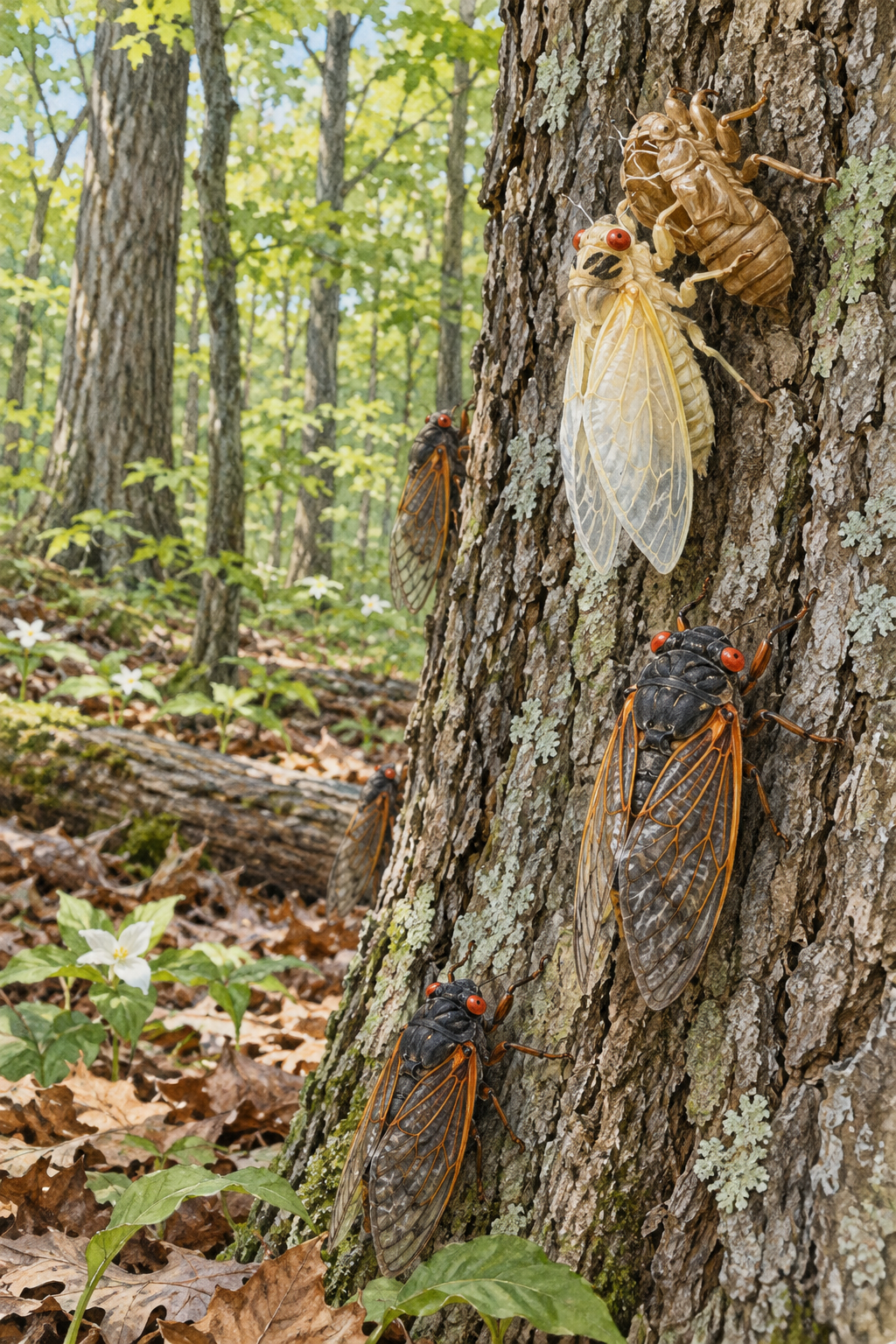
Imagine keeping an appointment arranged before a child was born. The landscape has changed, trees have grown, and the child can now drive. Yet, beneath the same neighborhood, a generation of insects is approaching the surface together. The extraordinary feature of periodical cicadas is not simply that they wait. It is that so many arrive on a shared schedule.
That distinction changes the story. A cicada appearing each summer need not have lived for only one year. Many so-called annual cicadas also develop underground for several years; different age groups overlap. In periodical cicadas of the genus Magicicada, adult appearances are concentrated into particular years, separated by thirteen or seventeen years of underground development. A brood is a geographical year-class, not a single species. Several species can share its calendar. Penn State's illustrated account separates those easily confused categories.
The long part happens where we cannot watch
A periodical cicada does not spend all those years asleep. Nymphs feed on fluids from tree roots and grow through juvenile stages. Near emergence, they prepare exit tunnels. On a suitable spring evening, a nymph leaves the soil, climbs vegetation, and splits its old outer skeleton. A pale adult unfolds from it. The abandoned shell remains gripping the bark: a useful trace of an event that may have happened while the observer was indoors.
The visible adult period occupies weeks rather than years. Males produce calls with specialized vibrating structures, and females place eggs in slits in living twigs. Newly hatched nymphs later drop and enter the ground. The Smithsonian's life-cycle resources put those stages side by side. Looking at the sequence restores proportion: the spectacle is the brief reproductive opening of a much longer animal life.
Safety through a temporary excess
A slow, conspicuous insect sounds like an easy meal. In a mass emergence it often is. The survival advantage lies at population scale: predators cannot necessarily consume a matching fraction of an enormous, short-lived food pulse. This is called predator satiation. The National Park Service explanation describes how sufficient survivors can reproduce despite heavy feeding by birds and other animals.
A toy example makes the logic visible without pretending to measure a real forest. Suppose a group of predators eats 900 insects during an observation interval. If 1,000 insects emerge, only 100 remain. If 10,000 emerge and predator consumption rises to 1,800, 8,200 remain. More insects are eaten in the second case, but the proportion lost falls from 90 percent to 18 percent. Real predators, timescales, and densities complicate the calculation; the important distinction is between the number eaten and the risk faced by each insect.
This also explains why a few insects appearing off schedule might face a different situation. They do not automatically receive the protection associated with a dense emergence. A 2024 mathematical study explores how predation can help shape the geographical separation of broods. Its modeled outcomes are tests of a proposed mechanism, not proof that one force alone created the whole life history.
Thirteen and seventeen are clues, not a complete answer
Both intervals are prime numbers. That invites a memorable story about insects defeating predators through arithmetic. But a memorable calculation is not itself an evolutionary history. The University of Connecticut's research guide stresses the unusual combination of long development, periodicity, and synchronized abundance. It also discusses gaps in explanations based solely on predation or past glaciation. Many insects face predators and climatic shifts without evolving this schedule.
We can know that a pattern exists, demonstrate that a mechanism could favor it, and still lack a complete account of its origin. Keeping those levels separate makes the cicadas more interesting. There is room for field measurements, comparisons among species, and experiments about timing, rather than only a clever anecdote about primes.
The same caution helps with maps. A broad brood map identifies an expected region, not a promise for every yard. Changes in vegetation and land use can alter a very local experience. For practical tree protection, consult the extension guide's discussion of young trees and egg-laying injury rather than treating the emergence as a crop-devouring locust invasion. Cicadas and locusts are different insects.
When the chorus subsides, the neighborhood can seem to have returned to normal. A better description is that the visible phase has ended. The next generation has begun a long relationship with the ground and its roots. An empty shell on a fence is therefore more than the remains of an insect costume. It marks a meeting between two timescales: a few weeks loud enough to dominate a summer memory, and years of life that passed beneath notice.
Follow the evidence: University of Connecticut: periodical cicada biology; Smithsonian: life cycle and educational films; National Park Service: emerging cicadas; Penn State Extension: species, broods and tree care; Predation-driven geographical isolation of broods: a mathematical model.
More curious connections, art and independent projects at Incoprea.