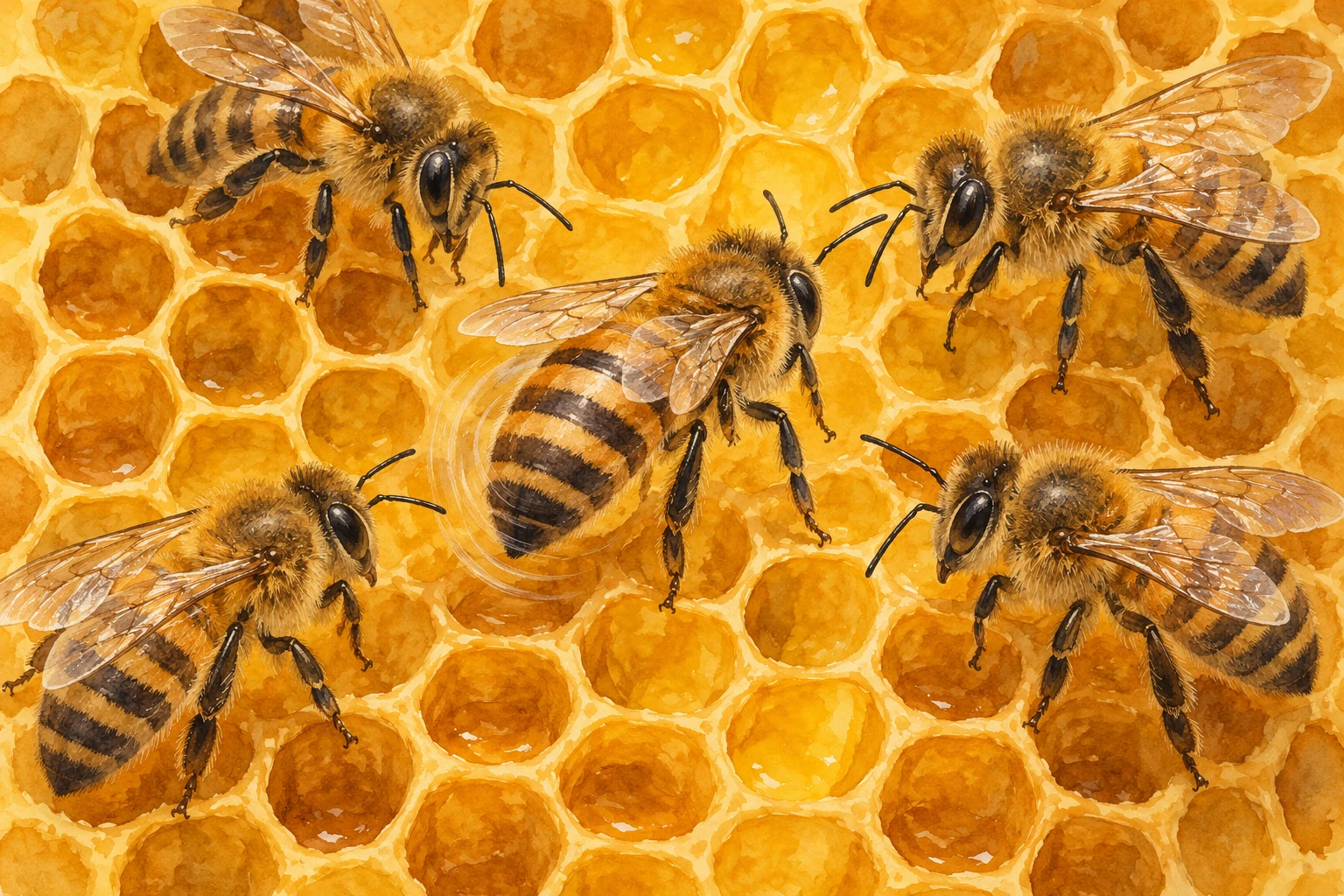
A foraging honeybee returns to a dark hive with information about a place the surrounding bees have not visited. She cannot point at a flower across the field. Instead, she moves across the comb in a repeating pattern whose central waggle runs contain information about direction and distance. The hive turns a journey through space into a signal made of motion.
The familiar figure-eight outline is only the beginning. If we watch the looping returns and miss the straight central runs, we miss much of what the signal communicates. And if we imagine a perfectly calibrated message produced without experience, recent research gives us a more interesting picture.
Read the central run, not just the loop
The Sussex guide to dance decoding explains how researchers translate waggle-run orientation and duration into estimates of resource location. On a vertical comb, direction is encoded relative to gravity and relates to the sun's direction outside. Waggle-run duration supplies information used to estimate distance. Repeated runs provide a set of measurements rather than one infallible coordinate.
For a simple directional example, imagine the sun's direction outside as a reference line. A run straight upward represents a direction toward that reference; a run tilted to one side represents a corresponding angle from it. The comb is not a miniature overhead map with north permanently at the top. It is a coordinate translation between an internal vertical surface and the outside world.
The distinction matters because the sun's position changes. A meaningful description must specify the reference system rather than attach a permanent compass direction to one tilt. Likewise, a duration-to-distance conversion is a calibrated biological relationship, not a universal rule that any one-second motion means the same distance for every bee in every circumstance.
The signal has an apprenticeship
A 2023 study in Science tested the role of early social experience. Researchers created colonies in which young bees lacked older, experienced dancers to follow before making their own first dances. They compared those bees with others that had the normal opportunity to observe experienced nestmates.
The socially deprived first dancers made less orderly and less accurate signals, including errors in the distance component. Experience later improved aspects of performance, but some differences persisted. The University of California account describes the result as evidence that social learning contributes to this communication system.
This does not mean a young bee starts with no biological predisposition to dance. Nor does it mean an older bee deliberately conducts a lesson. It means that the developmental environment—including the opportunity to follow experienced signals—changes subsequent performance. A behavior can have an evolved foundation and still be refined through learning.
Noise can carry a message without being an exact address
Individual waggle runs vary. A researcher decoding a dance therefore asks how many runs were measured, how their angles were summarized, and which calibration converted duration into distance. The result is better understood as evidence about a likely foraging area than as the equivalent of a consumer navigation pin accurate to a doorway.
The same issue appears whenever an animal communicates about a variable world. Flowers differ in reward, conditions change, and the receiver still has to search. A useful message can narrow a problem without solving every part of it. Precision is not all-or-nothing.
The colony also needs brakes
A dance can recruit other foragers, producing positive feedback around a resource. But useful collective behavior requires ways to limit recruitment too. The Nieh Lab's research overview includes honeybee stop signals that counteract dance-related positive feedback. A colony is not simply a room of advertisers trying to make every discovered patch sound irresistible.
That balance gives the communication system a wider meaning. An individual has partial information. Another bee can use it, check the world, and contribute a further signal. Recruitment and inhibition help turn many local experiences into a changing pattern of collective effort. No bee needs an overview of every field for the colony to distribute foraging activity.
When watching the research video linked in the university account, follow one dancer rather than the crowd. Identify the central run, the returns, and the nearby followers. Then watch a second sequence and notice variation. The real behavior is more useful to see than a perfectly repeated animated figure eight.
The waggle dance is remarkable because it refers to something beyond the immediate hive. Its richness increases when learning, calibration, and noise are included. The returning bee has converted a lived trip into a signal others can use. What looks like a few inches of busy motion contains a relationship between bodies, sunlight, experience, and a landscape outside the comb.
Follow the evidence: Dong and colleagues: social signal learning in honeybees; University of California: learning improves waggle dance; Ratnieks: decoding waggle dances; Nieh Lab: communication, learning and stop signals.
More curious connections, art and independent projects at Incoprea.