To an ant on a salt-flat surface, a short human walk is a large expedition. The nest entrance may be a small, inconspicuous opening. An efficient return requires more than recognizing a general patch of desert: the animal must keep track of both direction and distance.
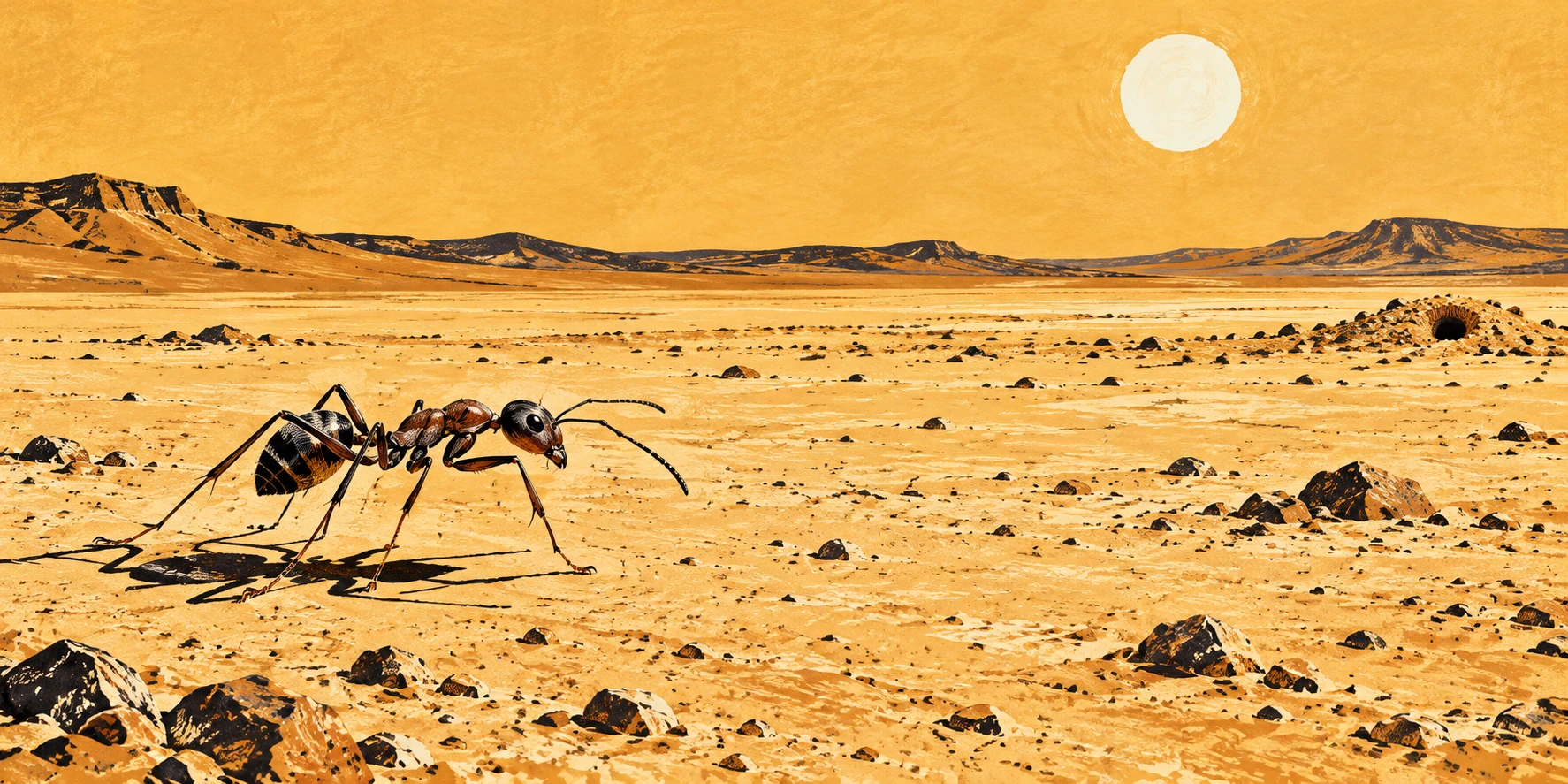
Desert ants in the genus Cataglyphis use path integration, combining information gathered during a journey into a homeward estimate. Distance is a particularly revealing component because a researcher can change how far one stride carries an animal without moving the nest.
The experiment changes the ruler
The 2006 “stilts and stumps” study manipulated leg length and therefore stride length after an outward journey. Longer-legged ants searching on their return overshot the normal goal region; shorter-legged ants searched too soon. The pattern supported a stride-based component of the distance estimate.
The crucial feature is the mismatch between the outward and return journeys. If the animal's locomotion supplies information about distance, altering that locomotion after the outward trip can produce a systematic error. It is an unusually direct way to ask what kind of ruler the navigator has been using.
“Step counter” is memorable, but it should not be taken as a claim that an ant consciously counts integers. A stride integrator can combine movement-related signals without resembling a person reciting numbers. The physiological mechanism is a separate question from the behavioral evidence for its contribution.
Change a hypothetical stride
The explorer below uses a deliberately simple fixed-count rule. Divide outward distance by outward stride length. Then multiply that count by the return stride length. The result is where a fictional walker would stop if it repeated the outward number of strides.
Change the outward and homeward stride
A fixed-count teaching model reveals how mismatched stride length causes overshoot or undershoot.
Open change the outward and homeward stride in its own window.
With a 100-unit outward trip and a one-unit stride, the count is 100. Give the return trip a 1.5-unit stride and the walker covers 150 units before stopping. Give it a half-unit stride and it stops after 50. These are invented numbers, not measurements from the ant experiment.
Now make both outward and return strides 1.5 units. The mismatch disappears in the model. The point is not that long legs inevitably cause an error. An error appears when the relationship between movement and distance changes between stages.
This model isolates one idea and deliberately leaves out terrain, speed-dependent stride adjustments, direction and visual cues. The broader navigation review describes a richer system. Real ants are not mechanical toys with one counter and no other information.
An ant can measure a trip it did not walk
A 2016 study of ants carried by nestmates supplied a particularly useful complication. Carried animals could estimate travel distance using optic flow: the movement of visual patterns across the eye during travel. In the tested conditions, that visual distance information did not transfer into the stride channel. The findings supported two independently operating sources of distance information.
A carried ant is therefore a natural challenge to a stride-only explanation. Its legs are not performing the journey's walking movements, but its visual scene still changes. The experiment asks what information remains available when one channel is absent.
Distance is only half the homeward problem
Imagine walking 10 units east and then 10 units north. Your path length is 20 units, but a direct return to the start is about 14.14 units southwest. A complete path integrator must combine directions as well as distances. This invented right-angle example explains why a pedometer alone cannot specify the homeward vector.
Compare it with walking 20 units straight east. The two journeys have equal path lengths but different endpoints. A record containing only the total distance cannot distinguish them. Drawing those two routes on paper exposes the missing directional information without needing to imagine what an ant consciously knows.
These studies are experiments to read, not procedures to repeat on wildlife. The explorer lets you investigate the logic with a fictional walker. You can change the ruler without changing an animal.
Seen at ant scale, the open ground becomes a landscape of estimates and cross-checks. The remarkable achievement is not one perfect internal number. It is the combination of movement and sensory information that brings a small traveler back toward a very small entrance.
Sources and further reading: The ant odometer: stepping on stilts and stumps (2006); Optic flow odometry in carried ants (2016); Path integration in a three-dimensional world: desert ants (2020).
Explore all 80 new articles · Browse the complete illustrated collection
Explore more art, ideas, and independent projects at Incoprea.