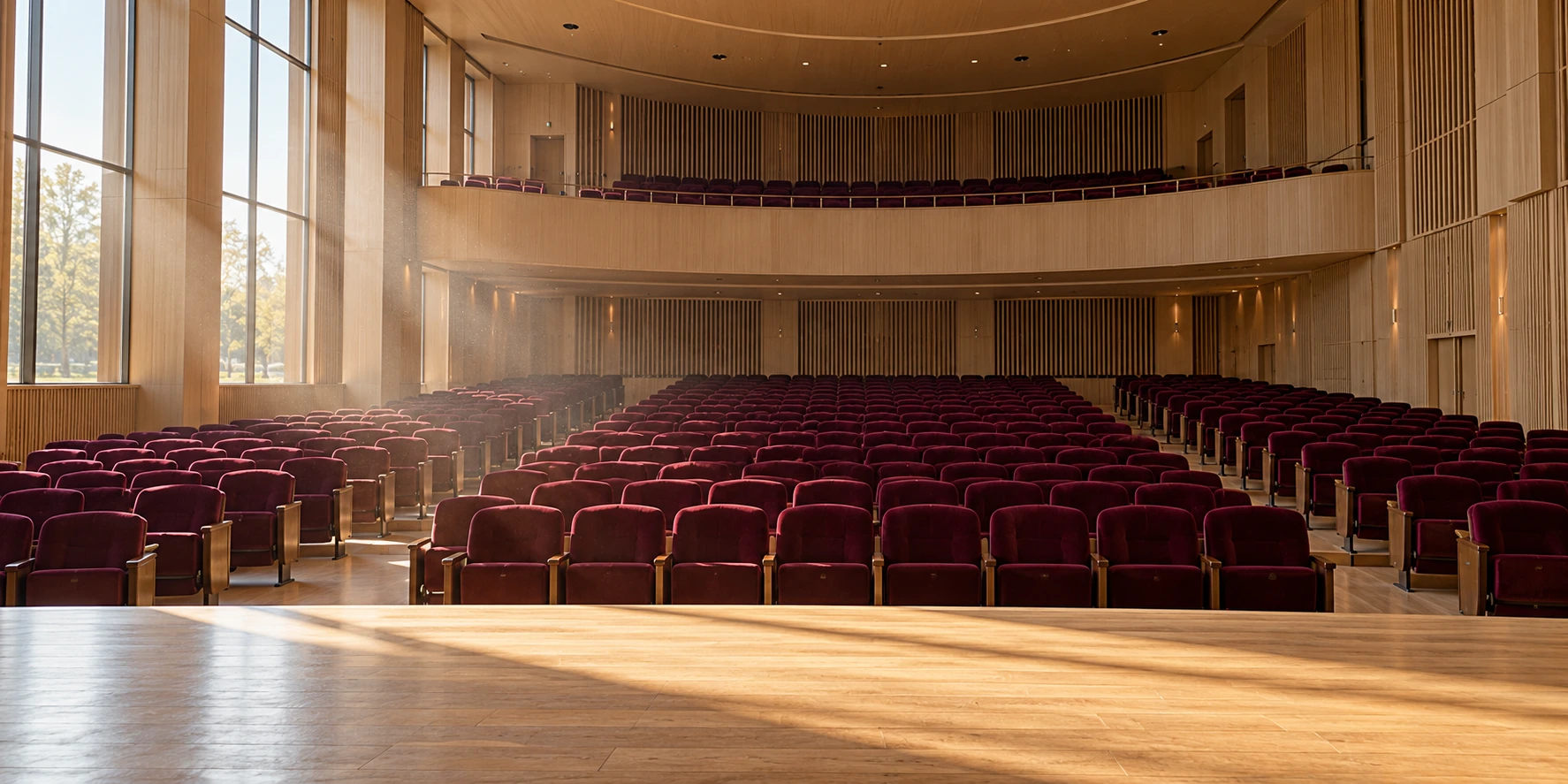
In dark midwater, a giant larvacean can look like a small animal occupying an enormous piece of invisible architecture. The tadpole-like body is only the most obvious living part. Around it lies a mucus house whose folded filtering structures can be far larger than the animal itself.
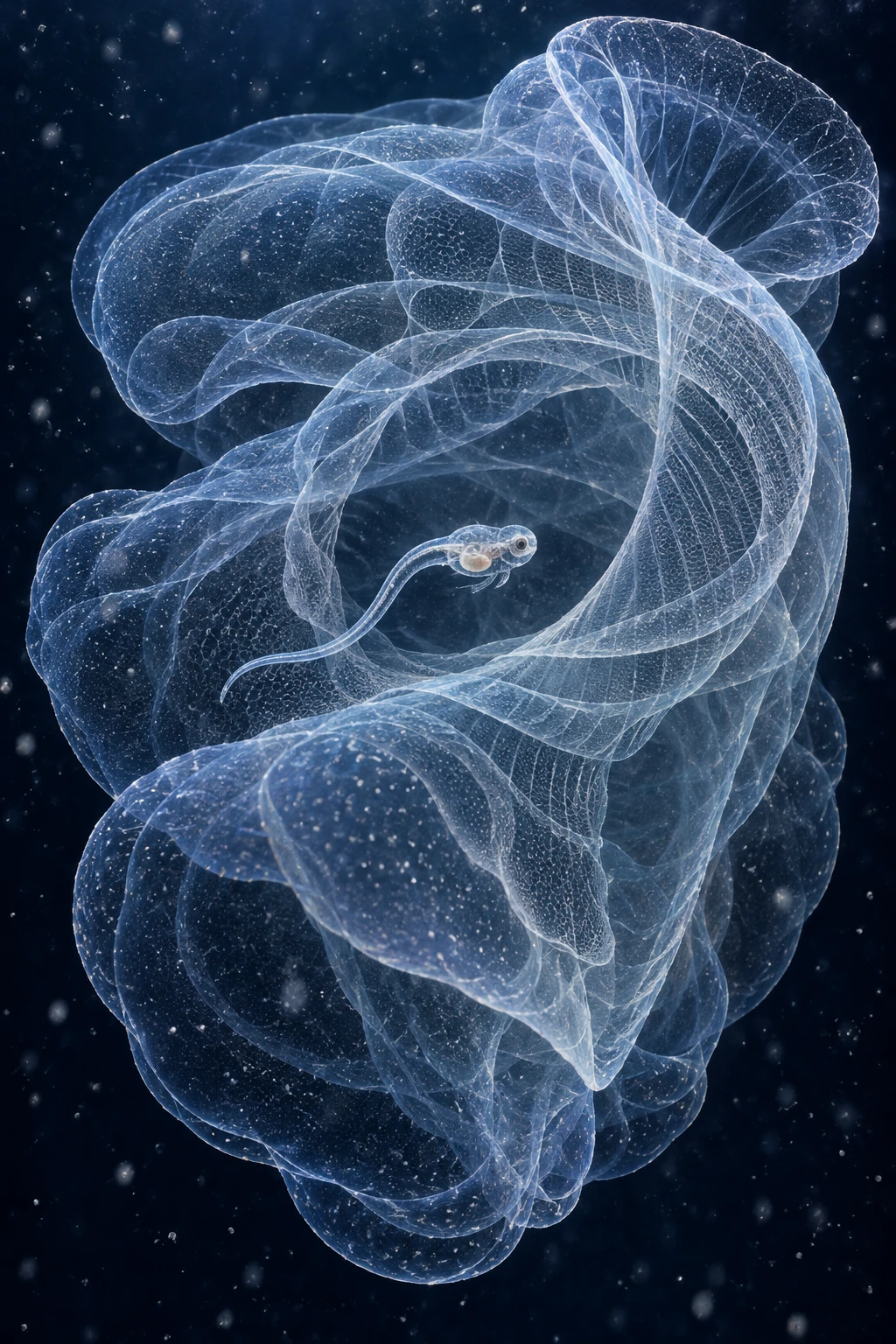
“House” is a useful word, but it can mislead if it suggests a sealed shelter. This is working feeding equipment. Water moves through the arrangement, particles encounter filters and the animal's beating tail helps drive the flow. The form is part of how the animal eats.
It is also a difficult object to study. A delicate transparent structure suspended in seawater is poorly suited to being hauled up in a net and laid on a bench. Damage during collection can erase the very geometry a researcher wants to understand.
A house revealed by slices of light
The 2020 DeepPIV study used in situ laser imaging to reconstruct three-dimensional mucus forms. A thin sheet of light revealed successive sections through the larvacean's house. Combining those sections made it possible to examine internal shapes that ordinary views could leave ambiguous.
The resulting model is not simply a prettier photograph. It lets researchers ask how channels, chambers and surfaces connect. A pale edge in one view might be a boundary, a fold or an overlap. A three-dimensional reconstruction can help distinguish those possibilities.
The MBARI account and film show the animal within a two-tier feeding system, including an inner filter. The institution also describes the skilled vehicle piloting needed to scan an object while both the animal and surrounding water move. The measurement has to preserve the system long enough to observe it.
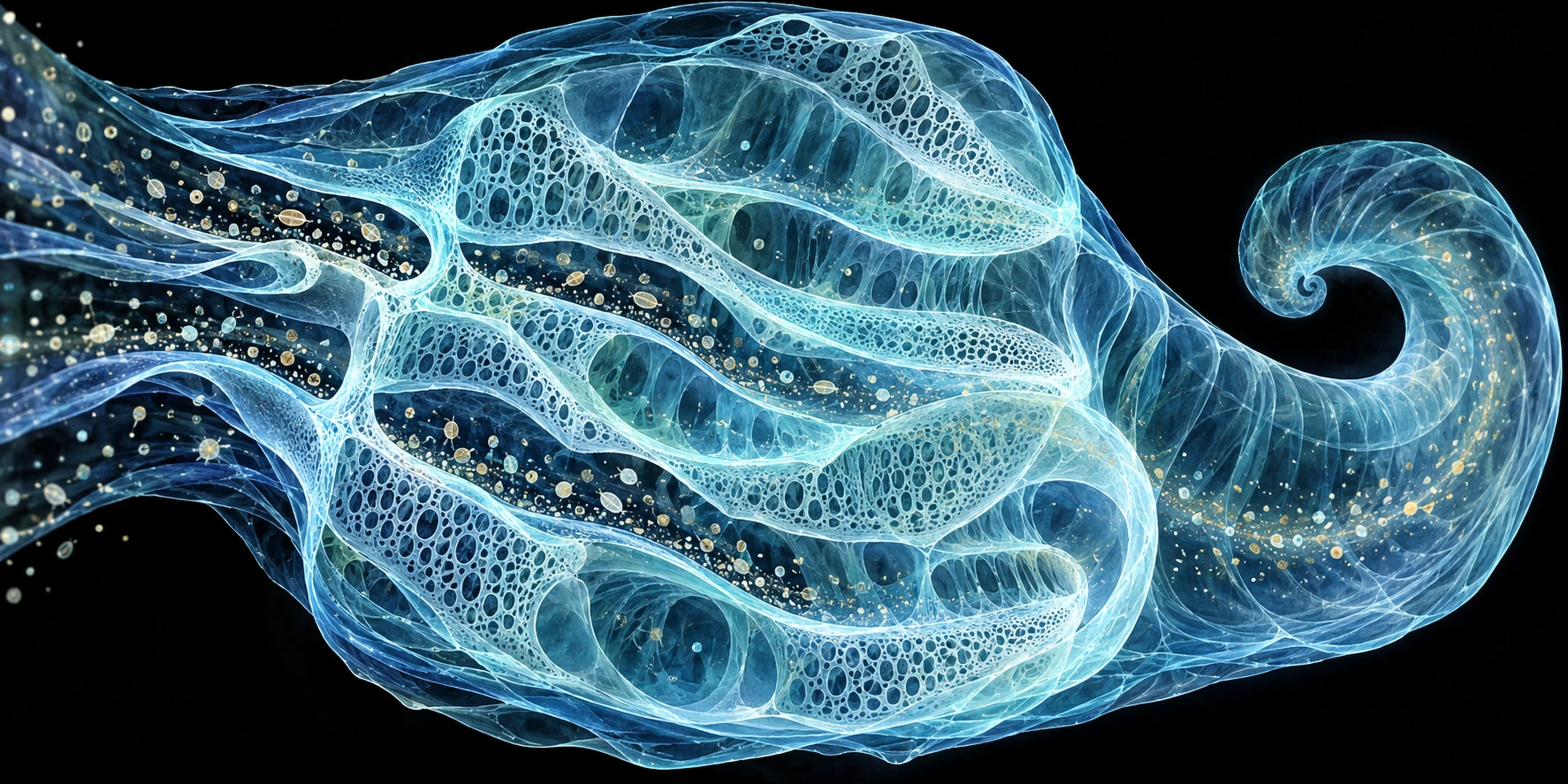
The artwork above offers a visual impression of delicate channels. Its shapes are not a substitute for the research reconstruction. For the actual geometry, use the linked film and paper figures; that is where the measured structure enters the story.
Watch the film twice
On the MBARI page, open the reconstruction video with the sound at a comfortable level. The first viewing is for orientation. Locate the small animal, the tail region and the much larger filtering arrangement. Resist the urge to treat every luminous surface as part of the animal's skin.
On a second pass, follow one channel through the virtual view. Ask where water can enter, where it passes a filter and how the animal sits in relation to that route. Pause when a cutaway appears. A cutaway can remove a wall from the display to reveal the interior; it does not mean the living house has the same opening.
Finally, distinguish three kinds of moving image: footage of the animal, a laser section and a rendered reconstruction. Each can be scientifically useful. They answer different questions, and the transitions between them are part of understanding the film.
How much water is a meal?
A 2017 study measured filtration in living giant larvaceans using particle motion illuminated by DeepPIV. It combined individual measurements with a long-term abundance record to estimate their regional grazing impact. That combination explains how an inconspicuous organism can matter to the movement of material through a water column.
Measured flow is not identical to food swallowed. Water can pass through a system while only some particles are retained, and some retained material can remain in the house. The animal's feeding performance depends on more than the number of liters processed.
The fictional calculation sheet below separates those stages. It assumes a filter processes 40 liters per hour for a quarter-hour, encounters 500 particles per liter, retains 40 percent and ingests half the retained particles. These numbers are invented for arithmetic, not measurements or fitted parameters for Bathochordaeus.
A fictional filtration budget
Five explicitly invented scenarios distinguish water processed, particle encounters, retention and ingestion.
The calculation yields 10 liters processed, 5,000 particle encounters, 2,000 retained particles and 1,000 ingested particles. Halving retention halves the last two quantities while leaving water volume unchanged. Changing particle concentration alters the encounter budget without changing the animal's pumping rate.
This distinction prevents a common shortcut in stories about filter feeders. “Filters a great deal of water” is not automatically “eats everything in that water.” Nor does repeated processing of a water volume establish that every original particle has been captured. Real flows can revisit water, and capture depends on particle properties.
A disposable structure keeps moving after use
As MBARI describes, clogged houses are abandoned. The discarded structures can sink with accumulated particles and become food for other animals. A feeding surface thus changes roles: first part of an active animal's equipment, later a package of material moving through the habitat.
That gives the word “disposable” a different ecological meaning. The larvacean may leave the structure, but it has not ceased to matter. Its material and captured particles enter other interactions. A house's biological career can outlast the occupancy that created it.
Separate 2017 feeding experiments showed giant larvaceans could take up experimental microplastic particles and package ingested material into fecal pellets. The work identified a biological route for particle transport. It did not show that plastic was destroyed or rendered harmless, and it did not establish the global share transported by larvaceans.
The food-capture system does not sort the ocean according to a human category of desirable and undesirable material. An introduced particle can enter a route that already moves organic matter. Following the particle's fate is therefore more informative than declaring the animal an ocean-cleaning device.
The fragile object is part of the animal's reach
A museum specimen may preserve a body while losing the equipment around it. The larvacean story shows how much can vanish in that separation. The larger filtering structure influences the animal's contact with food, surrounding water and other particles.
It also shows why a new observation method can change natural history. Laser sections, particle tracks and three-dimensional reconstruction expose relationships that an isolated collected body cannot reveal. Better knowledge comes from keeping the organism within the setting where its unusual material works.
Look again at the small body in the large transparent house. The apparent empty space is doing work. Water, mucus, movement and suspended food form a temporary arrangement, one that will eventually be abandoned and continue its journey without its builder.
Sources and further reading: New technology reveals giant larvacean carbon cycling (2017); Revealing enigmatic mucus structures using DeepPIV (2020); MBARI: Reconstructing an animal’s intricate feeding filter; MBARI: Bathochordaeus in the 2018 annual report; From the surface to the seafloor: microplastic transport (2017).
Explore all 80 new articles · Browse the complete illustrated collection
Explore more art, ideas, and independent projects at Incoprea.