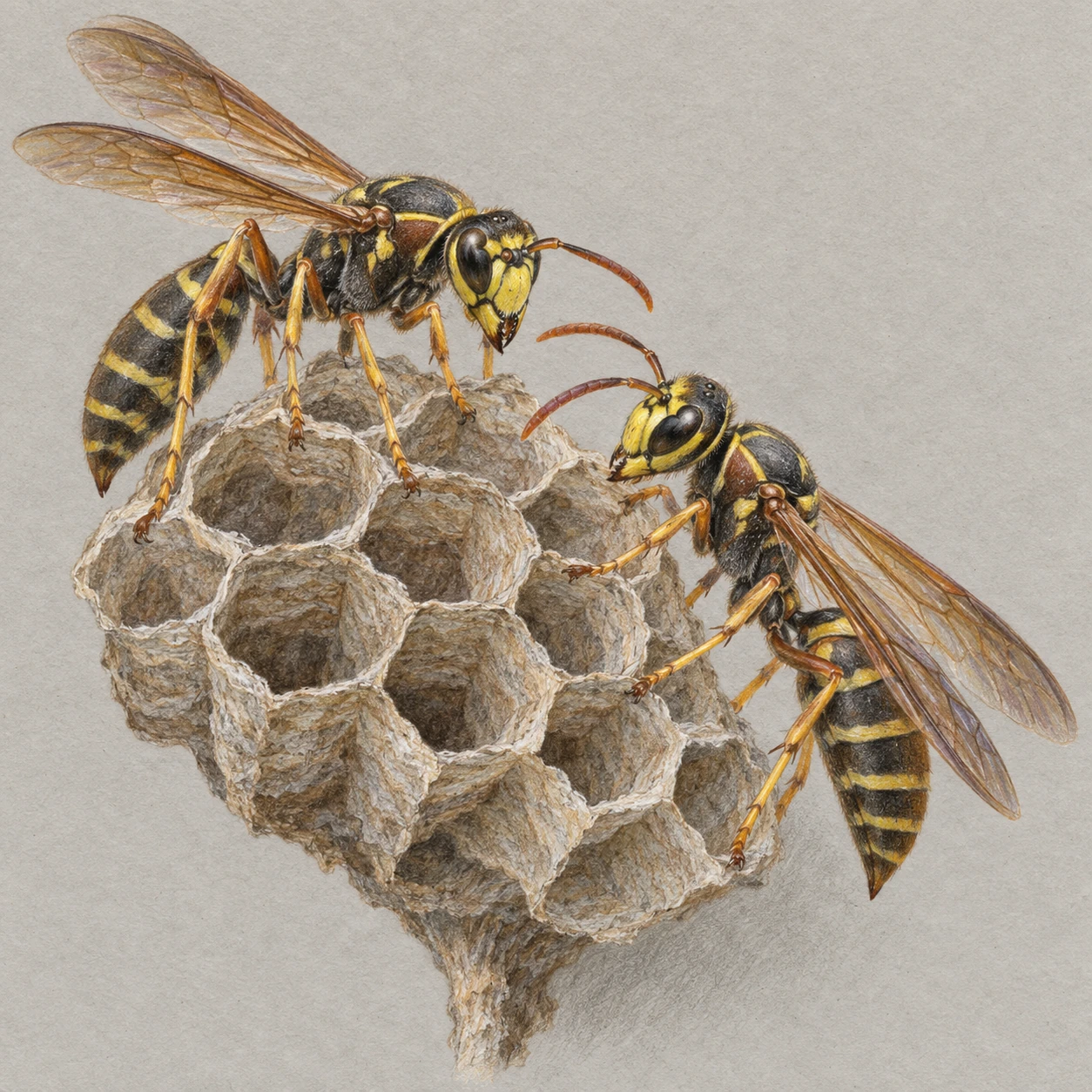
From a distance, two paper wasps on a nest can seem interchangeable. Close photographs reveal different yellow and black markings across their faces. In some populations of the northern paper wasp, Polistes fuscatus, those patterns help individuals recognize one another.
This is a narrower and more interesting claim than “wasps recognize faces.” Which species, which faces and which conditions are all part of the result. The research follows how a specific social task can be associated with specialized visual learning.
A 2011 study found that P. fuscatus learned to distinguish normal wasp-face images more rapidly and accurately than manipulated faces or nonface images. The close relative P. metricus did not show the same specialization in that comparison. Small evolutionary distances can therefore contain substantial differences in a cognitive task.
The whole face changes the task
One way to recognize a pattern is to identify an isolated feature. Another is to process features in their usual arrangement. A 2021 experiment used a part-whole comparison to investigate that distinction.
The researchers standardized the outer parts of the images, while the informative differences remained in the central face. If the central features alone supplied everything needed, presenting them without the whole context should preserve performance. Instead, P. fuscatus showed an advantage for its own species' whole faces, consistent with holistic processing. The effect did not generalize to every tested species or stimulus.
The word “holistic” need not be mysterious. Here it names an experimental pattern: an informative part works differently when presented within the familiar whole. It does not establish that a wasp's experience is identical to a person's experience of recognizing a friend.
Color is part of the information
A color study compared normal colored face images with grayscale versions of the same images. The tested wasps performed better with color. Grayscale-trained animals did not exceed chance in that task. The result suggests that removing color did more than make a familiar picture slightly less vivid.
This is a useful lesson for anyone comparing animal photographs. A transformation that looks minor to a person can remove a cue important to the animal. An experiment must be designed around its receiver's visual system, rather than around our intuition about which details are equivalent.
Experience belongs in the account
A 2024 study manipulated the amount and timing of social experience. Normally social wasps learned and remembered individual faces better than isolated animals. Within the tested schedules, early isolation was not more disruptive than later isolation. The researchers found flexibility rather than a single early sensitive window.
The result guards against treating a species label as a complete prediction of an individual's performance. Developmental experience can affect the skill being measured. It also keeps “specialized” from becoming a synonym for “entirely independent of learning.”
Read the part-whole experiment as a small logic puzzle
Suppose two images differ only in their centers. The surrounding parts are identical. A feature-only account predicts that removing those uninformative surroundings should leave the useful differences available. A whole-pattern account allows performance to fall when the context disappears. Ask which image changes are controlled, which outcome is measured and whether a second species responds the same way. The puzzle concerns the logic of the published test, not a test you need to perform on an insect.
Sketch the comparison as labeled boxes rather than drawing substitute faces. Put the same central difference into two contexts, then write the competing predictions underneath. This keeps attention on what information changed. It also prevents an attractive illustration from being mistaken for a controlled stimulus.
There is no need to approach or disturb a nest to appreciate the finding. The papers' stimulus figures provide the appropriate close view. Compare their carefully controlled images with the illustration here, which is simply a natural-history scene and contains no experimental clues.
A paper nest can thus be imagined as a society of particular individuals rather than identical moving dots. Their recognition task has its own visual details, its own developmental conditions and an evolutionary history that cannot be guessed from brain size alone.
Sources and further reading: Specialized face learning in paper wasps (2011); Holistic face processing in Polistes paper wasps (2021); Color is necessary for face discrimination (2023); No sensitive period for development of face learning (2024).
Explore all 80 new articles · Browse the complete illustrated collection
Explore more art, ideas, and independent projects at Incoprea.