Following a European eel across the Atlantic sounds like a problem a satellite ought to settle. Attach a tag, draw the line and wait for the destination. In practice, the tag records only certain things, the animal spends time far below the surface and the final biological event can remain unseen even when the journey becomes clearer.
The distinction matters because two common stories are equally unsatisfying. One declares the eel's reproduction entirely unknowable. The other treats a point inside a presumed breeding region as a camera view of spawning. The research offers a more substantial story between those extremes.
First, leave the continent
A European eel's journey begins from many possible continental and coastal settings. The departure is therefore not one synchronized exit from one river. A 2025 biotelemetry meta-analysis combined 2,306 eels from 18 water bodies. It examined freshwater and transitional systems, finding earlier arrival at sea among eels from higher latitudes.
The scope is important. “Arrival at sea” is not arrival at the spawning area. The study reveals organization in an earlier stage of migration, while the oceanic stage poses different tracking problems. A large sample in one phase does not automatically provide observations of the next.
This is also a useful way to read a life-cycle diagram. Its arrows can look equally well known, although each may rest on a different method. A river receiver detecting a tagged animal and a larval net sampling the ocean are not watching the same event.
Then follow a depth-changing traveler
The 2016 electronic-tagging study received 206 datasets from 707 tagged eels and reconstructed detailed routes for more than 80 animals. Tracks extended toward the Azores, and the eels showed daily depth changes: deeper during the day and shallower at night. Some migrations ended through predation.
The timing and speed evidence also challenged a simple assumption that all autumn migrants must spawn the following spring. The authors proposed a mixed strategy in which some individuals could arrive later. That is a hypothesis informed by combined observations, not a record of each tagged eel eventually reproducing.
Imagine reading one animal's record as a diary written in pressure and temperature. It can reveal recurring changes without describing what the animal sees. The instrument does not automatically identify a navigational cue, a mate or a reproductive act. Choosing a tag means choosing which questions it can answer.
The Azores study closes an important gap
In 2022 research, satellite tags were attached to 26 eels from the Azores. Twenty-one tags supplied substantive records. Five pop-up locations fell within Sargasso Sea boundaries, and one was within the presumed breeding area used in the paper. This supplied direct evidence of adult European eels reaching that region.
The paper explicitly distinguished that advance from sampling eggs or spawning adults there. It also did not demonstrate the exact navigational mechanism. A tag in the right region strengthens a migration account while leaving the last reproductive chapter open in that dataset.
The recorded durations ranged from 40 to 366 days. The distance and speed figures in the paper are not interchangeable with a continuous camera record of swimming. Pop-up positions, stored measurements and reconstructed routes each contribute a different kind of information.
A line on a map can hide several journeys
The downloadable route worksheet uses a fictional, flat-coordinate example. An animal starts at (0,0) and ends at (300,400), with distances measured in kilometers. The straight-line separation is 500 kilometers. A route via (0,400) is 700 kilometers. Both share the same endpoints.
Two routes, the same endpoints
A fictional arithmetic worksheet distinguishes displacement, route length and average rates.
Give both journeys 100 days. Dividing endpoint separation by time yields 5 kilometers per day. Dividing the longer route's path length by time yields 7. Those are different quantities even before allowing for vertical travel or moving water. The worksheet does not estimate a real eel's speed; it shows why the label on a reported distance matters.
Now remove the intermediate point. Which number can you still calculate confidently? This is the everyday reasoning behind a technical limitation. A neat drawn line between observations can be useful without being a literal record of the intervening path.
It is similarly important to distinguish the animal from a detached tag. Once a tag reaches the surface, it can drift before or while transmitting. Tracking papers describe how they interpret such records. A map symbol should be read with its method, rather than as an unquestioned location of a living animal at every moment.
Keep a ledger of the unanswered questions
| Observation | What it helps establish | What it does not show alone |
|---|---|---|
| River or estuary detection | Timing of passage at a monitored location | Arrival in the oceanic breeding region |
| Depth and temperature record | Conditions and changes during the deployment | The eel’s navigational intention |
| Oceanic tag endpoint | A location associated with the end of tracking | A complete continuous route |
| Adult reaches presumed spawning region | A major migration link | Direct observation of spawning |
The table is not a list of reasons to distrust the work. It explains how the pieces fit. A study can answer one major question while making the next one sharper. That is a more satisfying form of progress than expecting one tag to settle an entire life cycle.
For a reader following future eel discoveries, the useful habit is to ask what new observation was added. Was it a route, an endpoint, a younger life stage or a directly witnessed event? Each would change the account in a different way.
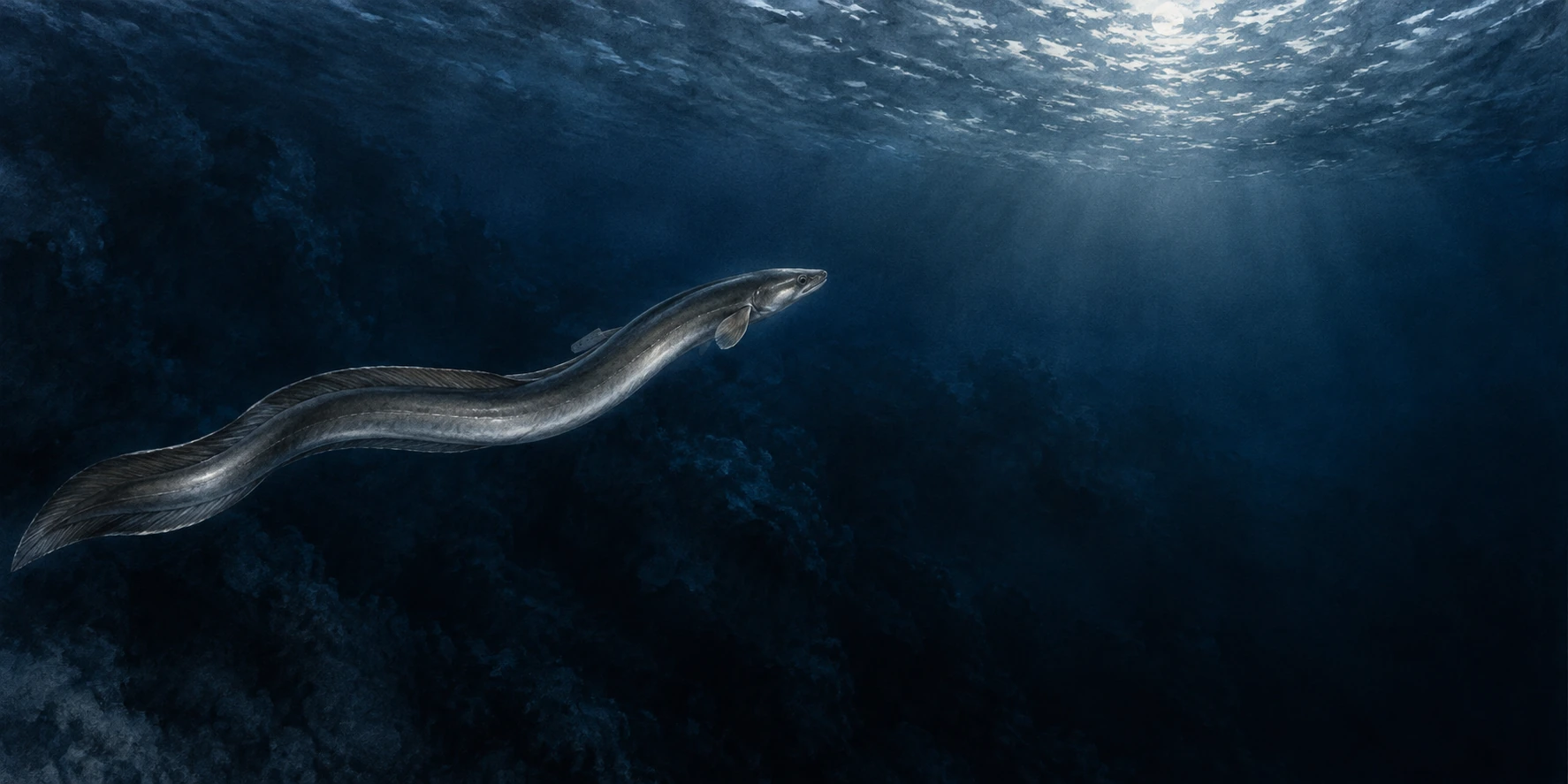
The eel swimming into dark water remains a compelling image. Its force comes partly from the distance and partly from the gap between where an instrument can follow and what biology still asks us to find.
Sources and further reading: Empirical observations of the spawning migration of European eels (2016); First direct evidence of adult European eels reaching their breeding region (2022); The seaward migration of European eel at a continental scale (2025).
Explore all 80 new articles · Browse the complete illustrated collection
Explore more art, ideas, and independent projects at Incoprea.