Look down into a still zoetrope and you see a ring of drawings. Spin it while looking over the rim and the drawings can blur together. Lower your eyes to the slits, and the same strip can become a bird flapping or a figure stepping. The difference is not hidden in a new set of pictures. It is in when you are allowed to see them.
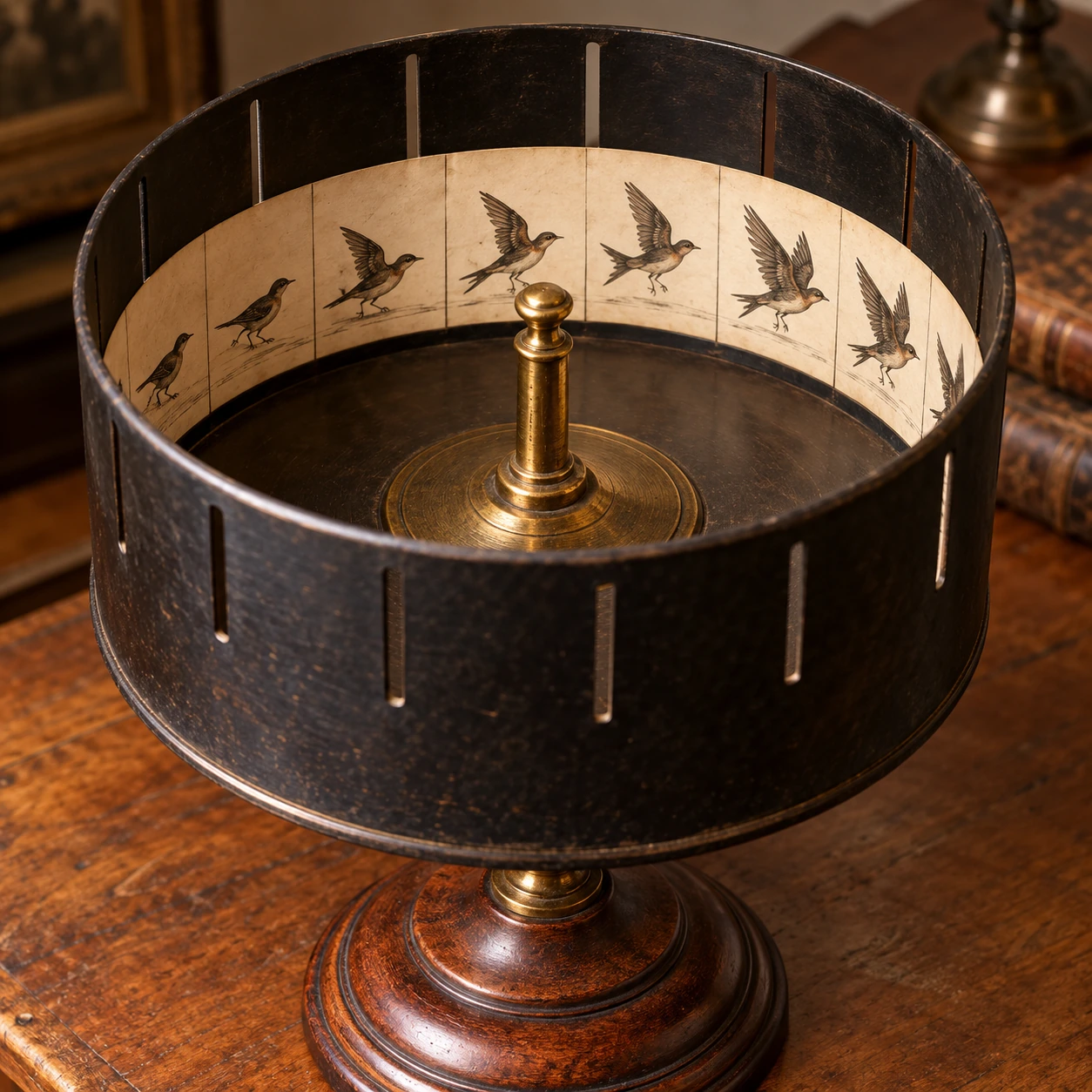
A zoetrope combines a sequence with a viewing mechanism. The sequence supplies changing poses. The slits break the view into brief glimpses. Both parts matter, and separating them makes the toy much more interesting than a vague claim that the eye is easily fooled.
First inspect the poses without moving anything
The Science Museum Group's zoetrope record describes an optical toy in which several people could look through the drum's slits. Its replaceable picture strip is a small piece of organized time: a cycle is spread out as neighboring images.
Choose a documented strip in the collection photographs and follow one feature from pose to pose. A foot might rise, move forward and return. Do not begin by asking whether the drawings are beautiful. Ask whether their differences create a usable sequence.
Now consider the join between the last drawing and the first. A looping action needs that transition too. An excellent run of intermediate poses can still produce a visible jump if the cycle's end does not meet its beginning.
Then inspect the interruptions
The vertical openings in a traditional drum let the viewer see brief samples of the opposite inner strip. Between openings, the dark wall blocks the view. Without that interruption, a rotating drawing would sweep across the eye for longer and become harder to separate from its neighbors.
This does not reduce motion perception to one simple “persistence of vision” switch. The apparatus supplies changing visual information, and the visual system interprets the sequence. Timing, contrast, spacing and the relationship among poses all influence what is seen. There is no single magic frame rate that explains every toy and every viewer.
For a paper exercise, make a list of eight positions of a dot moving around a circle. The dot is a diagram, not a character you need to draw well. Read the list from start to finish, then change the fourth position so it jumps across the circle. You have altered the sequence while leaving the number of positions unchanged.
A modern version uses light as a gate
The National Science and Media Museum's exhibit sheet discusses a modern work by artist Akinori Goto. Narrow strips of light illuminate different poses as the object rotates. Instead of relying only on a viewer peering through a traditional drum, the exhibit controls which parts of the structure become visible.
That is the revealing comparison. One apparatus blocks your view between glimpses; another controls the illumination. Both organize access to separate stages of an action. The materials and experience differ, even though the problem of presenting a sequence remains.
The History of Science Museum's Animate It project offers another route into learning through animated instrument stories. If you open an external demonstration, choose a short segment and pause it. Identify the separate physical or drawn states before watching them form an action.
Three questions for a moving image
What changes between samples? What separates one sample from the next? What happens at the loop? Those three questions work on a zoetrope, a flipbook and a short digital animation, while leaving room for each medium's particular mechanism.
A flipbook, for example, does not need a rotating drum. Its pages hide one drawing as another arrives. A digital display uses different hardware again. Calling all of them “the same trick” can conceal the useful engineering differences that determine how the sequence is presented.
Try watching in two passes
First watch an ordinary, non-flashing animation for its action. Then pause and advance through frames if the player supports it. Notice whether the animator uses equal distances between positions, holds a pose or changes the apparent spacing to suggest acceleration. A sequence is designed; it need not be evenly divided.
There is no need for rapid strobing or a full-screen flashing demonstration to explore this subject. A static strip and a controlled pause already reveal much of the craft. If a moving display is uncomfortable, stop and use still images.
The zoetrope's satisfying moment is the instant a row of separate drawings becomes an apparent action. Its deeper invitation is to look back at the drum and notice the missing intervals. The dark parts, as much as the pictures, help the movement arrive.
Sources and further exploration: Science Museum Group: zoetrope; National Science and Media Museum: zoetrope exhibit; Oxford History of Science Museum: Animate It.
Explore all 50 new articles · Browse the complete illustrated collection
Explore more art, ideas, and independent projects at Incoprea.