The plant is pale. The surrounding paper is deep blue. A delicate branch seems to have left its shadow behind, yet the image preserves details too fine to dismiss as a simple silhouette. A cyanotype asks you to read the space around an object as carefully as the object itself.
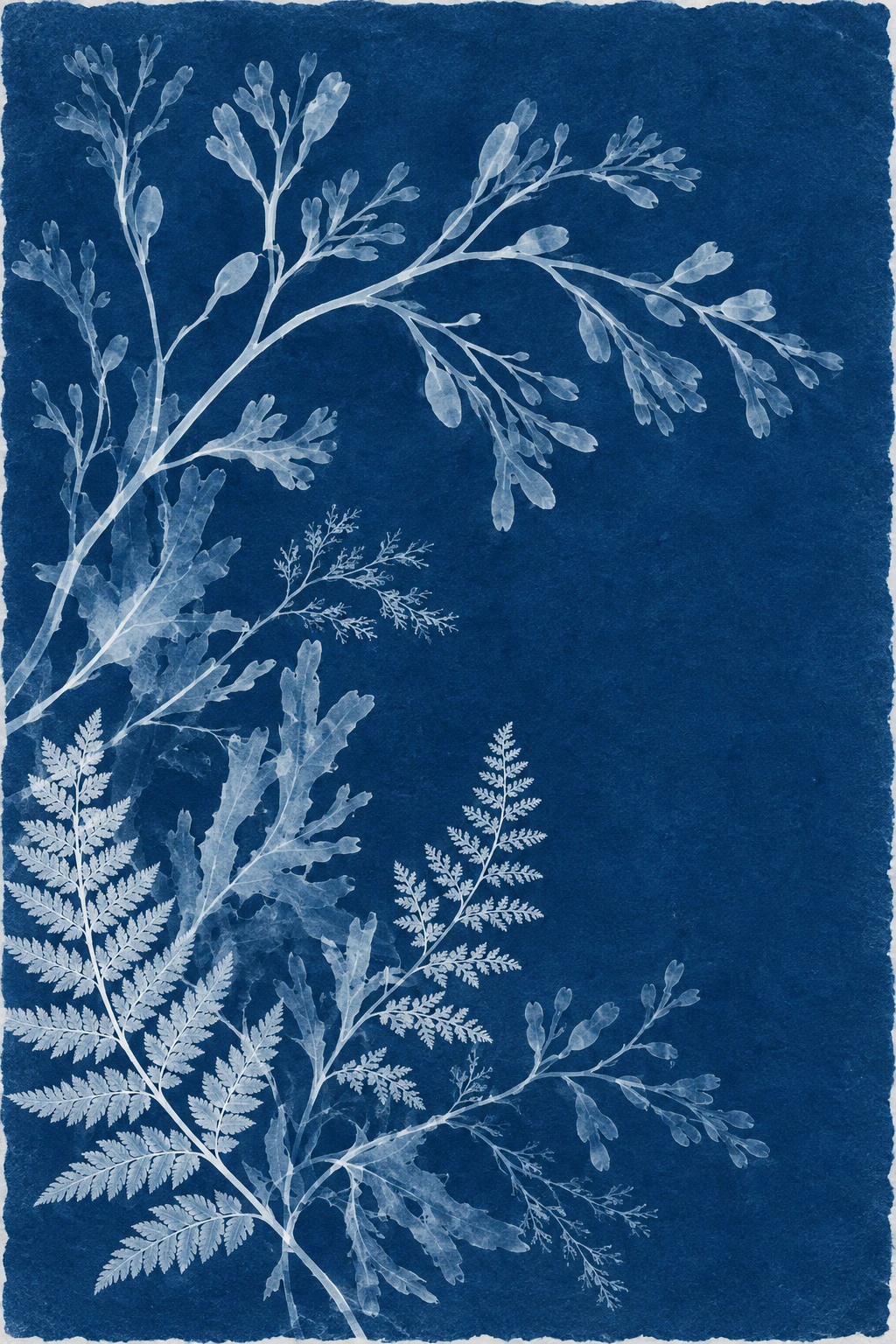
Anna Atkins made that reversal into an extraordinary way of presenting botanical specimens. Her pages belong to the history of photography, but they also reward the attention we give to a herbarium sheet, a carefully arranged drawing or a handwritten gift.
A specimen on a light-sensitive surface
The Victoria and Albert Museum's account of cameraless photography explains that Atkins used cyanotype paper and placed botanical material in contact with it. Light affected exposed regions, and washing developed the characteristic blue image. No camera lens was required to draw the plant's outline.
Opaque parts blocked more light. Translucent parts allowed some through. That difference can produce tonal information within the outline, rather than a uniform white cutout. Contact and the specimen's physical structure both contribute to the result.
Start with the reproduction of a real Atkins print on the museum page. Choose a thin part and a dense part of the specimen. Does one show more tonal variation? Before guessing why, note whether overlapping material, different thickness or an image reproduction might also affect what you see.
Making a book one contact at a time
The New York Public Library's record of Photographs of British Algae describes a self-published work issued in parts, beginning in October 1843. Atkins arranged, exposed and developed photograms of a large body of specimens. Her work joined a photographic process to the problem of communicating botanical form.
A contact process also makes the page's arrangement a physical event. The specimen must occupy a position during exposure. A branch that crosses another branch can hide information; a crowded page can make comparison harder. Composition is therefore both an aesthetic choice and a decision about what another person will be able to inspect.
Imagine arranging three leaves for someone who has never seen their plant. Would you overlap them to create an elegant shape, or separate them to make every edge available? There is no need to pick one aim forever. The interesting question is which aim your particular page serves.
One process, more than one purpose
The V&A's discussion of Atkins's gift to Anne Dixon focuses on later botanical images associated with friendship. The collection includes fescue grasses, dandelion and poppy studies. These pages invite us to see the work as a material exchange between people as well as a record of plants.
That dual role is familiar. A photograph can document a specimen and also be a carefully chosen gift. The presence of scientific information does not cancel composition, and a beautiful arrangement does not make the plant irrelevant. Atkins's cyanotypes are compelling because those purposes can coexist on one blue sheet.
A close-looking exercise without chemicals
Place a translucent leaf or a small piece of thin fabric on white paper near a window. Observe the object itself, then its shadow under ordinary room light. You are not making a cyanotype. You are separating two questions: what shape does the object occupy, and how does it transmit or block light?
Now look again at an Atkins reproduction. Identify one feature that seems connected to an outer contour and one that seems connected to transparency. Keep the comparison modest. A shadow on your desk is not a chemical print, but it can train attention to the properties the print records.
If you choose to try cyanotype later, use a prepared kit and its instructions. Exposure and washing conditions depend on the material. This article's illustration is a modern composition inspired by the process, not a recipe, an authenticated Atkins page or a botanical identification aid.
Three things the blue cannot tell you by itself
A blue background does not establish a plant's original color, its complete three-dimensional structure or its scientific identity. Labels and specimen knowledge add information the image alone cannot supply. Ask what has been recorded and what has been intentionally transformed.
Leave the page open for a little longer than a quick scroll would allow. Follow a branch into an overlap. Notice the way empty blue spaces hold the specimen apart. The process has replaced natural color with a striking constraint, and within that constraint an individual arrangement becomes wonderfully clear.
Atkins's achievement was not merely making plants look blue. It was finding a repeatable encounter among light, paper and a specimen, then using that encounter to make pages worth studying and sharing.
Sources and further exploration: V&A: cameraless photography; NYPL: Photographs of British Algae; V&A: cyanotypes for Anne Dixon.
Explore all 50 new articles · Browse the complete illustrated collection
Explore more art, ideas, and independent projects at Incoprea.