Walk around a corner with a friend beside you. The person on the outside has farther to travel. Keep your shoulders aligned and that person must take longer steps or move their feet faster. A pair of driven car wheels meets the same geometrical problem, with the added complication that both wheels are connected to one power source.
Joining them with one rigid shaft would make agreement compulsory. The road, however, asks for different distances. An open differential solves this disagreement with a surprisingly compact promise: the two outputs may change speed, provided their average continues to match the carrier that drives them.
Find the moving reference frame
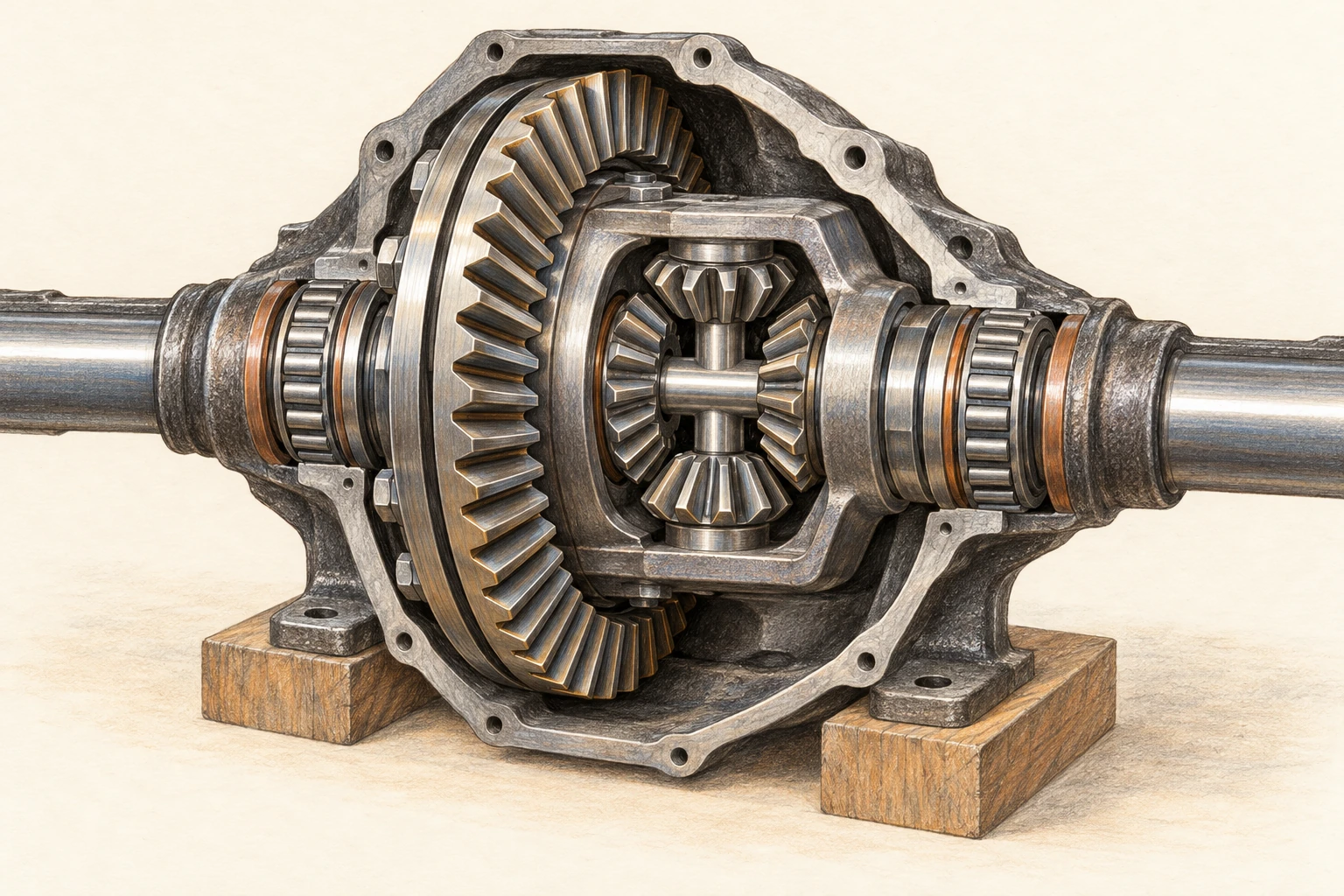
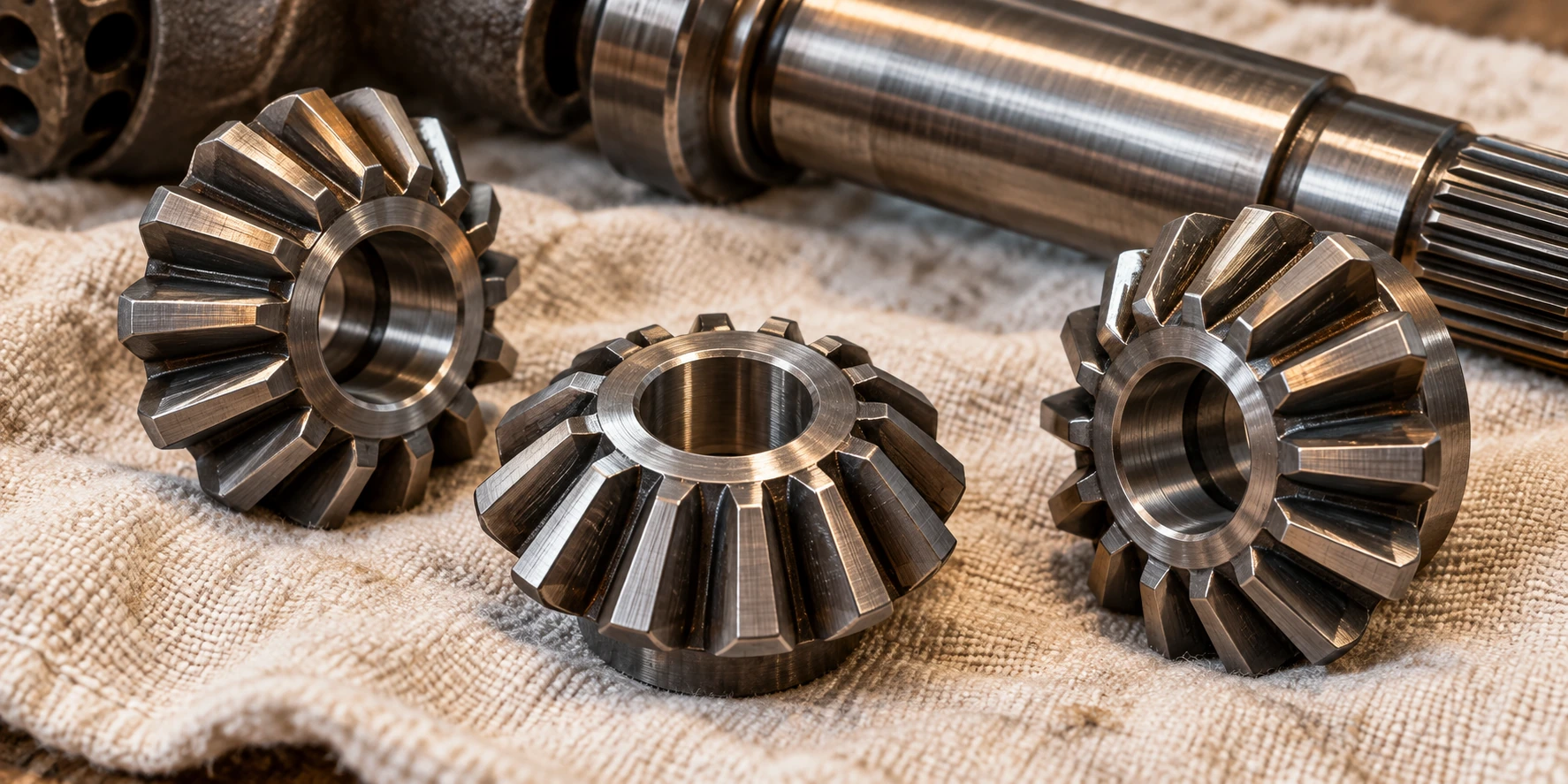
In a familiar bevel-gear design, a large ring gear turns a carrier. Inside it, small pinion gears mesh with side gears connected to the two axle shafts. The small gears travel around with the carrier. They can also spin within it. Those are two different motions, and confusing them makes the mechanism look more mysterious than it is.
When both outputs turn equally, the small gears can travel with the carrier without rotating relative to it. When the outputs differ, those gears rotate within the moving carrier. MIT's mechanism explanation follows these two cases and gives the useful relationship: carrier speed equals half the sum of the two output speeds. All three speeds must use the same units and reference convention.
One average, many possible pairs
Suppose a fictional demonstration model holds its carrier at 100 revolutions per minute. Both outputs at 100 rpm satisfy the rule. So do 80 and 120. So do 0 and 200. The last pair is not a recommendation for operating a car; it is simply another solution to the same mechanical constraint.
| Left output | Right output | Their average |
|---|---|---|
| 100 rpm | 100 rpm | 100 rpm |
| 80 rpm | 120 rpm | 100 rpm |
| 0 rpm | 200 rpm | 100 rpm |
Now imagine changing only the left output from 80 to 70 while keeping the carrier fixed. What must happen on the right? It rises to 130. The small gears do not choose a destination or measure the road. Their meshing geometry admits one change only alongside its complementary change.
Change the two wheel speeds
A constrained-speed calculator with readable values and no claim to simulate tire grip.
The model lets you change the carrier speed and the difference between the outputs. Begin with no difference, then increase it. Predict the missing number before looking. The bars represent speeds, not torque or traction; the interface deliberately keeps those quantities separate.
The road supplies the reason for the difference
In a turn with rolling tires of equal effective size, the outside wheel follows the larger arc. If a toy axle's two paths have radii of 9 and 11 units, the outside wheel must cover 11/9 as much distance in the same time. Their speeds therefore share that ratio. This is geometry imposing a demand on the two outputs; the differential provides the freedom to meet it.
Eaton's current open-differential overview shows that this principle is still relevant to electric vehicles. The examples include compact bevel and planetary designs. Electrification changes how power arrives at an axle; it does not remove the difference between the inside and outside arcs of a corner.
Freedom is useful, but it is not traction control
A speed relationship alone cannot tell us how much useful force each tire can transmit. An open differential also has an important limitation when the two road contacts offer very different grip. A wheel on a slippery patch can spin while the vehicle fails to make useful progress. A mathematically valid speed pair is not necessarily a successful journey.
Eaton's account of limited-slip systems explains why other differential designs restrict or manage the difference between outputs. Different mechanisms address that problem in different ways. Their behavior should not be inferred from the simple speed calculator here, which contains no tire-friction model, clutch pack, electronic control, or braking intervention.
Try to catch a misleading explanation
Someone says, “The outside wheel always turns twice as fast.” Ask what radius, speed, and turn they mean. A gentle bend requires a small difference. In our 9-and-11 example, the ratio is 11/9, not two. Another person says, “Both wheels are connected, so their speeds must be equal.” That overlooks the internal degree of freedom. Each statement loses the condition that makes the claim meaningful.
The next time you notice a vehicle making an ordinary corner, the hidden achievement is agreement without sameness. The power source can keep turning one carrier while two road contacts follow different paths. A small set of gears makes room for a difference the rest of the vehicle cannot avoid.
Keep exploring: MIT 2.972: how a differential works; Eaton: open differential designs; Eaton: differentials and electric vehicles.
Explore all 80 new articles · Browse the complete illustrated collection
Explore more art, ideas, experiments, and independent projects at Incoprea.