A small streetlamp looks ordinary while you stand beneath it. In a photograph it can acquire long, sharp rays, as if a tiny star has been installed above the pavement. The rays do not have to belong to the lamp. They can be a signature of the opening inside the lens.
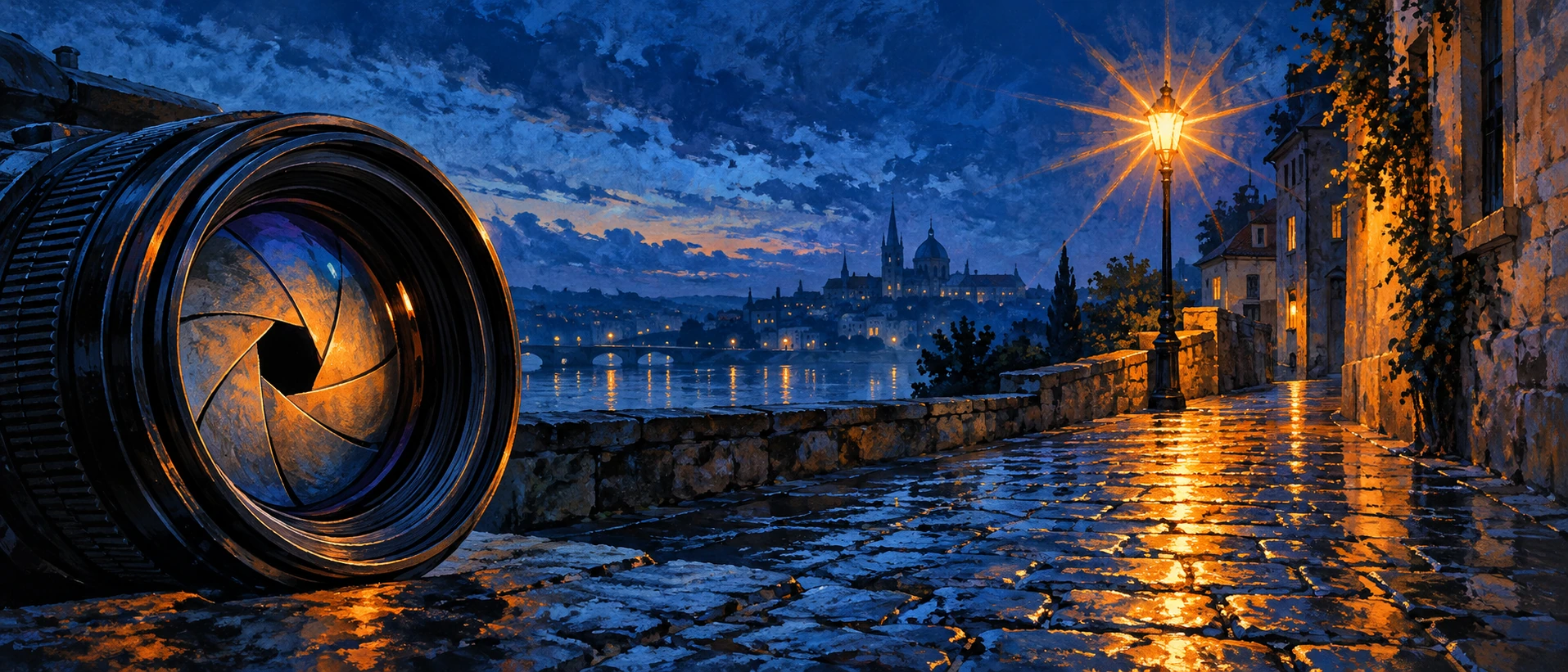
This makes the effect especially satisfying to investigate. The scene can stay nearly unchanged while the camera's treatment of it changes. Instead of asking whether the photograph is “what was really there,” ask which parts of the result describe the scene and which reveal the instrument that recorded it.
The opening has edges
A lens diaphragm uses overlapping blades to change the aperture: the opening through which light passes. Canon's diaphragm definition describes this mechanical iris. Open it widely and the blades leave a broad passage. Close it down and their edges shape a smaller one.
Light does not travel through that opening as an indefinitely narrow collection of perfectly independent rays. Diffraction spreads the response to a point of light. With suitable aperture geometry, the image develops recognizable spikes. Nikon's starburst guide recommends a small, bright source against darker surroundings and experimenting with smaller apertures. A distant night light provides a convenient subject without needing the Sun.
The number on the lens can run against intuition
A larger f-number means a smaller relative opening. Moving from f/4 toward f/11 closes the aperture down rather than opening it. That language matters when you compare photographs: “larger aperture” and “larger f-number” point in opposite directions.
Keep a record of what you changed. If you alter aperture, exposure time, focus, camera position, and image processing together, the comparison may look dramatic while explaining very little. A useful small experiment asks one question at a time. What changes when the opening changes and the framing remains fixed?
Count blades carefully; count rays more carefully
Canon's photographic guide describes a useful pattern: an even blade count commonly produces the same number of starburst rays, while an odd count commonly produces twice as many. Opposite parallel edges can place spikes on top of each other. An odd-sided opening lacks those same paired overlaps.
That rule describes an idealized geometry, not a guarantee that every point will be equally visible in your picture. Blade curvature, the chosen aperture, the brightness and size of the source, and the rest of the optical design affect the appearance. Counting faint rays in a processed image can be less reliable than the neat diagram in your imagination.
Predict before checking the manufacturer's example
A simplified six-bladed opening has opposite pairs of edges, so the usual count is six visible ray directions. A simplified seven-bladed opening usually gives fourteen. Now ask a different question: would a much brighter central patch help you count, or could it hide the bases of the rays? A photograph can make a theoretically simple count practically awkward.
A stronger effect is not automatically a better photograph
Closing the aperture further can make starbursts more pronounced, but diffraction also spreads image detail. Canon explicitly notes that very small apertures can soften the picture. There is a choice to make between the look of a light source and the rendering of the rest of the scene. The most interesting setting is the one that serves the picture you intend.
It is also worth separating a starburst from every other bright-light artifact. Reflections within a lens can create flare or ghost shapes. Camera movement can stretch a light into a trail. Deliberate star filters can add their own pattern. Several causes can coexist, so the presence of a ray is a starting clue rather than a complete diagnosis.
Once you notice the instrument's contribution, these night photographs become a small lesson in observation. A camera does not simply collect a finished image from the world. Its aperture helps make the image. A familiar lamp can tell you something new about a set of blades you rarely see.
Keep exploring: Nikon: adding star power; Canon: capturing sunbursts; Canon: diaphragm glossary.
Explore all 80 new articles · Browse the complete illustrated collection
Explore more art, ideas, experiments, and independent projects at Incoprea.