The receipt emerges while the shop assistant is already reaching for the next task. A row of letters, a total, perhaps a code: the little printer seems to have done the ordinary thing printers do. Yet in a direct thermal machine, no fresh ink has been deposited on that paper. The paper itself has been made to change.
That difference moves a crucial part of the printing system out of the machine and into the roll. A blank sheet is not necessarily an inert surface waiting for a mark. It may already contain the chemistry that makes the mark possible.
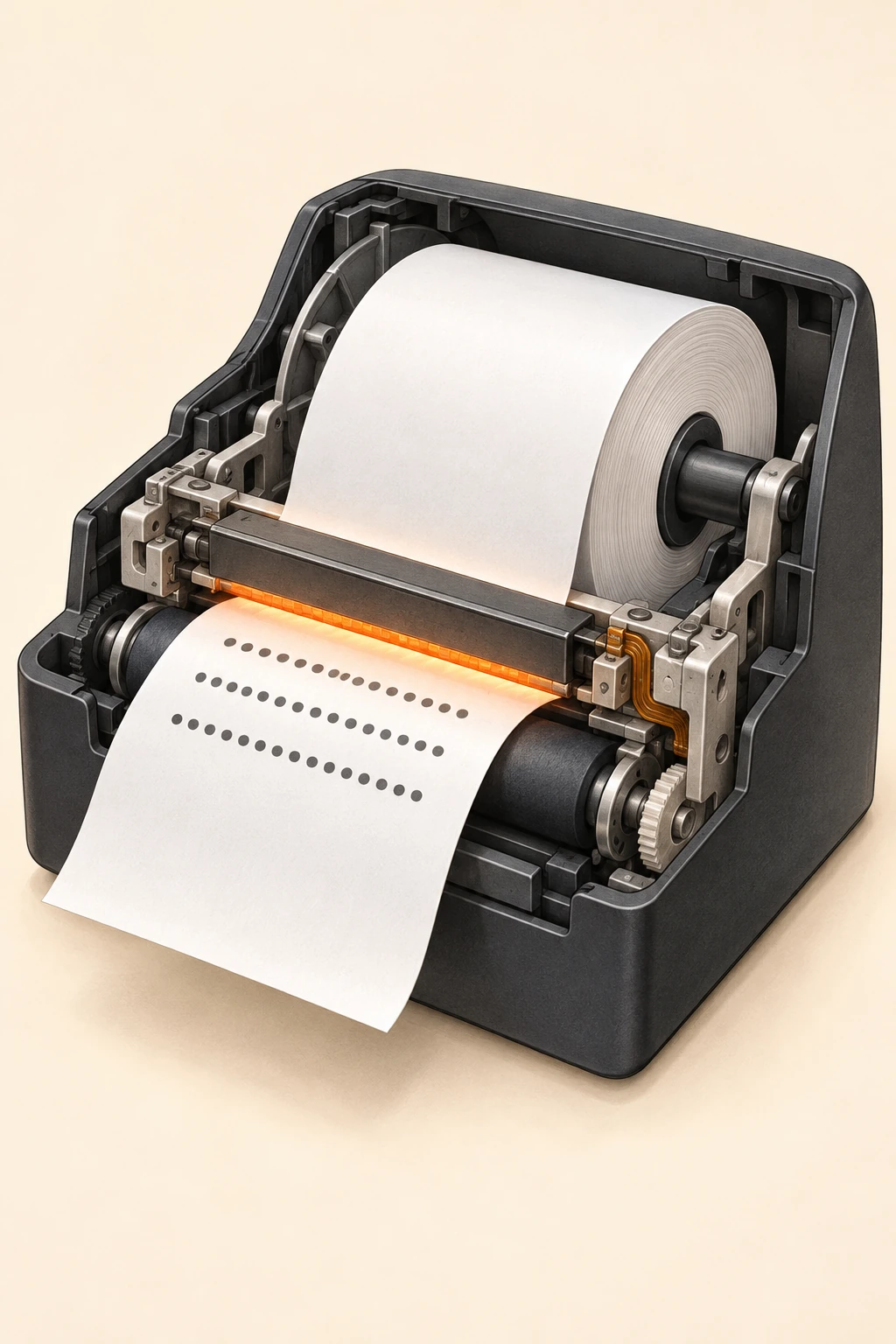
The picture is written one row at a time
A direct thermal printhead carries many small heating elements. Selected elements heat the coated media where it touches the head. As the paper advances, successive rows become a recognizable image. Zebra's technical glossary identifies the decisive feature: this method uses heat-sensitive media and no ribbon.
A row does not need to contain a whole letter. Imagine a deliberately crude letter made from a grid only five dots across. The first row may have a dark center; the next may have two separated dots; another may make a crossbar. Feed those rows past one fixed line of heaters and the accumulated pattern becomes a character. The motion of the paper supplies the other dimension.
Advance a tiny thermal printhead
A row-by-row dot demonstration with step/reset controls and a readable heater-state description.
Advance the toy printer one row at a time. The example is a large, readable teaching grid, not the resolution or firmware of a commercial device. Before pressing the next step, try to predict which heaters must be selected. The point is the relationship between one line of elements and a two-dimensional result.
Zebra's mobile-printer guide describes a densely packed head making graphics and characters as media moves past. Real print engines must also manage energy, paper movement, battery conditions, and print quality. The apparent simplicity of “heat these dots” leaves substantial engineering work in timing and consistency.
Two thermal printers can make marks differently
The word thermal alone does not identify the complete process. In thermal-transfer printing, heat moves material from a ribbon onto the receiving surface. Direct thermal printing instead changes a sensitive coating on the media. Looking only at the outside of a printer can conceal this difference.
| Question | Direct thermal | Thermal transfer |
|---|---|---|
| Where is the image-forming material? | In a sensitive media coating | On a ribbon that transfers material |
| Is a ribbon part of this process? | No | Yes |
| What does heat do? | Changes the coating locally | Helps release and transfer the ribbon material |
This is a comparison of mechanisms, not a promise that every label from one method will outlast every label from the other. Media formulations and the environment still matter. A durable-looking mark and a stable long-term record are different questions.
The unfinished chemistry of a finished receipt
A printout may look complete even though its surroundings can keep changing it. Heat or light can affect sensitive media after printing. Background darkening can reduce contrast, and printed information can fade. Different thermal papers do not age identically.
The US National Archives' paper guidance specifically notes variable thermal-paper stability and describes both darkening and fading. That is a useful correction to a simple story about a receipt “losing its ink.” In this printing process, the problem was never ordinary ink sitting on an otherwise passive sheet.
When the information matters, making an accessible copy while it remains readable is more useful than waiting for a rescue trick. The Archives' reformatting guidance explains the role of duplicate paper or digital versions for unstable records. A copy also needs sensible filenames and storage if you expect to find it later.
The little printer has solved one problem elegantly: it can make a readable image with a compact head and a specially prepared roll. It has not made the resulting object independent of chemistry or time. The receipt is a useful reminder that information can be easy to produce and surprisingly conditional to keep.
Keep exploring: Zebra: direct thermal glossary; Zebra: printing technology; US National Archives: paper-based records; US National Archives: reformatting paper-based records.
Explore all 80 new articles · Browse the complete illustrated collection
Explore more art, ideas, experiments, and independent projects at Incoprea.