Put on a pair of noise-cancelling headphones in a room with a steady hum. Switch the cancellation on without starting any music. The room may seem to recede. The headphones have not simply covered the hum with a louder sound. They have added a carefully controlled sound that reduces the pressure variation reaching a particular place.
The surprising word is added. A quieter result can require an active speaker, microphones, electrical power, and continual adjustment. Silence, in this small region, is something a system works to approach.
First separate the cushion from the calculation
An earcup already blocks some outside sound by its physical construction and fit. That is passive isolation. Active noise cancellation adds microphones and signal processing to generate an opposing sound. Bose's explanation distinguishes these two contributions and notes that cancellation can operate even when no music is playing.
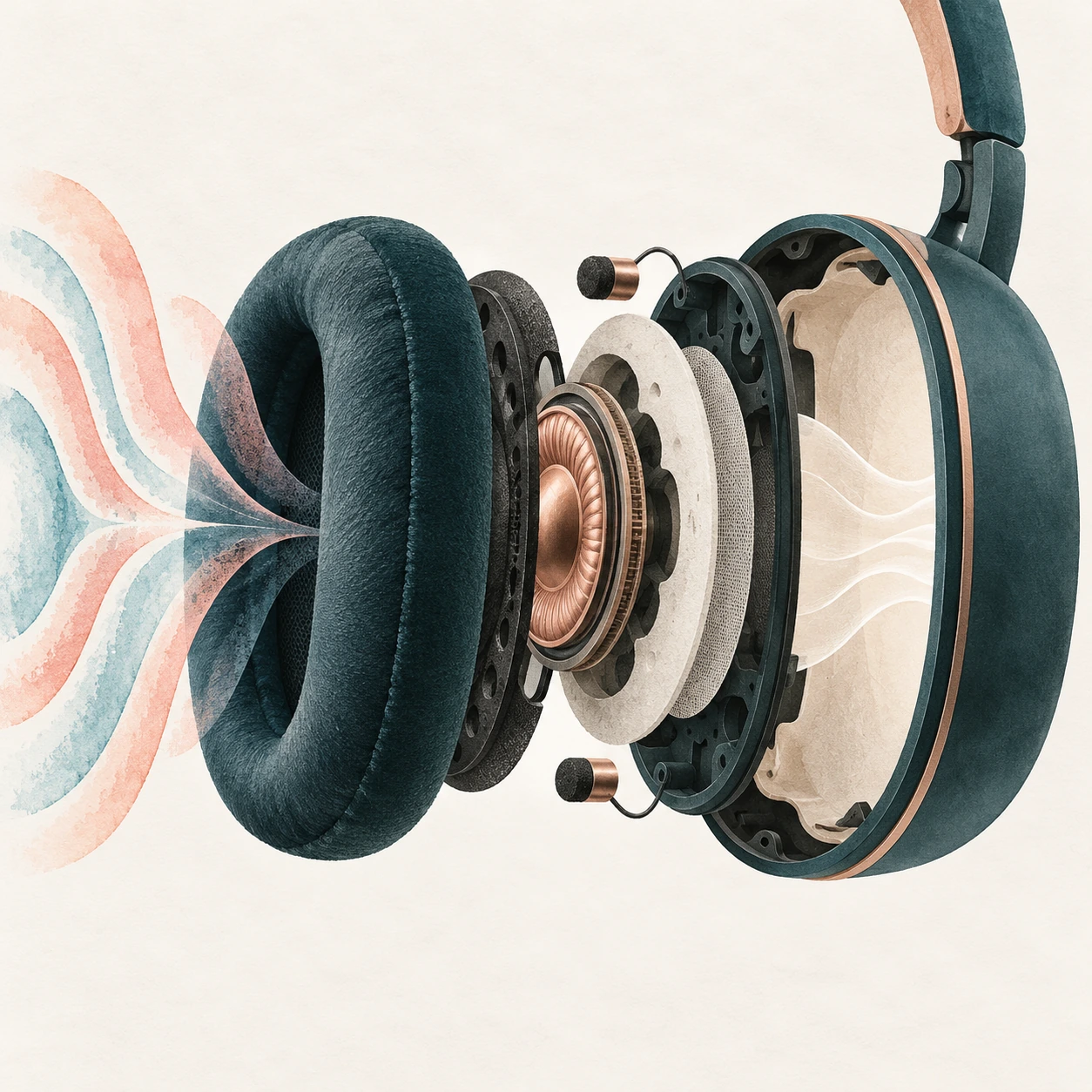
Those contributions should not be treated as interchangeable. A gap in a cushion can change the acoustic path. A processing system designed around that path must still work through the physical speaker, air space, and earcup. The electronic problem cannot be solved entirely apart from the object sitting on your head.
Two pressure changes can oppose each other
Take a deliberately simple example: a single repeating tone arriving at one location. Represent its pressure variation with a smooth wave. An equally strong wave with the opposite sign can cancel it at that location. Where the first raises pressure, the second lowers it by a matching amount.
The Texas Instruments technical account describes this superposition and the use of measured signals to guide a controller. In real headphones, producing the right pressure at the ear involves the response of the speaker and acoustic cavity, not merely drawing an upside-down line on a screen.
Change the delay in a cancellation model
Silent-by-default sine-wave superposition with amplitude, frequency and delay controls; optional low-level synthetic audio.
Open change the delay in a cancellation model in its own window.
In the model, begin with equal amplitudes and zero added delay. Then introduce a delay while holding frequency fixed. Small delays initially increase the residual; larger delays make it vary periodically. Double the frequency and repeat. A fixed time error occupies a larger fraction of a shorter cycle. A numerical setting that is tolerable for one tone can be poor for another.
A calculation you can check without playing audio
A 100 Hz tone has a 10 millisecond period. A 1 millisecond mismatch is one-tenth of its cycle, or 36 degrees. A 1000 Hz tone has a 1 millisecond period, so the same mismatch is a complete cycle. For this perfectly periodic one-tone model, a full-period delay restores the same phase and can cancel again; half-period errors give the largest residual when amplitudes match. Real broadband noise cannot be aligned at every frequency by exploiting one tone’s full cycle. Delay changes phase according to frequency. Our model uses a sine wave and an exact mathematical delay; it does not represent a complete headset controller.
The useful measurement is the leftover sound
A reference microphone can tell a system about an incoming disturbance. An error microphone can tell it what remains near the controlled location. Feedforward and feedback approaches use information differently, and practical products may combine methods. The controller has to account for the path between its electrical output and the pressure it ultimately creates.
Timing is therefore part of the design rather than a minor implementation detail. Analog Devices' ADAU1777 overview explicitly identifies low latency through the input, processing, and output path as useful for noise-cancelling headsets. A chip cannot abolish acoustic travel time, but it can reduce the extra delay introduced by processing.
Why the world does not simply disappear
The demonstration has one frequency, one observation point, and a perfectly known waveform. A room contains sound from multiple directions, reflections, speech, and abrupt events. The fit changes as a person moves. A controller must perform with incomplete information and physical limits. Its quieter region is not a universal cancellation of the whole room.
Steady background noise often makes the effect especially noticeable, as Bose's examples of ventilation and cabin noise suggest. It is still reasonable to hear voices or sudden sounds. The presence of a remaining sound does not by itself identify which part of the system limited the reduction.
The achievement is more precise than “sound erases sound.” The system produces an additional pressure field so that less of a chosen disturbance remains where listening occurs. That is a small, moving target, and meeting it requires both the softness of a cushion and the speed of a calculation.
Keep exploring: Bose: how noise cancelling headphones work; Texas Instruments: adaptive active noise control for headphones; Analog Devices: ADAU1777 technical overview.
Explore all 80 new articles · Browse the complete illustrated collection
Explore more art, ideas, experiments, and independent projects at Incoprea.




