Imagine a ship crossing a sea that looks almost level. Far below its keel, a boundary between water masses rises and falls through a distance that would dwarf the ship. The disturbance can pass without becoming a wall of water on the horizon. Its large motion belongs to the ocean’s interior.
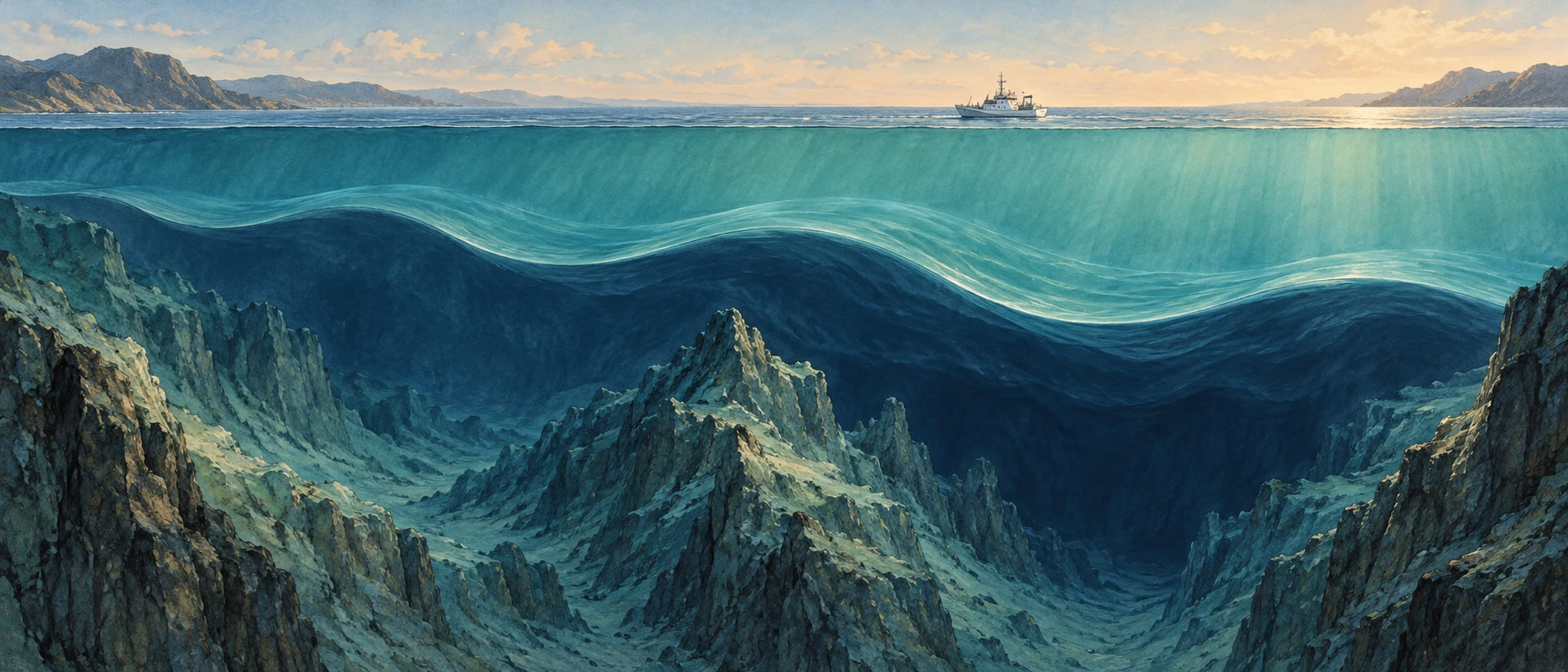
These are internal waves. They occur wherever a stable density structure can be displaced and then pulled back toward equilibrium. The ocean offers many such structures because temperature and salinity change with depth. A real water column usually has continuous gradients; the clean two-layer boundary in the illustration is a useful simplification.
The boundary supplies a different kind of spring
A surface wave lifts water against air. An internal wave moves denser water against water that is only slightly lighter. That smaller density contrast provides a weaker restoring force. Large displacements can therefore accompany comparatively slow propagation. The words “hundreds of metres” describe vertical movement inside the sea, not a surface crest of the same height.
NASA’s explanation of internal-wave patterns describes waves hundreds of metres tall with horizontal lengths of tens to hundreds of kilometres. The range matters. There is no single typical internal wave that fits every ocean basin, season and depth.
A tide meets an underwater ridge
The familiar tide can supply the energy. As stratified water moves across a submarine ridge, it is displaced vertically. Some of the tidal motion becomes an internal tide that travels away from the obstacle. Its later evolution depends on the density profile, seafloor geometry, currents and the disturbance’s amplitude.
Luzon Strait, between Taiwan and the Philippines, is a particularly energetic example. In a large rotating-tank study published in 2013, researchers reproduced important aspects of its double-ridge geometry. Their results supported a broad, coherent internal tide that subsequently steepens, rather than a large solitary wave emerging fully formed from one special point.
The laboratory was valuable because researchers could control and compare conditions that are difficult to isolate at sea. It was still a scaled model. Matching the important ratios of forces does not make a tank a miniature ocean in every respect.
Try the density difference
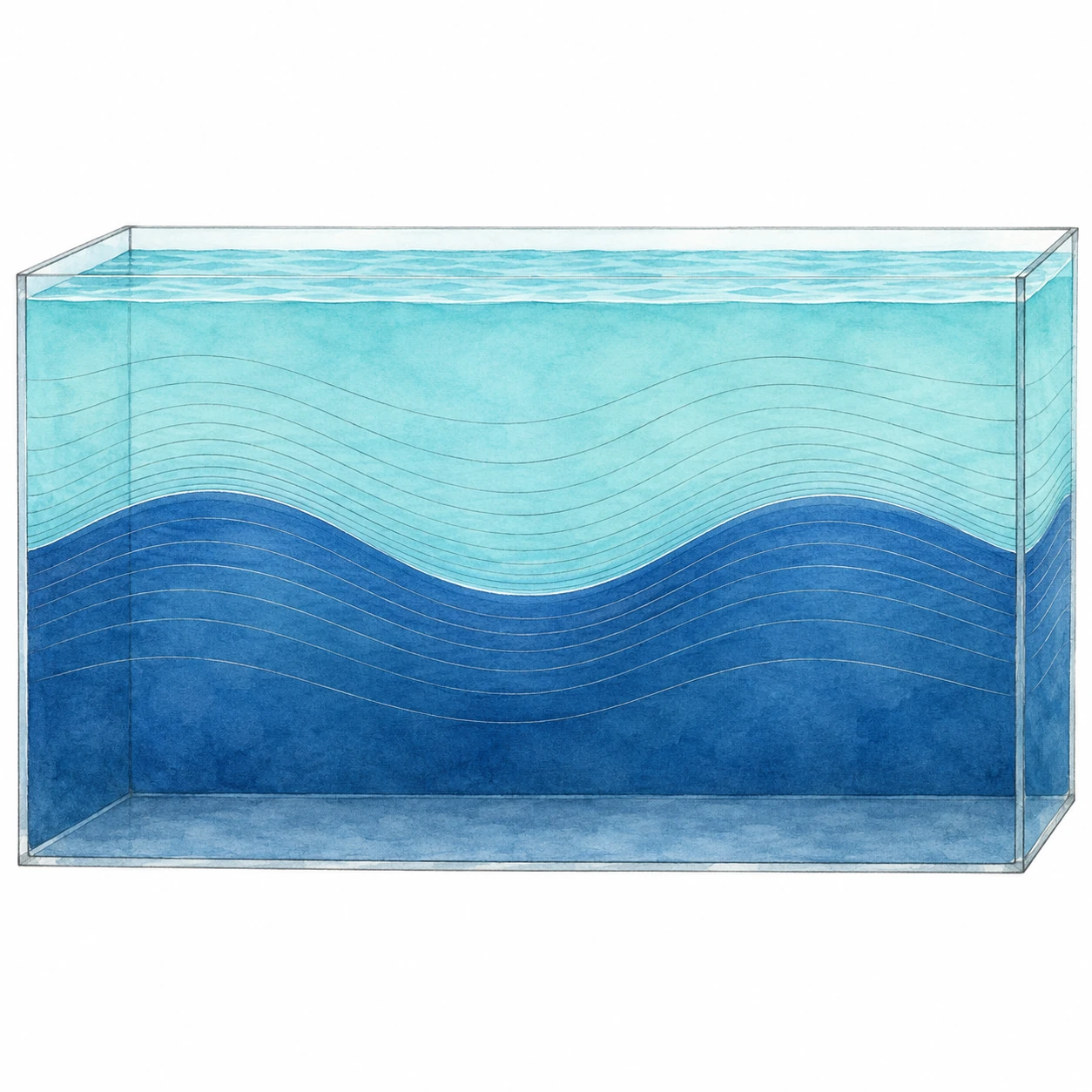
The explorer below deliberately removes most ocean complexity. It treats the water as two uniform layers and calculates the speed of a small, very long internal wave. Compare its result with a long surface wave in the same total water depth.
Explore a two-layer wave speed
Adjust layer depths and density contrast; compare internal and surface wave speeds with explicit limits.
At the starting settings, the upper layer is 100 metres deep and the lower layer 400 metres deep. Their density difference is 2 kilograms per cubic metre, against a reference density of 1,025. The calculated internal speed is about 1.24 metres per second. The corresponding surface-wave estimate is about 70 metres per second.
Those are original illustrative inputs, not measurements of Luzon Strait. Their purpose is to expose the weaker restoring force. Double the density contrast and the internal speed increases by a factor of about 1.41, not two. The square root in the wave-speed relationship makes that prediction testable.
The approximation, outlined in University of Washington fluid-dynamics notes, is unsuitable for estimating the height of a large solitary wave. Rotation, shear, continuous stratification and breaking can all matter outside this deliberately narrow calculation.
Seeing a wave without seeing through the water
A satellite photograph may show alternating bright and dark curves. These are not a direct photograph of an underwater wall. Internal-wave currents alter the small surface ripples that scatter or reflect sunlight. Under suitable viewing conditions, that roughness pattern becomes visible.
Another route uses precise measurements of sea-surface height. NASA’s narrated film, “NASA Sees Tides Under the Ocean’s Surface,” connects a small surface signal with much larger internal motion. Watch for the distinction between an observed surface signature and a visualization of what is happening below it.
A three-step way to read an internal-wave image
- Identify what the instrument measured: reflected light, radar response or surface height.
- Look for the repeated curved bands, then ask whether wind and viewing geometry could affect their appearance.
- Find the accompanying ocean measurements or model before assigning a depth, amplitude or energy.
This distinction makes the phenomenon more interesting. A quiet-looking surface is a boundary carrying indirect evidence. Reading it well reveals a moving interior without pretending that one photograph contains the ocean’s entire structure.
Sources and further exploration
- NASA Earth Observatory: Waves Above and Below the Water
- Mercier and colleagues: Laboratory modelling of the Luzon Strait internal tide
- University of Washington: Two-layer geophysical fluid dynamics
- NASA Goddard: NASA Sees Tides Under the Ocean’s Surface
Explore all 80 new articles · Browse the complete illustrated collection
Keep exploring at Incoprea.