Look beneath a red mangrove branch and you may find something that seems to be waiting for a gardener: a long green structure, tapered toward one end, already hanging above the water. It resembles a seed that has been stretched into a pencil. The more surprising part is its timing. Development has carried on while it is still attached to the tree.
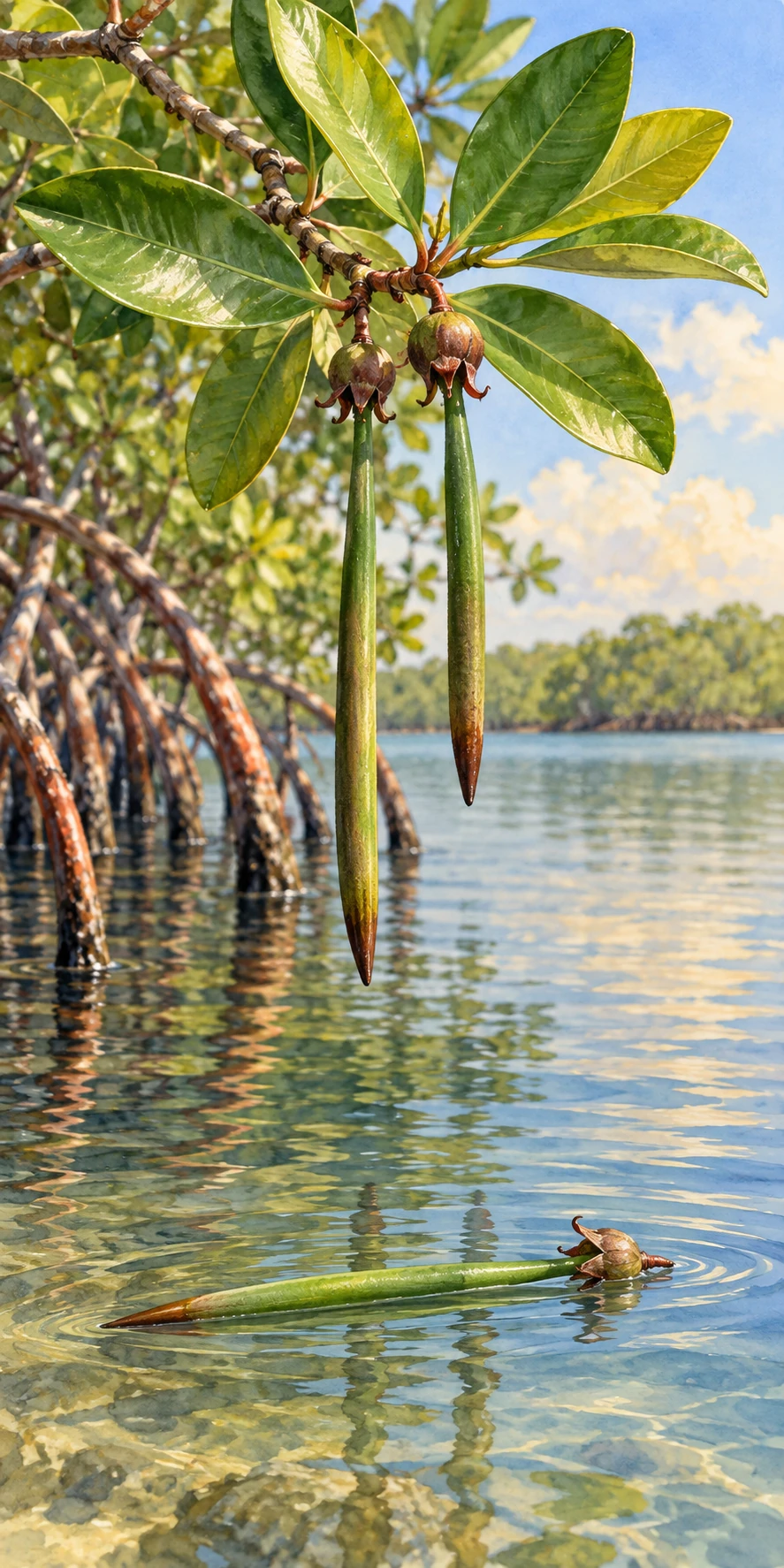
In Rhizophora mangle, the red mangrove, the seed germinates on the parent plant. The elongated structure is largely the hypocotyl, the part of a young plant's axis below the seed leaves. When it finally separates, the dispersal unit is a living seedling, often called a propagule. The Forest Service species account follows this development through emergence and eventual release. A propagule is therefore more than a seed that will begin everything later.
That head start is only the opening of the story. Leaving the parent, traveling, arriving and staying alive are different achievements. Looking closely at each stage makes a familiar coastal tree much more interesting than the phrase “ready-made seedling” suggests.
The pause that never arrives
Many seeds are familiar to us as compact packages: development produces a mature seed, growth pauses, and germination begins when suitable conditions arrive. Mangrove vivipary changes that sequence. The offspring continues developing across a boundary that we often imagine as a clean stop.
A 2023 study of Kandelia obovata, another mangrove in the same family, investigated that continuity using developmental observations and gene-expression measurements. The researchers associated the transition with reduced dormancy signals and increased germination potential. They also found activity consistent with photosynthesis in the growing embryo and material transport through the seed coat.
The paper concerns Kandelia, rather than a direct molecular test of every Rhizophora species. Its value here is the question it opens: how does a developing offspring keep growing instead of entering the usual pause? The findings suggest a coordinated developmental program, including partial self-provision and maternal support. They do not identify a single universal switch shared by every coastal tree.
Even the word “birth” can obscure this sequence if taken too literally. The seedling does not suddenly become alive when it falls. Separation changes its relationship with the parent and its surroundings. It does not mark the beginning of all development.
Transport is a different job from taking root
While afloat, a propagule can move with water. Once stranded, it must remain in place long enough to establish. A structure suited to one phase still faces the demands of the next. This creates a useful tension: travel can expand the possible destinations, while anchorage limits further movement.
In experiments conducted in Kenya, researchers compared Ceriops tagal with Rhizophora mucronata. They exposed propagules to seawater, moist mud and dry sand, then examined subsequent root development. The larger Rhizophora propagules retained water better and tended to remain buoyant longer. Their roots began later, but grew faster after initiation. The smaller Ceriops propagules were more vulnerable to dehydration and started roots sooner.
The experiments also linked dehydration with root initiation, and lower salinity with faster establishment under the tested conditions. These are findings about two species in a particular study. They give us reasons to ask about water storage, timing and local conditions, rather than assume all mangrove propagules follow an identical schedule.
Notice what an attractive photograph leaves out. An upright propagule beside a mudbank may look successfully planted. The image alone cannot tell us whether roots have grown, whether the next tide will remove it or whether it will survive a later dry period. A position is an observation. Establishment is a process.
Why a long voyage does not explain everything
A Hawaiʻi study provides a particularly clear test of that distinction. Neither of its two mangrove species was native to the archipelago. One had spread much more widely than the other. Could a difference in floating ability explain the contrast?
The researchers tested propagules for extended flotation and subsequent growth under different light levels. Some of both species remained afloat for 60 days and then rooted and grew. The authors concluded that flotation alone was unlikely to explain why one species had failed to establish on other islands.
This is a useful pattern in ecological reasoning. A trait can make an event possible without making it inevitable. A floating propagule may be capable of a journey while currents, arrival conditions and later survival still determine the outcome. Measuring one stage of a life cycle cannot substitute for investigating the whole sequence.
Related seedlings still differ
Even within red mangroves, “the species tolerates salt” is not a complete prediction for every seedling. A 2021 common-environment experiment grew material from six Florida populations under contrasting salinity and nitrogen treatments. The researchers found changes in traits such as succulence and the allocation of biomass between roots and shoots. Responses depended on the trait and treatment combination.
Maternal families and source populations also differed in survival and most measured traits. This does not mean a particular seedling's future can be read from its family label. It means the variation was biologically consequential in the experiment. The green objects hanging together in a canopy are not interchangeable units with one guaranteed response to every shoreline.
Four stages to notice on your next coastal walk
The observation sheet separates an attached propagule, a floating one, a stranded one and an established seedling. You can use it with an accessible coastal view, a reliable photograph or the figures in the research papers. There is no need to collect or relocate anything.
Mangrove: four stages, four questions
A printable observation sheet distinguishes attached, floating, stranded and established stages, with separate spaces for evidence and inference.
Open mangrove: four stages, four questions in its own window.
For each stage, write two short notes: what you can see and what you would need to find out. “Horizontal in water” belongs in the first column. “Has drifted for several weeks” belongs in the second unless tracking evidence supplies that history. Revisit a safe viewing point if you want to distinguish a brief landing from continued growth.
That small discipline changes the scene. A mangrove canopy becomes a place where development is already underway. The water becomes a transport route with uncertain destinations. A quiet patch of sediment becomes a test of timing, attachment and survival. The seedling's unusual beginning is remarkable because it prepares for these later demands, while leaving their outcome open.
Sources and further reading: Red mangrove species account — USDA Forest Service; Uninterrupted embryonic growth in Kandelia obovata (2023); Different dispersal and establishment strategies in two mangroves (2015); Flotation and establishment of introduced mangroves in Hawaiʻi (2006); Salinity, nitrogen and maternal-family variation in red mangrove (2021).
Explore all 80 new articles · Browse the complete illustrated collection
Explore more art, ideas, and independent projects at Incoprea.