The river is moving. Its surface has not sealed into a sheet. Yet beneath the current, pale ice is gathering on stones. The apparently wrong location is the clue: winter river ice does not have to begin as a continuous lid.
Two names help separate the processes. Frazil is a population of small ice crystals in the water. Anchor ice is ice attached to submerged material. They can participate in the same event, but neither term means the whole river has suddenly become solid.
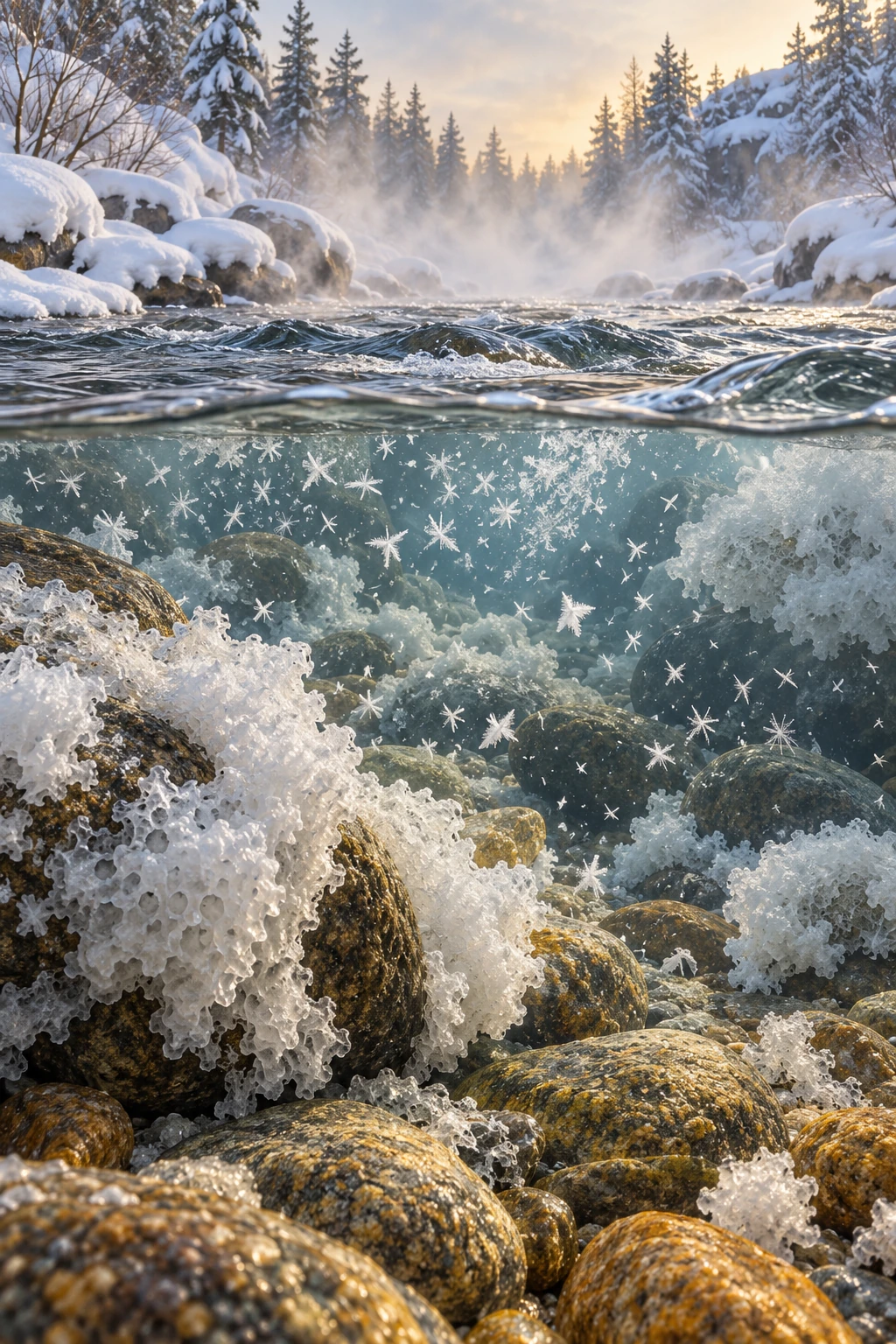
The temperature can cross a boundary before the river looks frozen
Moving water loses heat to a cold atmosphere. Turbulence carries that cooling through the water column. Under appropriate conditions, the water becomes slightly supercooled: it remains liquid just below its local freezing temperature. Crystals can then grow, releasing latent heat as water changes phase.
The deficit can be tiny. In a USGS flume investigation, the supercooled saltwater conditions discussed were only about 0.05–0.1°C below freezing. That laboratory range is not a universal threshold for rivers. It shows why “below freezing” need not mean a large temperature excursion.
Crystals may collect in loose clusters, collide with sediment and become attached to the bed. Direct crystal growth on submerged surfaces can also contribute. Which route dominates depends on the event rather than on the name we give the final accumulation.
A small amount of freezing can balance a small amount of supercooling
Here is a desk calculation. Take 1,000 kilograms of freshwater that is 0.05°C below its freezing point. For this example, use a heat capacity of 4,180 joules per kilogram per degree and a freezing latent heat of 334,000 joules per kilogram.
Warming the liquid through that small deficit requires about 209,000 joules. Freezing roughly 0.63 kilogram releases the same amount of heat. That is only about 0.063 percent of the starting mass.
The result does not say a river can produce only that much ice. It describes a closed batch with no further heat loss. A real river continues exchanging heat, moving crystals and importing water. The calculation helps explain why the initial appearance of crystals and the later accumulation of slush are different questions.
A river’s small freezing budget
A printable numerical exercise with assumptions, blank answers and a worked key.
Watching the bed change
A 2021 field study of anchor-ice formation, growth and release used continuous observations to follow events that an occasional visit could miss. This is a useful change in perspective. A photograph records the accumulation at one moment; a time series can reveal when crystals first attach, how an accumulation develops and how it leaves.
Ice on a stone changes the flow around it. Enough accumulation can alter water levels and the channel’s effective geometry. Later warming or other changing conditions can help release the ice. A bed that looks quiet in the afternoon may have undergone substantial activity overnight.
For a reader examining field evidence, the sequence is more informative than one dramatic image. Was the water actually measured below its local freezing point? Did the material grow in place or arrive from upstream? Did the apparent disappearance result from melting, detachment or burial?
Ice becomes a sediment carrier
The USGS experiments also found that freshwater frazil clusters could gather material from the bed. Some came to rest in sheltered locations and were subsequently buried by migrating sand ripples. Saltwater clusters behaved differently under the experimental conditions.
That comparison is valuable because “ice carries sediment” is too broad to predict a particular river. Salinity, current speed, sediment type and warming all affect the interaction. The experiment establishes mechanisms worth looking for; it does not assign every disturbed winter deposit to anchor ice.
One film, two kinds of explanation
The National Park Service’s Yosemite frazil-ice page links a 7-minute, 39-second Nature Notes film. Yosemite’s waterfall setting includes freezing mist that contributes crystals to the stream. That setting should not be treated as the sole formation mechanism for frazil everywhere.
Watch the film for movement: separate floating clumps, crowding in narrow passages and changes in the path of the flow. Then compare those visible events with the submerged growth in the field study. They are related pieces of an ice system, seen from different positions.
A useful observation note, made from a safe established viewpoint
Record the time, recent air conditions, whether the surface is open, whether ice moves with the current, and whether any accumulation is visibly attached. Leave “measured water temperature” blank unless a reliable measurement exists. A slushy appearance alone cannot provide it. Do not approach or stand on river ice to complete a note.
The surprise is not simply that water can freeze in a moving river. It is that a small phase change can start a changing partnership among heat, turbulence, buoyancy and sediment, well before the surface looks like the familiar winter picture.
Sources and further exploration
- USGS: Frazil, anchor ice and sediment in a flume
- The Cryosphere: Continuous in situ measurements of anchor ice
- National Park Service: Frazil Ice and Yosemite Nature Notes
Explore all 80 new articles · Browse the complete illustrated collection
Keep exploring at Incoprea.




