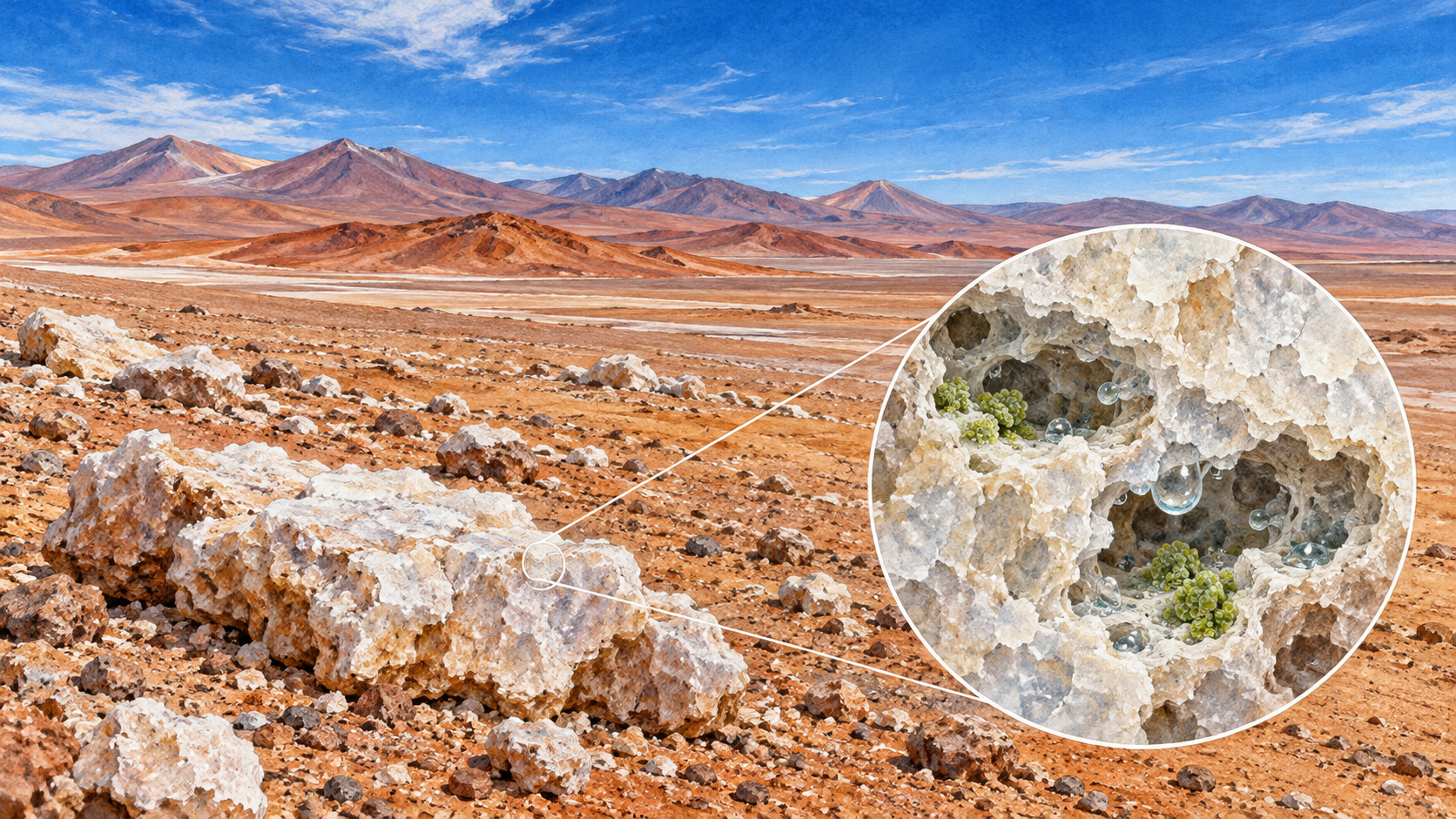
A barren desert surface can look like a simple answer: nothing grows here. In the hyperarid parts of Chile's Atacama Desert, that conclusion is too quick. Some habitats contain microbial communities, while other samples preserve remnants of past life or organisms surviving with little opportunity to reproduce.
The distinction makes this landscape an unusually valuable natural laboratory. The question is not merely whether scientists can detect something biological. It is what that evidence says about activity, growth and the conditions required for a community to persist.
Small habitats change the picture
The Atacama is not uniformly dry. Conditions vary across the region, and tiny differences within a site can matter. A shaded pore, a salt crust or a protected space inside a rock may offer conditions unlike those on an exposed soil surface.
Studies of halite, the mineral form of common salt, have found microbial communities within salt nodules. The salt can absorb atmospheric moisture under suitable conditions, creating highly saline liquid in its pores. Researchers have measured activity in such communities, including photosynthetic processes where enough light and water are available.
Living inside rock is not the same as finding a universal way to ignore dryness. The mineral, humidity, light and chemistry together create a particular microhabitat. A successful refuge in one location need not work in another.
Surviving is different from growing
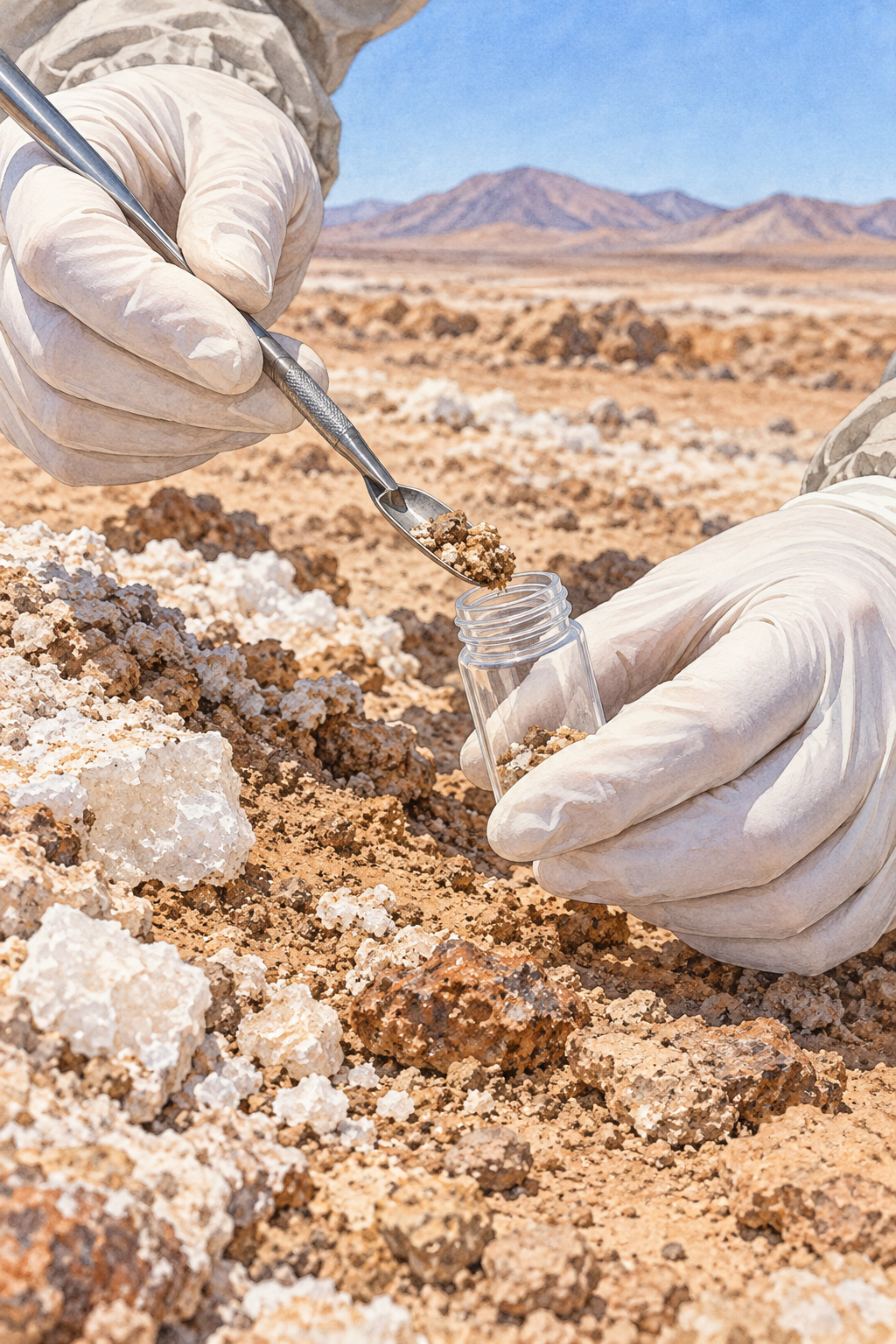
A 2018 study described temporarily active communities in hyperarid soils following rare rain. Other research on the driest surface soils found evidence consistent with severe limits on growth, even when biological material remained detectable.
These findings need not be contradictory. Sampling time, location, depth and habitat differ, as do the measurements used to infer activity. A brief wet period may open a window that is closed for most of the surrounding years.
DNA or other organic molecules can be informative without proving that a population is currently flourishing. Scientists therefore combine methods and examine whether cells are maintaining themselves, reproducing or simply leaving chemical traces behind.
A careful rehearsal for another planet
The Atacama helps researchers test ideas and instruments for investigating dry planetary environments, especially Mars. It supplies difficult samples in which faint biological signals must be distinguished from preservation, contamination and nonbiological chemistry.
The analogy has limits. Mars differs in temperature, radiation, atmospheric pressure and chemical conditions. Discovering an earthly refuge does not establish that an equivalent Martian refuge contains life. It helps refine questions about where to look and what a convincing signal might require.
That is why the desert is more interesting than either a lifeless wasteland or a hidden garden. It contains a patchwork of opportunities, constraints and histories that can disappear inside a sweeping headline.
At the dry edge, a tiny amount of accessible water can matter enormously. The landscape teaches investigators to lower their expectations of visible abundance while raising their standards for deciding what a subtle trace actually means.
Sources and further reading: NASA: Transitory activity in hyperarid soils; NASA Ames: Growth and survival at the dry limit; Davila et al.: In-situ metabolism within halite.
Explore more creative curiosity at Incoprea.