On 21 August 1986, gas released from Lake Nyos in Cameroon killed more than 1,700 people in surrounding communities. The tragedy did not resemble the familiar image of a volcano throwing out lava and ash. Much of the danger had accumulated quietly in deep water.
The subsequent engineering depended on understanding that hidden reservoir. Carbon dioxide could be removed through pipes in a controlled flow, using the same broad physical feedback that made a sudden release dangerous. The story joins an immense human loss to a demanding question: how do you reduce a hazard you cannot assess by looking at the surface?
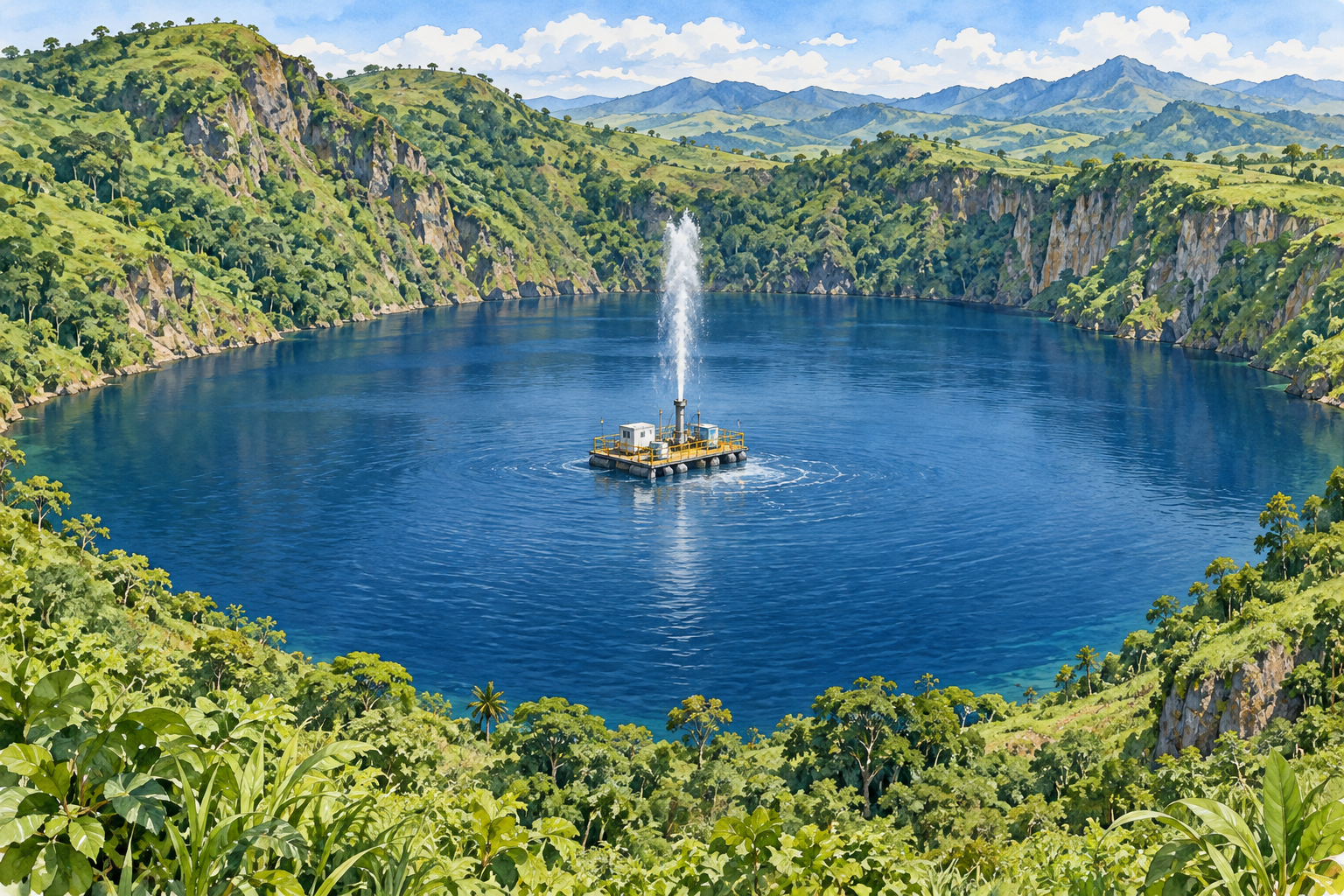
How water holds an invisible reservoir
Carbon dioxide of geological origin can enter deep lake water. Greater pressure at depth allows more gas to remain dissolved. If the lake's layers do not mix freely with the surface, that gas can accumulate rather than escaping gradually into the air.
The essential ingredients are therefore connected: a continuing supply, water capable of holding it and a structure that limits regular release. A quiet lake is not evidence that the deep reservoir is empty. Instruments measuring conditions through the water column reveal information that a surface photograph cannot.
Pressure also changes with movement. If gas-rich water rises, the pressure on it decreases. Dissolved gas can form bubbles. Those bubbles lighten the rising mixture and can help it move upward, bringing more gas-rich water into lower-pressure conditions.
A feedback that can accelerate
The process is often compared with opening a carbonated drink, but the lake is far more complicated. Depth, layering, the volume of water involved and the surrounding terrain all matter. The analogy helps explain pressure and bubbles; it does not reproduce a lake disaster in miniature.
The term limnic eruption describes the rapid release of gas from a lake. At Nyos, concentrated carbon dioxide spread into nearby low areas, creating a lethal atmosphere for people and livestock. A dense gas moving across the landscape presented a different danger from hot volcanic fragments.
The precise disturbance that initiated the 1986 event remains uncertain. That unresolved trigger should be distinguished from the well-supported importance of dissolved gas accumulation and release. Engineers did not need to know every detail of one initiating moment to address the reservoir that continued to build afterwards.
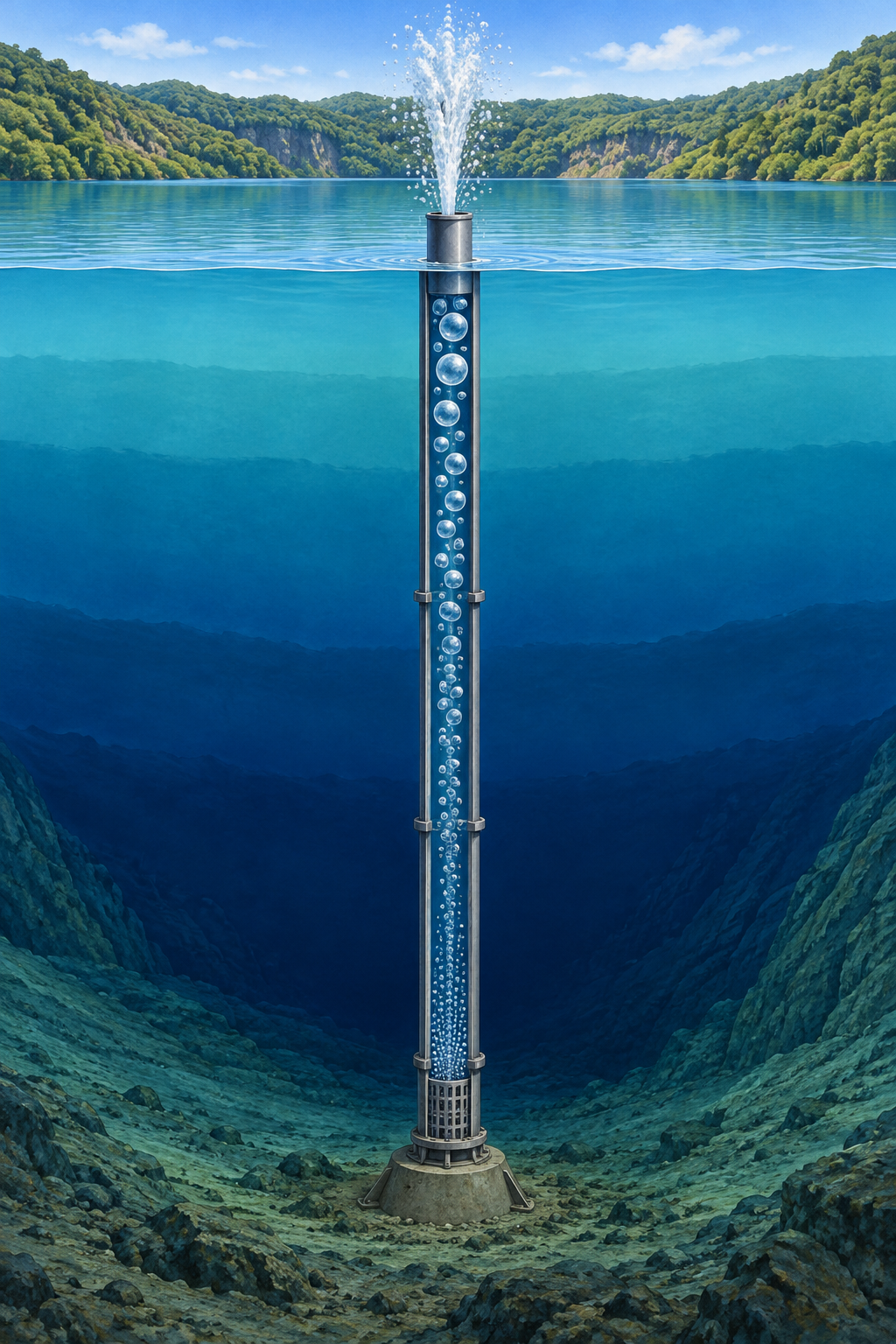
In the conceptual cutaway, follow the water upward and consider what changes as pressure falls. The illustration is an explanatory sequence, not a measured profile of the lake. The real intervention required measurements and modelling of conditions at depth.
Put the upward flow inside a pipe
Michel Halbwachs's account of the degassing principle describes a vertical pipe connecting deep water to the surface. A pump starts the movement. Once the rising water releases enough gas, the bubbles can sustain the upward flow. The energy comes from the gas-water system rather than a pump lifting every litre continuously.
This is commonly called gas lift. The pipe gives the flow a defined path and allows extraction to occur in a controlled way. Early demonstrations at Monoun and Nyos tested whether the predicted flow could be achieved and stopped. The engineering question concerned control as well as initiation.
Permanent controlled degassing began at Nyos in 2001. Research by George Kling and colleagues measured the lakes' response and examined whether the intervention might destabilise their water columns. Their 2005 study reported increasing local stability in the zones of degassing, while emphasising that removal capacity and continuing gas input had to be considered together.
Read the balance, not just the fountain
A dramatic photograph of spray proves that gas-rich water is reaching the surface at that moment. It does not, by itself, show how much gas remains at depth or whether extraction exceeds recharge. Those questions require repeated measurements.
Use this simplified accounting exercise. Imagine a reservoir gains ten units of gas over an interval and a system removes fourteen. Its stored amount falls by four units. If later the same system removes only eight while recharge remains ten, the stored amount rises by two. These invented numbers are for reasoning, not measurements from Nyos.
Why might one successful pipe not settle the problem forever?
Extraction performance can change as the gas inventory and conditions at the intake change. The source can continue supplying gas. A system therefore has to be evaluated against both the remaining reservoir and the continuing input, rather than judged only by whether a fountain appears.
A 2020 study by the degassing researchers revisited the balance between natural recharge and discharge through the pipes. Its historical progression is instructive: first reduce a dangerous accumulated inventory, then determine the extraction needed to prevent it from rebuilding. These are related but different tasks.
A short route through the evidence
Begin with the project's degassing-principle page. Follow its diagrams from pump-assisted start to bubble-driven flow. Then read the abstract of Kling and colleagues' study and identify the two quantities it compares: gas removed and gas remaining.
Finally look at the dates. A successful early test, a 2005 assessment and a later recharge study describe different stages of an intervention. None should be presented as a current declaration covering every site hazard or every operating condition. The durable lesson is a method: investigate the hidden store, measure the response and adjust the system to the continuing process.
Nyos is not merely an unusual physical effect. It is a place where people died and communities were displaced. Understanding the mechanism matters because it supports prevention. The engineering achievement is the conversion of an invisible, accumulating danger into a quantity that can be monitored and deliberately reduced.




