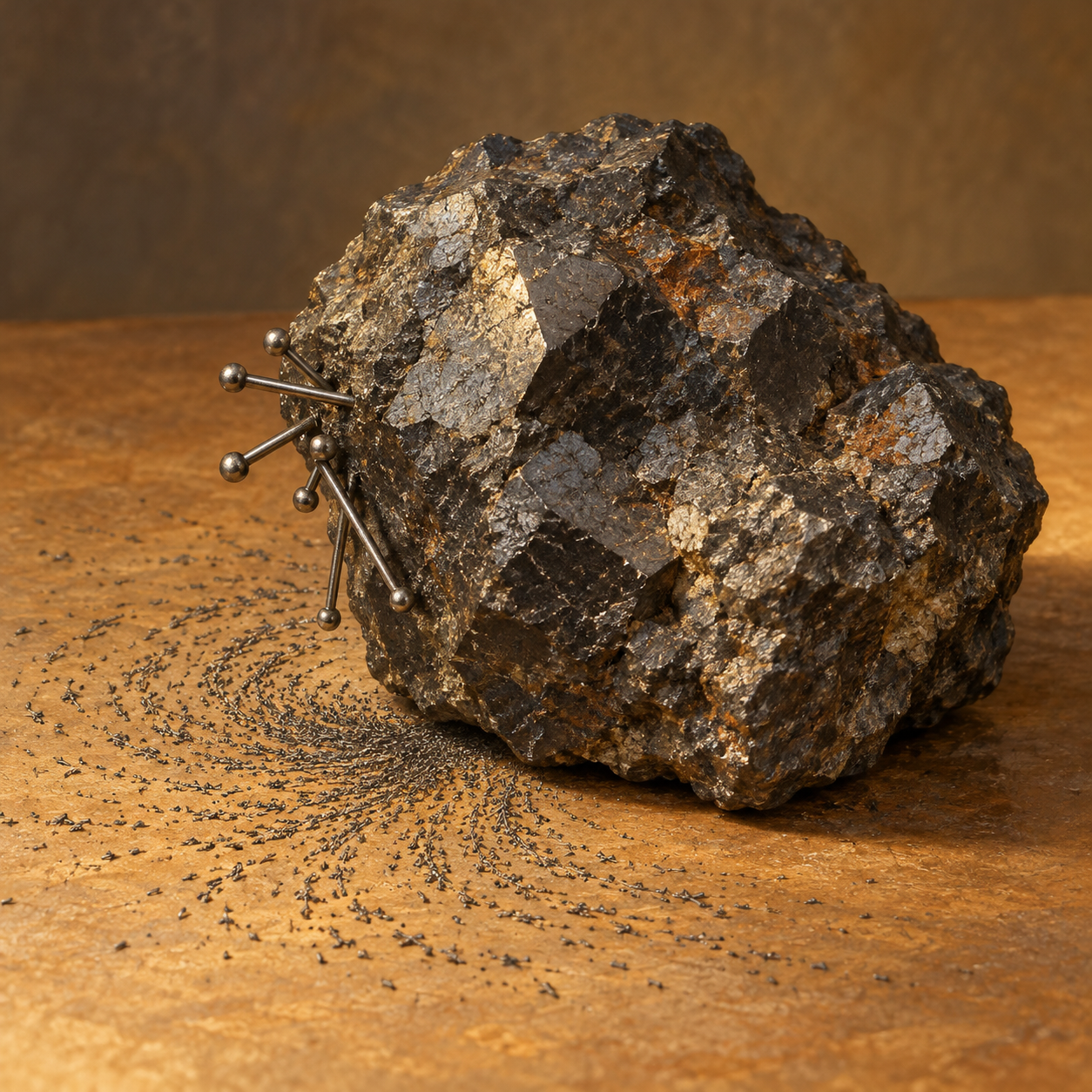
A rough dark stone picks up a steel pin. There is no wire, battery or hidden manufactured magnet inside it. A lodestone is a naturally magnetized piece of magnetite, an iron oxide mineral, and its ability to attract certain metals connects a simple tabletop curiosity with the history of navigation.
It is useful to distinguish the mineral from the magnetic specimen. Magnetite is relatively common. A piece that retains a substantial natural magnetization is a more specific thing: the lodestone.
The stone has a direction
Like a manufactured magnet, a lodestone has identifiable magnetic poles. A suitably supported specimen can orient in Earth's magnetic field, and its interaction with another magnet can reveal attraction and repulsion. That behavior explains why naturally magnetic materials could help people discover directional instruments.
The stone does not attract every metal equally. Iron and many steels respond strongly, while materials such as copper do not behave like the pins clinging to a classroom specimen. Magnetism is a property of particular materials and structures, not a universal metallic stickiness.
The irregular surface can disguise that organization. A rock need not look symmetrical, pointy or arrow-shaped to carry a persistent magnetic field. Its useful direction belongs to the physical state of the material rather than its visible outline.
How did the rock become a magnet?
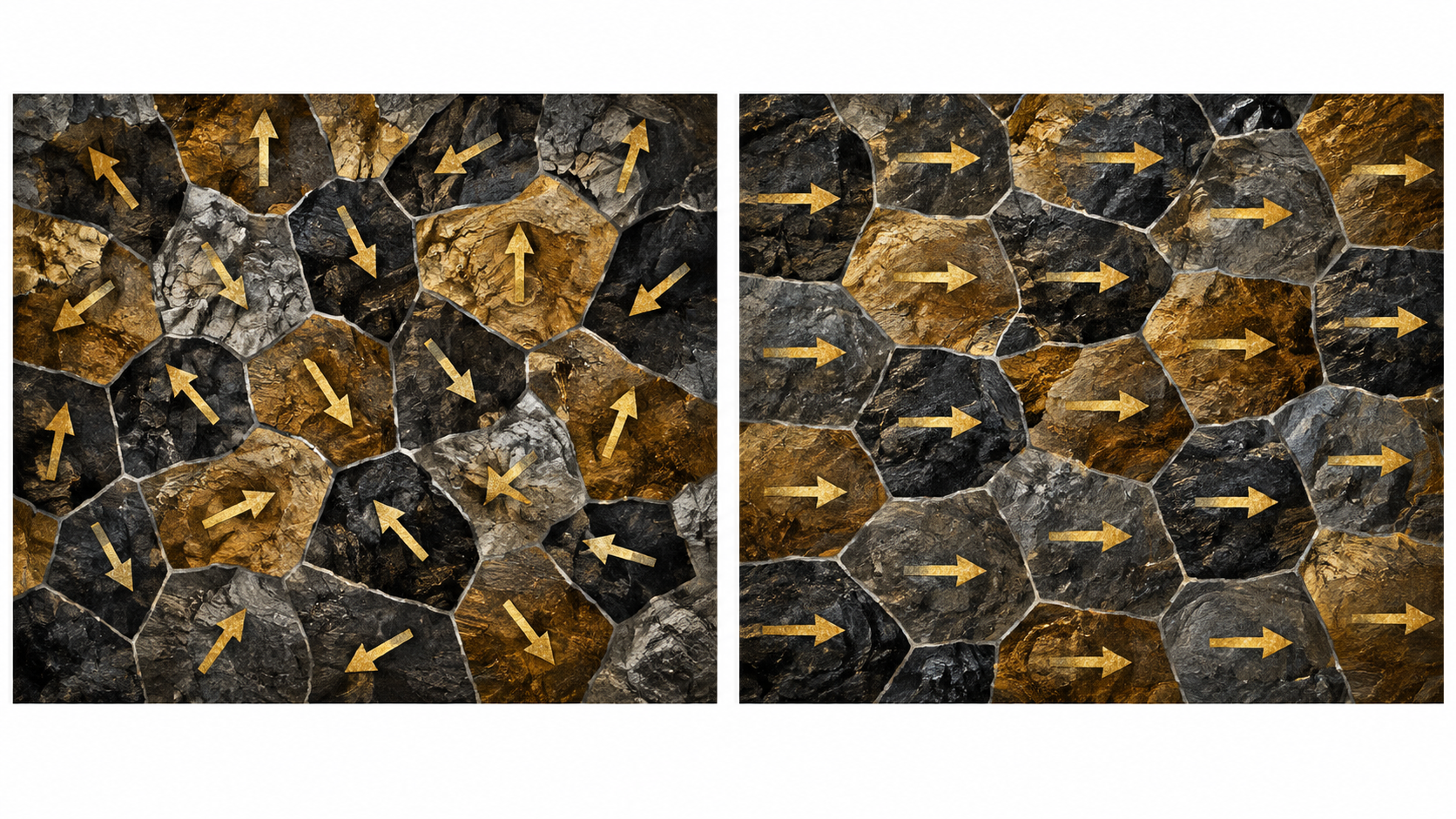
Researchers have investigated whether lightning can produce strong magnetization in suitable magnetite. A lightning current generates an intense, brief magnetic field. Experiments associated with NASA researcher Peter Wasilewski showed that appropriate mineral samples could become strongly magnetized after exposure to lightning.
That supports a mechanism for producing lodestones, while leaving the history of any particular found specimen to be established. A dark magnetic rock is not, on its own, a timestamped record of a specific strike.
Composition and crystal structure also matter. Different samples can respond differently, and simply resting in Earth's comparatively weak field is not equivalent to receiving a strong magnetic pulse.
A small clue to invisible fields
Magnetic behavior is especially engaging because the force is visible through its effects rather than directly. A clinging pin or turning needle gives an otherwise invisible field a readable consequence.
That is also a lesson in the difference between a material and its history. Two similar-looking pieces of mineral may carry different magnetic states. An object's behavior can depend on what happened to it, not merely on its ingredients.
Natural magnetism helped turn a rock into an instrument, but the attraction of a lodestone remains worth observing without a grand historical claim attached to every specimen. There is already a satisfying puzzle on the table: an unassuming piece of geology organizes the motion of another object.
The stone's surface tells one story about mineral formation. Its magnetic field adds another story that cannot be read by color and shape alone.
Sources and further reading: University of Colorado Boulder: Lodestone demonstration; NASA Goddard archive: Lodestones and lightning research.
Explore more creative curiosity at Incoprea.