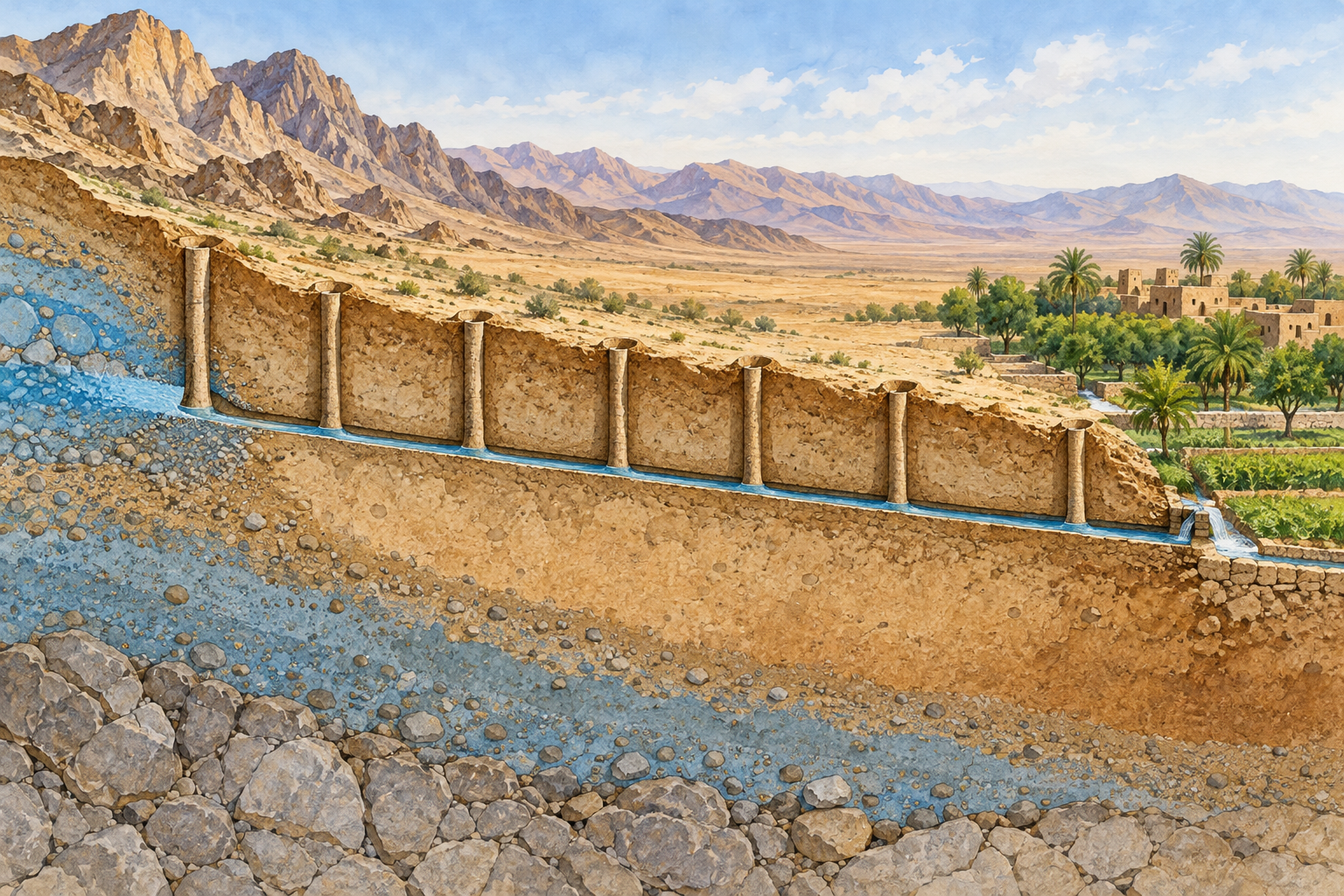
From above, a qanat can look like a line of small craters crossing dry land. Beneath those openings lies a carefully graded tunnel, carrying groundwater toward a settlement. The visible holes are only the access points of an engineering system whose essential work happens underground.
Qanats have helped support agriculture and communities in arid parts of Iran for centuries. Their central idea is beautifully economical: reach water in higher ground and arrange a route that allows gravity to deliver it where people need it.
A slope gentle enough to work
A qanat begins by tapping a suitable underground water source, often in an alluvial area near the head of a valley. A deep “mother well” helps establish the source, and a nearly horizontal tunnel leads toward a lower outlet.
“Nearly horizontal” is the important phrase. The tunnel needs a controlled downward gradient. Its level, length, and slope must be calculated in relation to the aquifer and the land surface. A channel that fails to meet those conditions cannot simply wish water uphill.
Vertical shafts along the route allow workers to remove excavated material and provide ventilation and access. Constructing and maintaining the system requires experienced workers and knowledge handed down through practice. The apparent simplicity of the finished flow conceals considerable skill.
The water system includes people
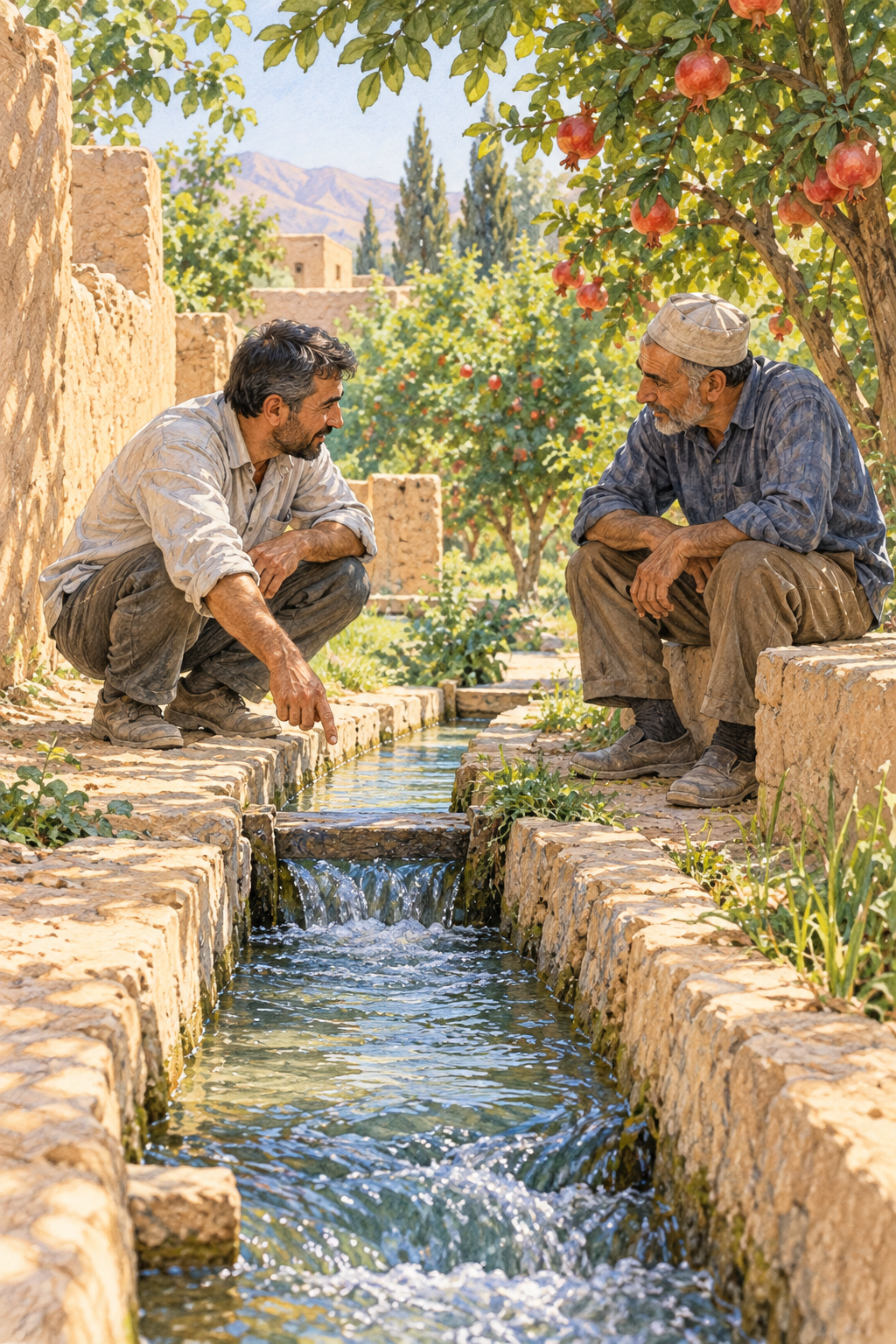
Once water reaches the outlet, channels distribute it to fields and gardens. The supply has to be shared. UNESCO's account of the Persian Qanat emphasizes traditional communal management alongside the physical structures: owners, users, and local councils coordinate the resource.
That social arrangement is part of the technology. A tunnel may transport water successfully while its benefits are distributed badly. A working agricultural system depends on rules, maintenance, trusted measurements, and cooperation as well as on a correctly dug channel.
FAO's account of qanat-irrigated farming around Kashan connects the water supply with crop diversity, livelihoods, and a landscape of gardens. The infrastructure influences what can grow, where people can settle, and how agricultural work is organized.
An old solution with continuing conditions
Underground transport limits the exposure that would allow water to evaporate from an open channel in a hot, dry environment. Gravity also supplies the movement without a pump lifting each volume along the tunnel. These qualities help explain the system's endurance.
They do not make its water supply unlimited. A qanat still depends on its source and catchment, its physical condition, and continued maintenance. UNESCO includes the protection of water catchment areas among the needs of the eleven qanats in the World Heritage property.
The most useful way to appreciate a qanat is as a connection among geology, geometry, and community. Its makers turn knowledge of an aquifer into a flowing line, then turn that line into shared food and settlement. The desert's small openings mark a much larger achievement beneath your feet.
Sources and further reading: UNESCO World Heritage: The Persian Qanat; FAO: Qanat Irrigated Agricultural Heritage Systems; ICOMOS: Persian Qanat World Heritage evaluation.
Explore more creative work at Incoprea.