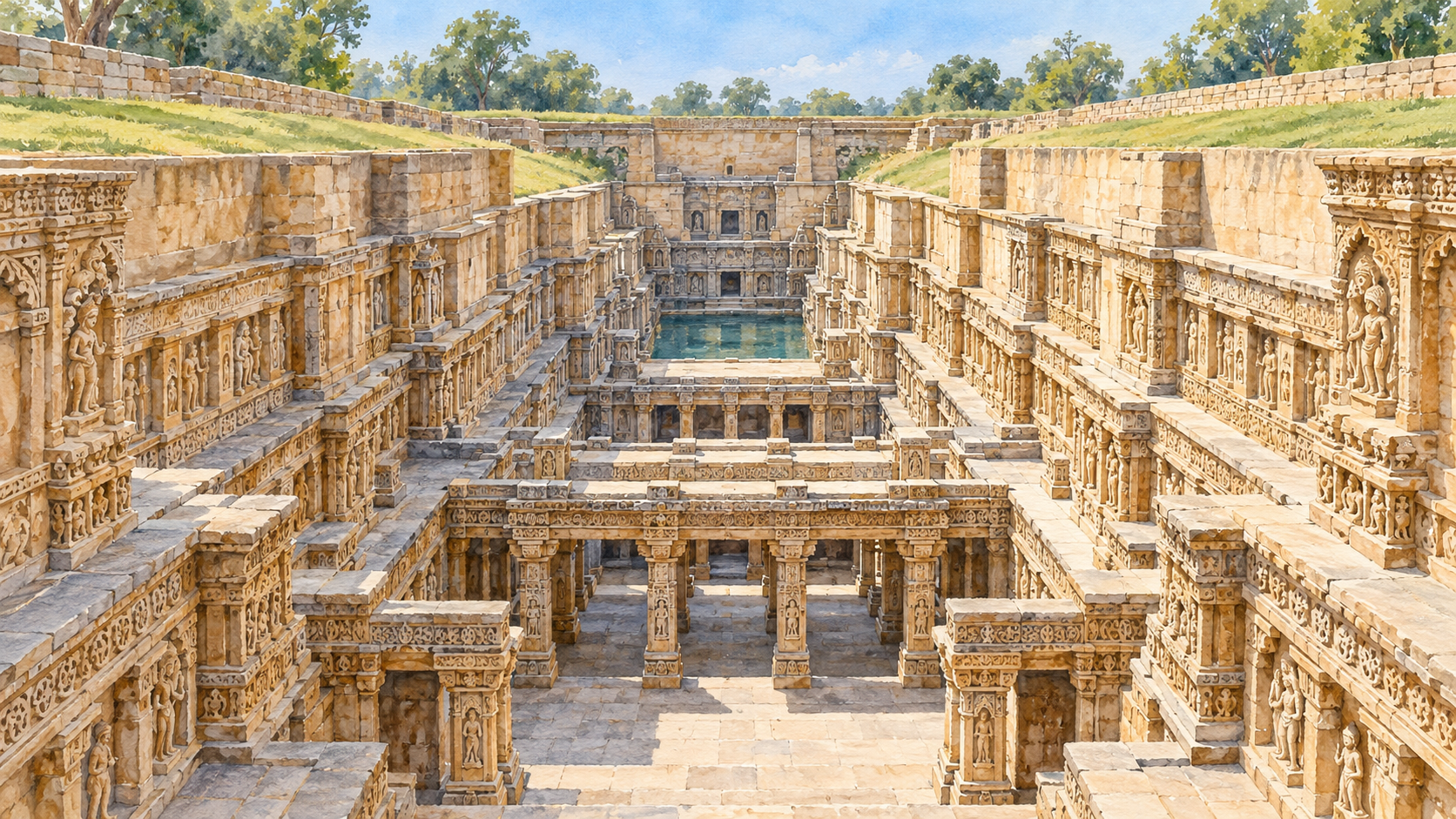
Most monuments ask you to look up. Rani-ki-Vav asks you to descend.
At Patan in Gujarat, India, the Queen's Stepwell turns the journey toward underground water into a richly carved architectural experience. From the surface, its scale is easy to underestimate. The structure opens downward, revealing steps, pavilions and sculptural walls where a visitor might expect only a simple well shaft.
Engineering a route to water
Stepwells made water reachable below ground. Their stairs addressed a practical difficulty: people needed access to a source whose level could lie far beneath the surface. At Rani-ki-Vav, that basic problem became an exceptionally elaborate composition.
UNESCO describes an east-to-west sequence of stepped corridor, four pavilions, tank and well shaft, organized across seven levels. The pavilions and sculptural surfaces give the descent a rhythm. It is a linear architectural journey, distinct from the tightly repeated zigzag stairs that make some other Indian stepwells famous in photographs.
The well was built in the eleventh century as a memorial. CyArk's documentation identifies Queen Udayamati as its patron. It is an example of Maru-Gurjara architecture, demonstrating how sophisticated water infrastructure could also carry artistic and commemorative ambitions.
Why an “inverted temple”?
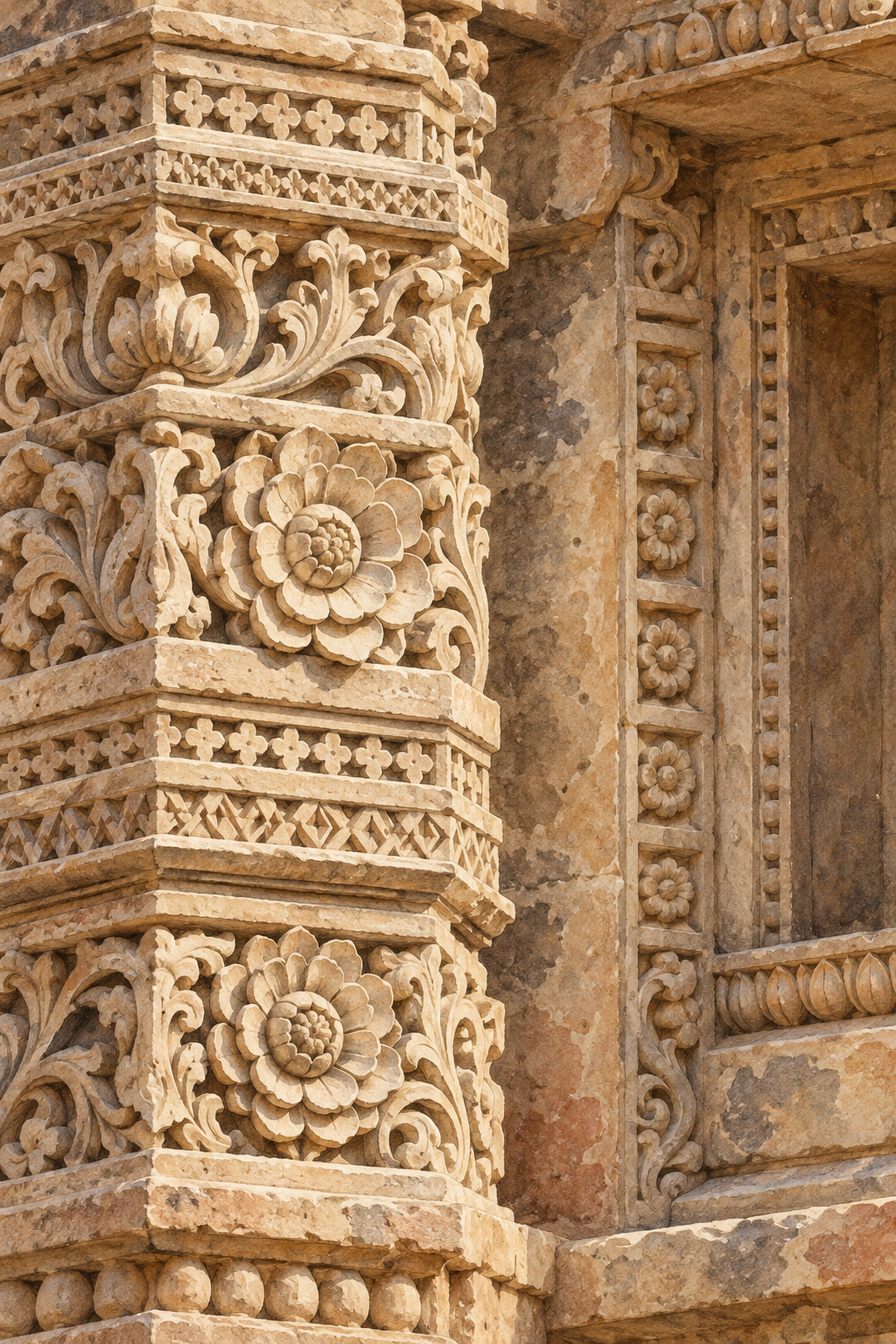
UNESCO's description emphasizes the sanctity of water, calling the design an inverted temple. Religious, mythological and secular imagery occupies its carved surfaces. The term points to the relationship between function and meaning: reaching water was given a monumental setting, rather than treated as a purely mechanical errand.
This helps explain why a close view matters as much as a wide photograph. The long descent establishes the overall arrangement; individual niches, figures and ornaments show the work of the sculptors. A building can operate at the scale of a whole community and still reward attention to a few inches of stone.
Preservation below the surface
The nearby Saraswati River also shaped the stepwell's later history. Flooding and sediment buried much of it, concealing the architecture while helping protect carved surfaces. Archaeological excavation brought the structure back into view.
Burial should not be confused with perfect preservation or a building frozen unchanged. The monument that can be studied today includes surviving fabric, missing elements and the results of conservation. Its water level, too, should not be guessed from an attractive reconstruction.
Rani-ki-Vav is memorable because necessity and ceremony share the same staircase. Water engineering supplies the reason to go down; architecture makes that movement something worth contemplating.
Explore: CyArk's documentation project provides photographs and project context for comparing the real monument with an interpretive illustration.
Sources: UNESCO: Rani-ki-Vav · CyArk: Rani ki Vav documentation project · UNESCO: The Queen's Stepwell
Explore more creative curiosities at Incoprea.




