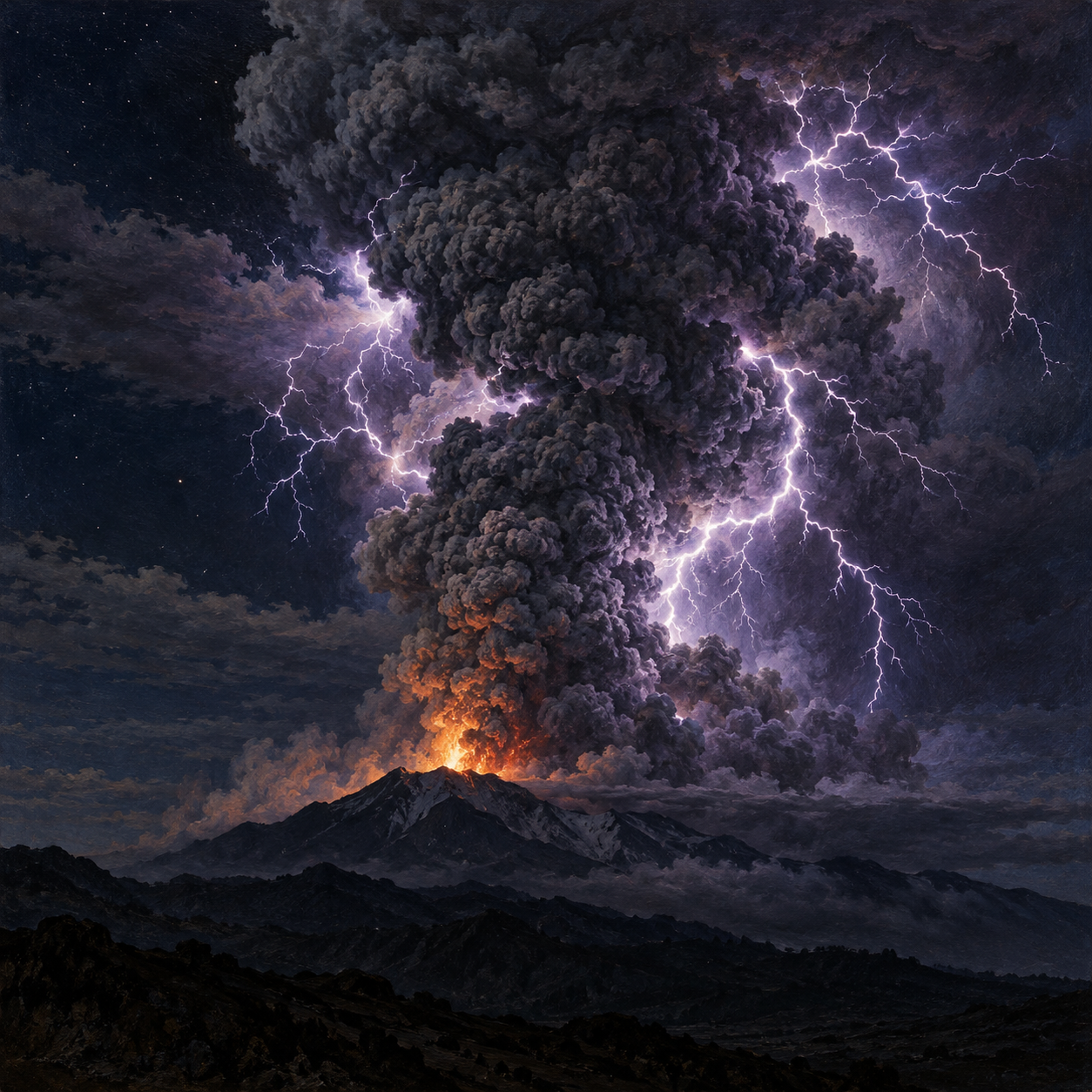
A volcanic plume is already a startling sight: a mountain sends fragmented rock and gas into the sky. Then lightning branches through the ash, turning the eruption into something that appears to belong to a fantasy painting. Yet the flashes are ordinary electricity produced under extraordinary conditions.
Volcanic lightning reveals that an ash plume is much more than a cloud of dirty smoke. It is a moving mixture of particles, gas, water and sometimes ice. As those ingredients interact, they can separate electric charge strongly enough for a discharge.
Ash can become electrically active
Near the vent, rock breaks apart and particles collide. Fragmentation and particle interactions can contribute to electrical charging. Farther up, rising motion and differences among particles help redistribute charge through the plume.
Once an electric field becomes strong enough, a conducting path forms through the air and a lightning discharge occurs. The process can operate in several parts of an eruption, from the region immediately above the vent to the high spreading cloud.
It is therefore misleading to give every volcanic flash one universal recipe. A low, ash-rich jet and a towering wet plume need not build charge in exactly the same way. The importance of different mechanisms varies with eruption conditions.
A volcano can borrow a thunderstorm's machinery
Ice becomes especially important in some tall plumes. Water carried upward can coexist with ice in a cold, turbulent region, allowing collisions similar to those that electrify meteorological thunderstorms.
USGS researchers studying Alaska's Bogoslof eruptions in 2016–2017 found detectable lightning in some explosive events and none in others. In the analyzed examples, flashes appeared after plumes rose above the atmospheric freezing level. Modeling supported ice-related charging as an important part of the explanation.
The January 2022 Hunga eruption in Tonga offered an exceptionally energetic example. Seawater blasted into the plume supplied abundant moisture. Researchers linked its tremendous electrical activity to interactions among volcanic ash, supercooled water and hailstones, recording more than 192,000 lightning flashes over the event they studied.
The flashes carry information
Lightning is not merely decoration around an eruption. Radio and optical sensors can detect electrical activity from far away, helping scientists identify explosive activity and follow changes in a plume. That is particularly valuable at remote volcanoes where direct observation is difficult.
But the absence of detected lightning does not prove an absence of ash. Bogoslof's non-lightning explosive events make that limitation clear. Electrical observations work best alongside satellites, seismic records and other monitoring tools.
There is something appealing about an eruption telling us about itself through a second kind of energy. Rock fragmentation begins the story; rising particles and water complicate it; a brief flash provides a clue.
The spectacular image becomes even more interesting when viewed this way: a volcano temporarily assembles a charged atmosphere, and scientists read its fleeting sparks to understand the cloud.
Sources and further reading: USGS: Volcanic ash and lightning; USGS: Ice charging during the Bogoslof eruption; USGS: Lightning during the Hunga eruption.
Explore more creative curiosities at Incoprea.