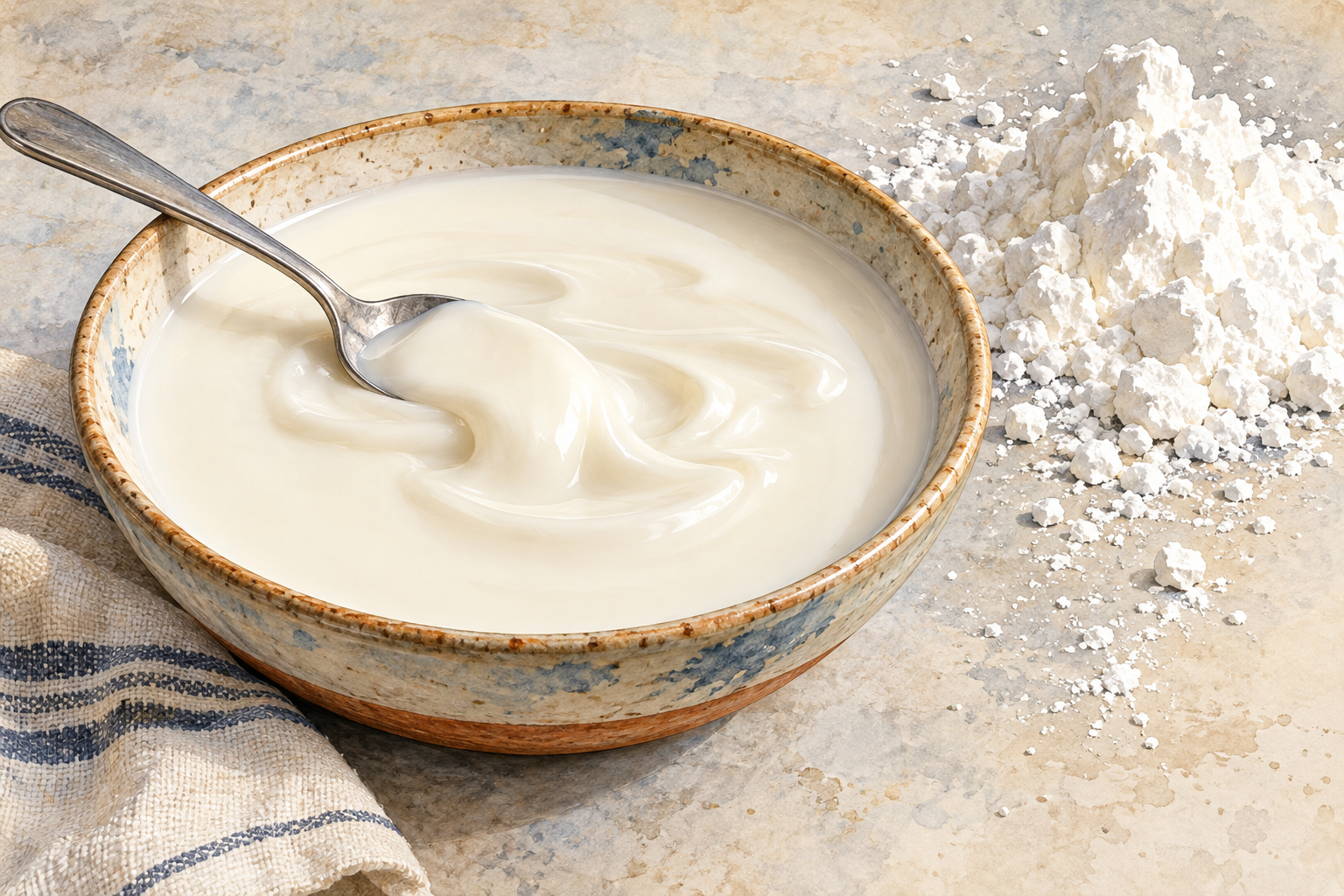
A spoon can move gently through a dense cornstarch suspension, then encounter much greater resistance when the motion becomes forceful. The familiar demonstration is surprising because the material's response depends on how it is being disturbed.
Such behavior belongs to a larger subject: how suspended particles alter flow. The liquid between the grains is only part of the story. Contacts among particles can create structures that make a concentrated suspension resist movement.
A network can form while material moves
Shear thickening means that a material becomes more resistant to shear flow under the relevant loading conditions. A cornstarch mixture is a useful example, but its behavior is more complicated than having a permanent switch labeled “liquid” and “solid.”
Cornell researchers described contact clusters that continually form and reorganize during flow. The collective arrangement of particles helps explain why a suspension can become difficult to stir or push through a narrow opening.
In 2016, the team showed that carefully chosen oscillations perpendicular to the original flow could disrupt those clusters. A motor's flywheel that stalled in a thickened suspension could turn when the additional disturbance was applied.
The direction and timing of the disturbance mattered. Simply adding more vigorous movement in any direction was not the method; the experiment used a controlled combination that broke up the contact structures.
Impact asks a different question
Videos of people moving over a cornstarch-filled pool illustrate another dramatic response: a concentrated suspension can temporarily resist an impact. Researchers study this with defined objects and controlled geometries, rather than relying on a stunt alone.
A 2020 Cornell account described a plate dropped onto a cornstarch suspension. Rotational oscillations applied through the apparatus changed how the material resisted the impact and made the plate sink more readily.
The study connected compression and extension to the earlier work on shear. Different ways of deforming a material can create different contact networks, even when the suspension itself looks unchanged.
| Observation | Useful question |
|---|---|
| Easy slow movement | What contacts exist under this loading? |
| Strong resistance to impact | How is stress transmitted through the suspension? |
| Oscillation changes resistance | Does the disturbance disrupt the particle network? |
The boundary conditions are part of the material's behavior
Concentration, stress and the way a sample is confined help determine what happens. A bowl demonstration, a moving plate and a continuously flowing industrial suspension do not impose identical conditions.
Research on scaling shear-thickening transitions has compared different suspensions, including cornstarch and silica particles in glycerol. It seeks relationships among stress, particle fraction and the approach to rigidity, helping connect particular experiments to broader models.
The practical interest extends beyond the odd sensation at a spoon. A concentrated material may need to pass through equipment, be printed into a shape, or change its resistance during a controlled task. Understanding the particle network helps researchers ask how to manage that response.
The surprise is that a material's apparent stiffness can emerge from interactions happening during movement. The grains are ordinary; their temporary collective arrangement is what makes the suspension unusual.
Watch the research: Cornell's article includes a film of the controlled thickening experiment.
Sources and further reading: Cornell: Controlling shear thickening with crosswise oscillation; Cornell: Tuning impact solidification; Cornell LASSP: Universal scaling of shear-thickening transitions.
Explore more creative work at Incoprea.




