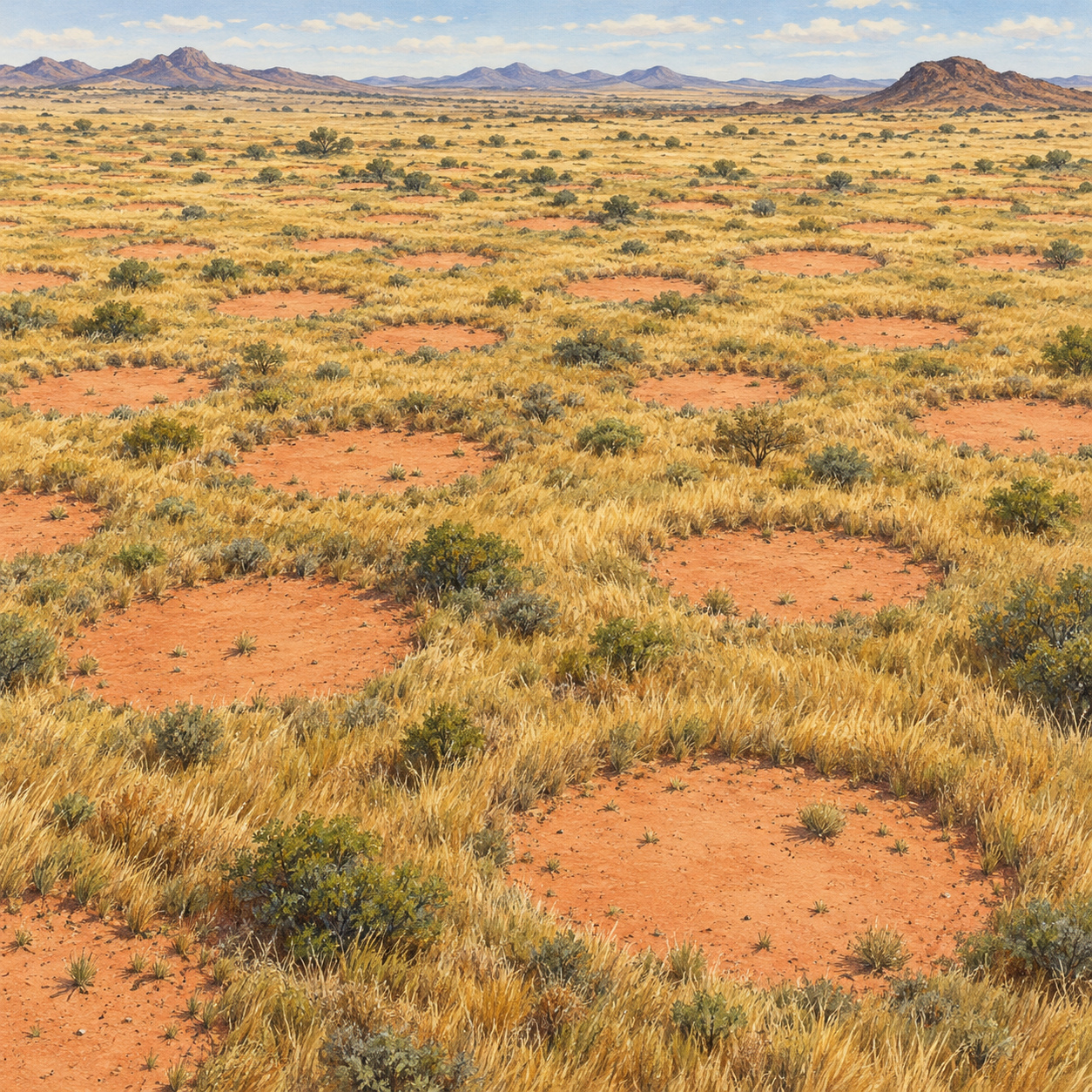
Seen from above, parts of the Namib Desert look as though someone has dotted the grassland with a giant stencil. Bare sandy circles interrupt the vegetation, often edged by more vigorous grass. The pattern is too orderly to ignore and too widespread to dismiss as a few accidental gaps.
These are fairy circles, a memorable name for a real ecological puzzle. The temptation is to find one elegant answer and declare the mystery closed. The more interesting story is how different researchers can measure the same landscape and argue about the machinery beneath its geometry.
Plants, water and the spaces between them
One major explanation focuses on vegetation organizing itself under severe water limitation. Plants affect the movement and availability of moisture around their roots. Under suitable conditions, that feedback can favor patches of vegetation separated by bare ground rather than an even carpet of grass.
A University of Göttingen-led team followed rainfall, examined newly growing grasses and recorded soil moisture in Namibia. In its 2022 study, grasses inside circles died without the root damage the researchers expected from termite feeding. The team interpreted the water measurements as evidence that surrounding grass depleted moisture and helped prevent interior plants from establishing.
In this view, a gap is part of the functioning vegetation pattern. It is not simply a dead place. The relationship between surviving plants and available water shapes where grass can persist.
The case for tiny underground engineers
Other researchers emphasize sand termites. A University of Hamburg team reported termites at more than 1,700 fairy circles across Namibia, Angola and South Africa. Its explanation is that termites remove vegetation, reducing water loss and creating a persistent underground water store that benefits the colony and surrounding plants.
That group also challenged the speed and distance of water movement proposed in the plant-competition explanation. The dispute involves details such as measurement depth, dry-soil conductivity and what happens immediately after rain. Those details matter more than the attractiveness of either story.
Finding termites in a circle does not by itself establish every step of causation. Equally, a model capable of producing circles is not automatically proof that its mechanism dominates in every real landscape. Each approach must connect predictions with observations.
Put the explanations into a prediction table
An argument about causes becomes more useful when each explanation is asked to predict an observation before the observation is known. For a newly growing patch after rain, what should happen first? Which roots should be damaged, which soil layers should retain water, and how quickly should conditions change between the center and the grassy edge?
For a termite explanation, evidence about the insects' activity must connect their presence with vegetation removal and the persistence of the bare patch. For a water-competition explanation, measurements must connect surviving vegetation with the availability of water to seedlings inside the circle. Both explanations involve water; the disagreement concerns which processes arrange it and prevent grass from establishing.
A compact table can keep the tests visible. In one column, write “root condition just after rainfall.” In another, write “soil moisture by depth and distance.” Add a third for “change through time.” Then record what each research account actually reports for those categories. An empty cell is a missing observation, not permission to fill it with whichever story feels more elegant.
Timing is especially important. Looking at damaged roots long after seedlings died may not establish what killed them. Measuring moisture at one depth may miss what happens at another. A disagreement about cause can therefore hinge on where a probe was placed and when investigators arrived, not merely on whether they noticed termites or grass.
Aerial beauty cannot settle the mechanism
Regular spacing is real information. It suggests that local interactions and the availability of resources help organize the pattern. Yet different models can produce visually similar circles. An image that resembles a model's output is a beginning for comparison, rather than a unique signature of one process.
Try a small visual exercise with a documented aerial photograph: choose several neighboring circles and note their spacing, shape and relationship to vegetation around them. Then ask what those observations do not show. The image cannot directly reveal the moisture profile below each circle, the condition of a seedling's roots or the history of an insect colony.
The place also matters. A circular bare patch in another region may sit in different soil, rainfall conditions and biological communities. Giving two patterns the same memorable name does not establish that their causes must be identical. Good comparison begins by describing what is shared and what differs.
This is not a reason to abandon explanation. It is a reason to make an explanation earn its scope. A mechanism supported for particular sites or episodes can remain valuable without becoming a universal rule for every ring of grass on Earth. The most interesting question is which new observation would most sharply distinguish the alternatives at a specific place.
Sources and further reading: University of Göttingen: Plant self-organization research · University of Hamburg: Sand-termite research and response