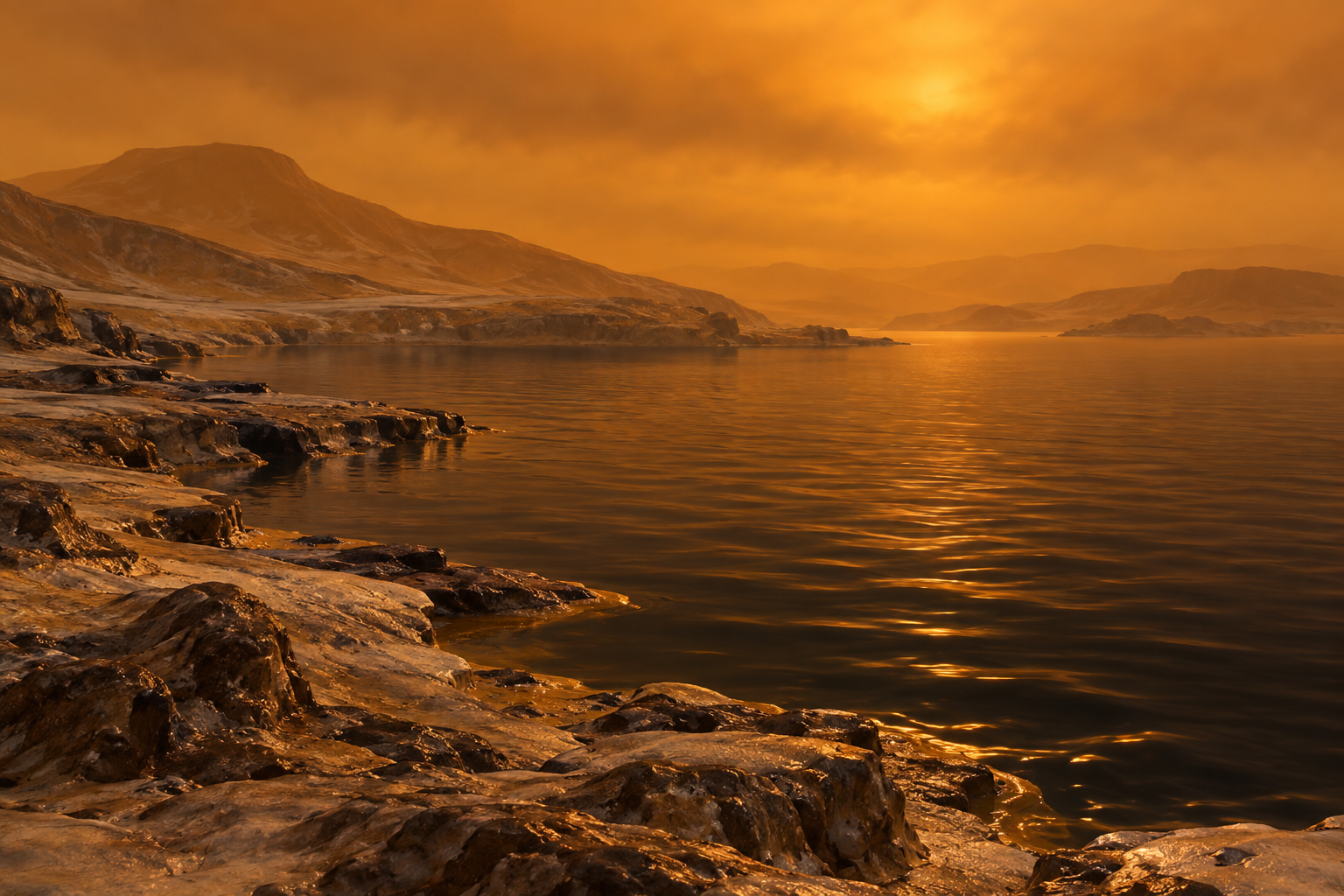
Picture a shoreline beneath an orange sky. Clouds gather, rain falls, streams carry liquid downhill and a lake slowly changes with the seasons. The scene sounds familiar until its chemistry is revealed: on Saturn's moon Titan, the flowing liquid is largely methane and ethane, not water.
Titan offers an extraordinary variation on an earthly theme. It has a thick atmosphere and a cycle of evaporation, clouds and precipitation. Familiar landscape processes operate in a cold environment where materials behave very differently from those in a kitchen or a summer lake.
Cold enough to rearrange the familiar
Titan's surface is about minus 179 degrees Celsius. At those temperatures, water ice is hard enough to form much of the solid landscape, while hydrocarbons that are gases under ordinary earthly conditions can remain liquid.
Methane and ethane can fill lakes and seas, especially near the poles. Liquid rain feeds channels and basins; evaporation returns material to the atmosphere. Calling this a hydrological cycle describes the movement of liquid, even though the moving substance is not Earth's water.
The atmosphere is mostly nitrogen. Its haze obscures the surface in visible light, giving Titan its characteristic muted appearance. That haze is a reminder that a clear, blue-sky picture of an alien lake would miss an important part of the actual setting.
Reading lakes through the haze
The Cassini spacecraft used radar and other instruments to investigate Titan's hidden landscape. Radar-dark regions, lake-like boundaries and associated channels supplied evidence of liquid bodies, while subsequent measurements helped reveal their composition and depth.
Data from Cassini's final Titan flyby in 2017 showed that some small northern lakes were more than 100 meters deep and contained mostly methane. They were also perched on elevated terrain, adding complexity to scientists' picture of how liquid is stored and moves across the moon.
Not every lake has the same mixture. Measurements of Ontario Lacus in the southern hemisphere indicated a more balanced methane-and-ethane composition. A lake's history, evaporation and connections to other reservoirs can matter, just as local conditions distinguish lakes on Earth.
An analogy with useful limits
Titan's seasons last more than seven Earth years each, so its weather belongs to a much slower seasonal calendar. Studying change there requires patience and careful interpretation of observations separated in time.
Its complex carbon chemistry makes it interesting to scientists investigating possible environments for life. That interest should be kept separate from a discovery: there is no confirmed evidence of life in Titan's lakes. Familiar rivers and shorelines do not guarantee familiar biology.
What Titan does provide is a remarkable test of our intuition. We recognize the shape of a drainage channel and the idea of a rainstorm, then discover that the same broad patterns can be written in different chemicals. The universe can repeat a landscape's grammar while changing nearly every word.
Sources and further reading: NASA Science: Titan facts; NASA: Cassini reveals surprises in Titan’s lakes; NASA: Radar evidence for Titan’s lakes.
Explore more creative curiosities at Incoprea.