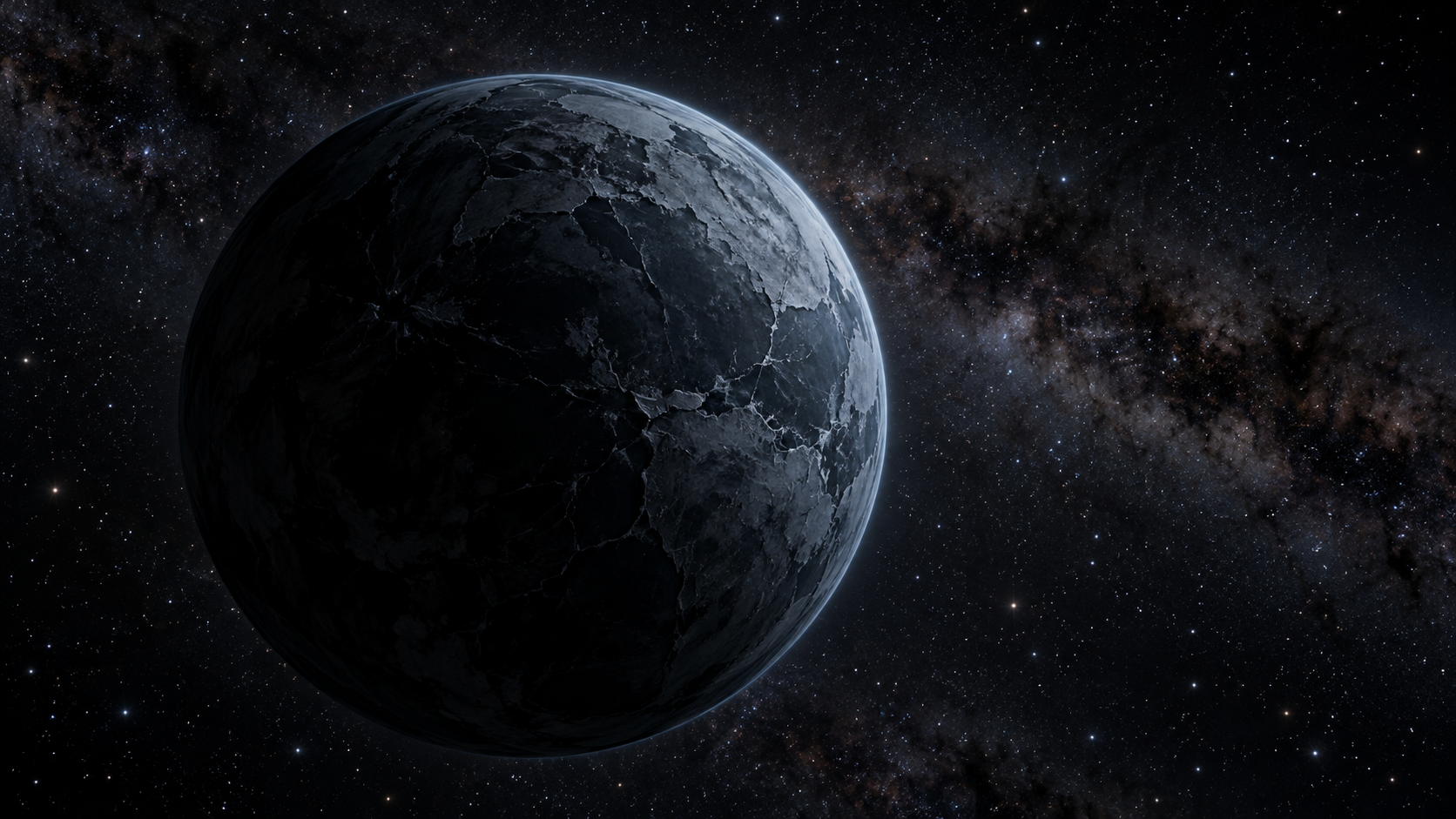
We tend to imagine a planet as a world circling a star. Our own solar system has taught us that arrangement so thoroughly that a planet without a sun sounds unfinished. Yet astronomers study planetary-mass objects that drift through the galaxy without a nearby host star.
These are often called rogue or free-floating planets. The name sounds adventurous, but it describes an orbital circumstance rather than a personality. Their importance lies in what they reveal about the making, disruption and variety of worlds.
How a world can lose its star
Planet formation is not always a peaceful process. Young systems contain bodies that collide and gravitationally disturb one another. A sufficiently strong encounter can eject a planet, allowing it to escape the system in which it formed.
Some isolated planetary-mass objects may have a different history. A small cloud of gas could collapse directly into a body too low in mass to become a star. Similar-looking lonely worlds therefore need not share the same origin, and the boundary between categories can depend on how an object formed.
Without a nearby star, the usual supply of sunlight disappears. An artist can imagine an icy landscape under an unfamiliar sky, but observations do not establish the surface details of most such objects. An Earth-like mass should never be mistaken for evidence of an Earth-like climate or living environment.
Finding something that barely shines
A cold isolated planet can be very difficult to see directly. Astronomers can instead detect its gravity through microlensing. When an unseen object passes close to the line of sight between us and a more distant star, it bends the background star's light.
That alignment briefly changes the star's apparent brightness. The shape and duration of the event provide clues to the intervening object's mass. A small planetary lens may announce itself for only hours or days, then move out of alignment.
There is an important uncertainty: a brief event does not always prove the lens is completely alone. A planet orbiting far from a host star can sometimes produce a signal resembling that of a free-floating object. Researchers must test how strongly the data exclude a stellar companion.
Why a brief brightening does not give one exact mass
Microlensing depends on geometry as well as the lens itself. The lens and background source move relative to each other, and their distances matter. A short event can therefore constrain a planetary interpretation without acting like a balance that displays a unique mass independent of every other quantity.
The 2018 study makes this concrete. For one very short event, the authors considered an Earth-mass object in the Galactic disk or a Neptune-mass object in the more distant bulge. Those alternatives did not describe two separately photographed worlds. They were interpretations of one event under different locations for the intervening lens.
This is a useful exercise in reading uncertainty. Write the measured light change on one line and the inferred object on another. Then list which additional quantities the inference needs. An estimate expressed as a range or a set of alternatives may be a faithful account of the data rather than a weakness to be edited out of a headline.
The missing-host question has a similar structure. The same paper ruled out stellar companions within stated separation limits for its events. That is a specific observational constraint, not proof that a star is absent at every possible distance. “Free-floating or wide-orbit” preserves a distinction that the colorful word “rogue” can erase.
A missing part of the planetary census
Microlensing surveys have produced candidates and estimates of how common these worlds may be. Those estimates depend on observations, statistical models and assumptions; they are not a completed inventory of every dark planet in the galaxy.
NASA's Roman Space Telescope survey is designed to help investigate this hidden population. Measuring the distribution of masses can distinguish between different formation and ejection scenarios. The question is not simply how many lonely planets exist, but which processes create them.
Count detections and populations separately
Imagine a survey that watches many stars but can recognize only brightening events lasting longer than a particular interval. Very short events will be undercounted even if the underlying objects are common. A different observing cadence changes which signals are easiest to catch. The number detected is therefore not automatically the number present per star in the galaxy.
Population studies must account for detection efficiency and the regions surveyed. They also need models linking event properties with the distribution of masses and distances. Improving those models and obtaining more events can narrow the allowed population without converting a statistical estimate into a literal list of individually identified planets.
The same distinction helps with claims about habitability. Mass, orbital isolation and surface conditions are separate questions. Microlensing can provide evidence about a dark object's gravitational influence while telling us little directly about an ocean, atmosphere or landscape. The icy scene accompanying this article is a possibility for the imagination, not a recovered surface photograph.
When you encounter a new rogue-planet result, ask three questions in order: what signal was measured, what alternatives were excluded, and what population was inferred from the survey? That sequence leaves room for the discovery to be extraordinary while keeping the dark spaces in our knowledge visible.
Sources and further reading: NASA: Unveiling rogue planets with Roman · Mróz et al.: Free-floating or wide-orbit microlensing planets · NASA: Research on low-mass rogue planets




