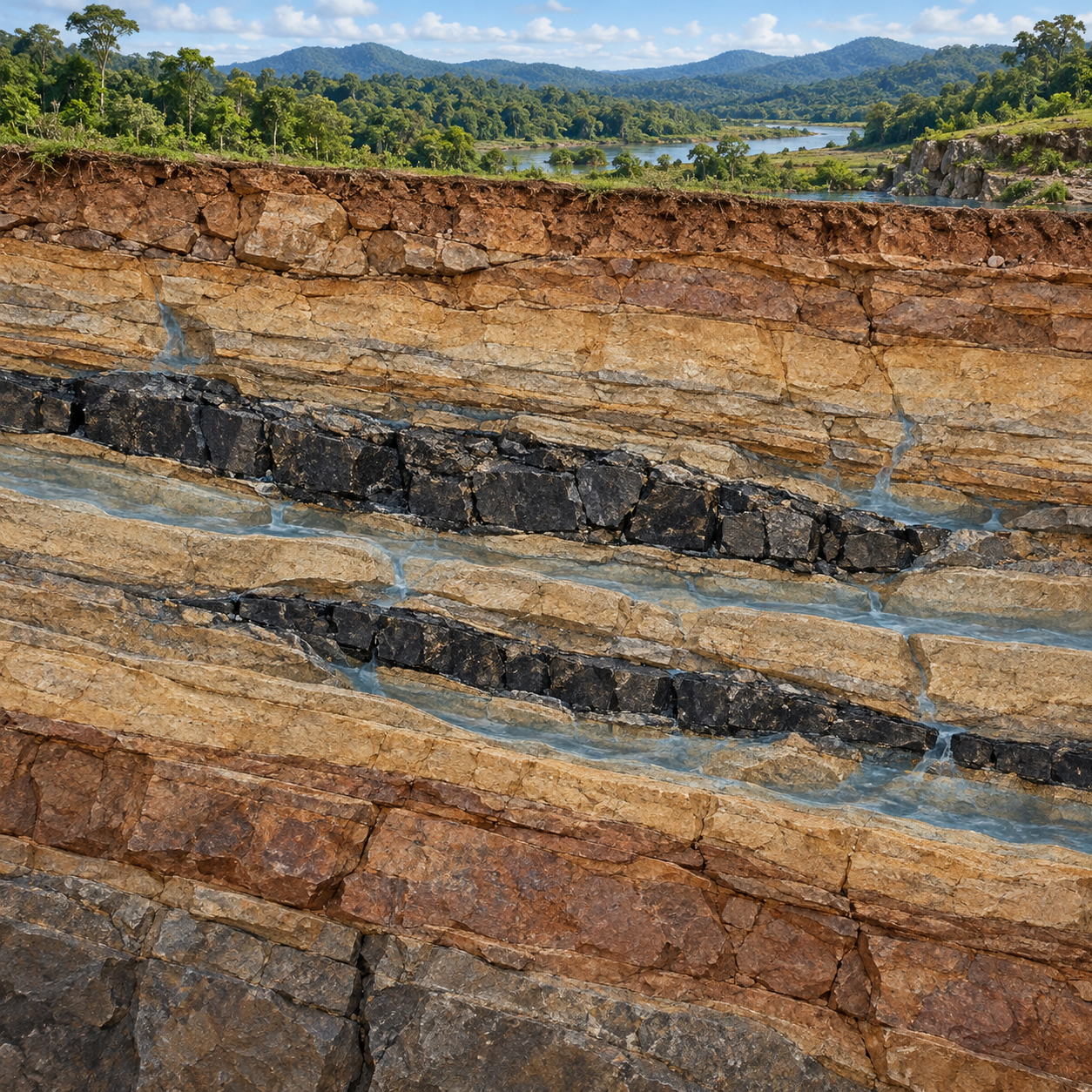
A rock can preserve a footprint, a ripple or the remains of an ancient organism. At Oklo in Gabon, some rocks preserve evidence of something less expected: sustained nuclear chain reactions that operated roughly two billion years ago.
No ancient civilization built them. There were no turbines, control rooms or concrete domes. A particular arrangement of uranium-rich ore and water allowed natural fission reactions to occur inside the ground. The landscape supplied conditions that humans would much later learn to assemble deliberately.
A missing isotope starts the investigation
The discovery emerged in 1972, when scientists examining uranium from Gabon noticed an unexpectedly low proportion of uranium-235. Isotopes are versions of an element with different numbers of neutrons. Uranium-235 is especially important because it can sustain a chain reaction under suitable conditions.
The unusual composition was more than a measurement curiosity. Investigators found evidence that some uranium-235 had been consumed, along with characteristic isotopic patterns in other elements left by fission and neutron capture. Together, those clues pointed to natural reactor zones within the deposits.
This is a kind of geological detective work: the original activity has ended, but its effects on atomic proportions remain. Instead of watching an ancient reaction, researchers reconstruct it from the materials it changed.
Why the ancient Earth could do it
Uranium-235 decays faster than uranium-238, so its proportion in natural uranium was higher in the distant past. Around the time the Oklo reactors operated, the available mixture was more favorable for a chain reaction than ordinary natural uranium is today.
The ore also needed a sufficiently high uranium concentration and a suitable physical arrangement. Water acted as a moderator, slowing neutrons so that they could more effectively trigger further fission in uranium-235. Other materials that absorb too many neutrons could interfere with the process.
A chain reaction is a balance, not a spark
A uranium atom undergoing fission can release neutrons that may trigger further fissions. For a sustained chain, enough of those neutrons must cause new reactions rather than escape the active region or be absorbed without continuing the chain. The ore's geometry and surroundings therefore matter along with the amount of uranium present.
Water's moderator role is easy to confuse with fuel. In the described natural system, it helped slow neutrons; it was not the main store of nuclear energy being consumed. Losing water could consequently change the efficiency of the chain. A substance can be essential to a reaction's operation without being the source of most of its released energy.
Researchers have used retained fission-product information to infer intermittent behavior in parts of the system. Such reconstructions depend on models of operating conditions. It is safer to think of a set of ancient reactor zones with histories to investigate than of one uniform machine following an identical timetable everywhere.
The difference between past and present uranium mixtures is equally important. The larger ancient proportion of uranium-235 helped make those arrangements possible. “Natural” does not mean “ordinary under today's conditions.” The historical isotope mixture and the geological concentration both belong to the explanation.
The past becomes a laboratory
Oklo offers information about how elements move through rock and how ancient nuclear reactions can be reconstructed. Researchers also use its isotope records to investigate whether fundamental physical constants might have changed over geological time.
Those studies require care. Interpretations depend on models of temperature, water content, neutron energies and the original geometry. A remarkable natural archive does not remove uncertainty about every detail of its operation.
The reactors are long extinct, and their existence does not imply ordinary rocks are poised to start producing nuclear power. The necessary circumstances were unusual and belonged to a different atomic composition of the Earth.
Reconstruct the investigation from the discrepancy
Begin with the unexpected isotope ratio. By itself, a slightly unusual measurement calls for checking the sample, the instrument and alternative explanations. It does not instantly supply a complete history of a natural reactor. The additional isotopic signatures associated with fission and neutron capture made the case much stronger.
This is a useful detective exercise because the first clue was small while the inference was enormous. List the measured differences separately from the proposed process that links them. Then ask which other traces that process should leave. A powerful explanation accounts for several independent features instead of simply giving the original anomaly an exciting name.
The same approach clarifies claims about long-term retention of radioactive products. Evidence that some elements remained near their original setting can inform geochemical research, but elements differ in mobility and the surrounding rocks have their own history. It does not establish that every product stayed completely fixed or that every modern waste-storage setting would behave the same way.
Likewise, using Oklo to constrain changes in fundamental constants involves more than comparing ancient and modern ore. Researchers must model neutron energies, temperatures and material composition to interpret the isotope record. The archive is valuable precisely because detailed physical questions can be asked of it. Its age does not make those questions disappear; it makes the care with which they are answered more consequential.
Sources and further reading: IAEA Bulletin: Meet Oklo · IAEA: Early investigation of the Oklo phenomenon · Davis, Gould and Sharapov: Oklo reactors and nuclear science




