
The difficult moment in a public sand-mandala ceremony may come after the difficult work is finished. Lines have become fields of color. Small adjustments have accumulated into a coherent whole. Then the makers begin to dismantle it. If we assume that painstaking craft must end in a permanent collectible, this conclusion can feel like a contradiction. The contradiction belongs to that assumption.
A Tibetan Buddhist mandala is not simply a decorative circle. The Rubin Museum explains that it can be a cosmological diagram and a sacred dwelling organized around a central deity. Mandalas may be made as paintings, sand constructions, or three-dimensional structures. Their meaning depends on a religious setting and practice that a pattern alone cannot reproduce.
Begin with a documented event
The Smithsonian’s Tibetan Healing Mandala archive documents a public construction following the September 11 attacks in 2001. It identifies monks from Drepung Loseling Monastery, a seven-foot-square work, and twenty monks working in shifts over two weeks. Those numbers describe that event; they are not rules for all mandalas.
The archive describes a sequence of preparation, drawing, filling, consecration, and eventual sweeping and dispersal into flowing water. Its explanation links dismantling to impermanence. It also presents healing energies as a Buddhist religious understanding. That is the practitioners’ framework, not evidence of a medical treatment.
Keeping those distinctions visible improves the experience. A visitor can take a belief seriously as part of what people are doing without converting it into a scientific claim or stripping it out as an embarrassment. Both the labor and its purpose deserve to be heard.
The precision is in the delivery
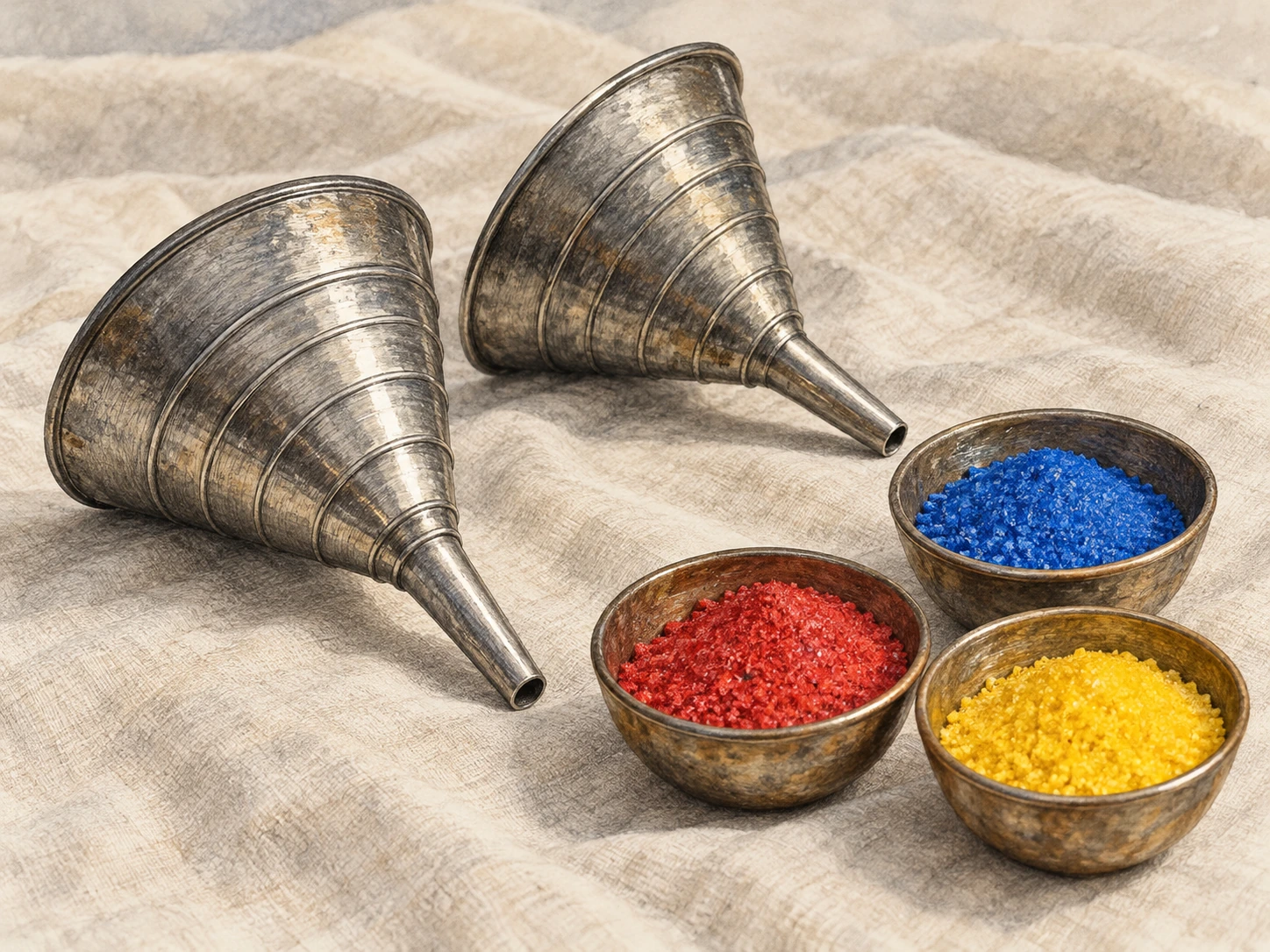
For the Smithsonian example, the colored material was powdered marble. The archive identifies a cone-shaped metal funnel called a chak-pur: rubbing a rod along its ridged surface produces vibration that releases a controlled stream. The construction begins with drawn guidelines rather than incised grooves.
That short description gives you something concrete to watch. Look for the relationship between tool position and the emerging line. Is the tip moving while the flow continues? Does the maker stop before changing direction? How does one filled area meet another? You need not know the entire iconographic program to notice disciplined handling of a granular material.
Do not infer a maker’s internal state from a still photograph. A lowered face is not proof of serenity, nor is a steady hand proof that a task is effortless. Public viewing shows actions and results. Training, attention, fatigue, devotion, and personal experience are larger matters than a camera can settle.
Watch time without losing the people
The National Museum of Asian Art offers a time-lapse recording of a mandala begun in March 2010 by Venerable Ngawang Chojor. A time-lapse is especially good at making cumulative structure legible. It is less good at communicating the duration of a pause or the physical repetition of a working session.
Use it twice. First watch the whole sequence for large changes. Then replay a short portion and concentrate on one boundary between colors. Ask what the compressed recording has removed. Speed can reveal organization while making work appear to arrive almost by itself.
A public account from UNC Pembroke in September 2026 describes another Drepung Loseling visit, this time a four-and-a-half-foot work made by six monks. The report includes a maker’s explanation of kindness and the intentional dismantling. Comparing the two institutional records shows continuity without pretending their scale, occasion, or audience was identical.
Three things a finished photograph leaves out
Order. A completed design makes adjacent elements look simultaneous. A process record can show which decisions came before others. Without that record, avoid inventing a construction sequence from appearance alone.
Sound. A silent picture cannot convey a tool being worked, spoken explanation, chanting, or the room’s ordinary movement. If a recording includes sound, listen to what it actually preserves. Do not add an imagined soundtrack and mistake it for observation.
The ending. An image of the completed surface can circulate indefinitely after the sand has been dispersed. That photograph is a durable record of an intentionally temporary work. It is not the same kind of object as the work it records.
This last distinction can change the way you share a picture. Naming the makers and occasion, linking their explanation, and including the documented conclusion gives viewers more than visual spectacle. It preserves something of the event’s own account of itself.
A respectful looking guide for a public visit
Read the host’s guidance before approaching. Viewing, photography, questions, and participation can have different arrangements at different events. A public invitation to observe does not mean every tool, symbol, or ritual action is available for casual imitation.
Choose one question that the setting can actually answer. “What material is used here?” is more useful than assuming it is beach sand. “Who selected this mandala?” respects a decision-making structure. “Where can I read the makers’ explanation?” keeps the account connected to its practitioners.
If you want a personal exercise afterward, arrange a few plain paper squares into an original temporary composition and then put them away. Use no sacred diagram or borrowed ritual. Observe your response to undoing your own arrangement. The exercise can help you notice attachment to a result; it does not reproduce Buddhist training or grant insight into somebody else’s religious experience.
Whose account accompanies the picture?
The practitioners’ own Mystical Arts of Tibet explanation describes an outlined platform, colored material delivered through vibrating metal funnels, and the eventual dismantling. It also explains consecration and blessing within its religious framework. Those statements should be attributed as the practitioners’ account, rather than turned into a universal description of every Buddhist mandala or a measured health outcome.
A Drepung Loseling event announcement from August 2019 identifies a White Tara mandala, opening and closing ceremonies, and separate days for construction and viewing. This dated program is useful because it distinguishes an unfolding public event from one isolated photograph. Its schedule documents that event’s planned sequence; it does not establish a fixed duration for all such work.
Try making a listening-and-label card before visiting a public program or its documented recording. Leave four spaces: the makers’ names or monastery, the selected work, the occasion, and the makers’ explanation of the ending. If a host supplies only the first three, the fourth is a question to research, not an invitation to invent a poetic meaning.
Next compare three possible captions for the same finished surface. One gives only color and geometry. Another adds the makers and occasion. A third explains the documented dismantling. What kind of encounter does each caption invite? The first may be visually accurate while leaving out the event’s stated purpose. Adding context changes the reader’s access without altering a grain of the image.
For an accessible alternative to a long film, read the event program and trace the order in words: preparation, construction, public encounter, conclusion. Identify which parts a still image could document and which require a sequence or explanation. Someone unable to attend every session can still understand that the finished surface was one stage rather than the whole event.
This exercise requires no copying of a sacred design. Its subject is how an account is presented and whose voice remains attached to it. A respectful record can preserve the visual achievement while allowing the makers’ own explanation to guide the interpretation.
The final act becomes easier to understand when it is not cropped out of the story. A photograph may continue circulating after the work has been dismantled. Naming that difference lets the lasting image serve as a record of an intentional process, instead of quietly converting the process into a permanent decorative object.
Completion can include release
There are many reasons people make things: exchange, use, remembrance, devotion, learning, pleasure. Permanence is only one possible goal. The public sand-mandala events described here ask viewers to attend to a process whose final action changes the visible work entirely.
The useful question is not how anyone could bear to “waste” so much effort. It is what that judgment assumes effort is for. Looking carefully, listening to the makers, and staying with the ending allows the event to challenge that assumption on its own terms.
Sources and a closer look
Smithsonian: Tibetan Healing Mandala archive; Rubin Museum: Circle in the Square; National Museum of Asian Art: Encountering the Buddha and time-lapse; UNC Pembroke: September 2026 mandala visit.
Find more art, ideas, and unexpected connections at Incoprea.




