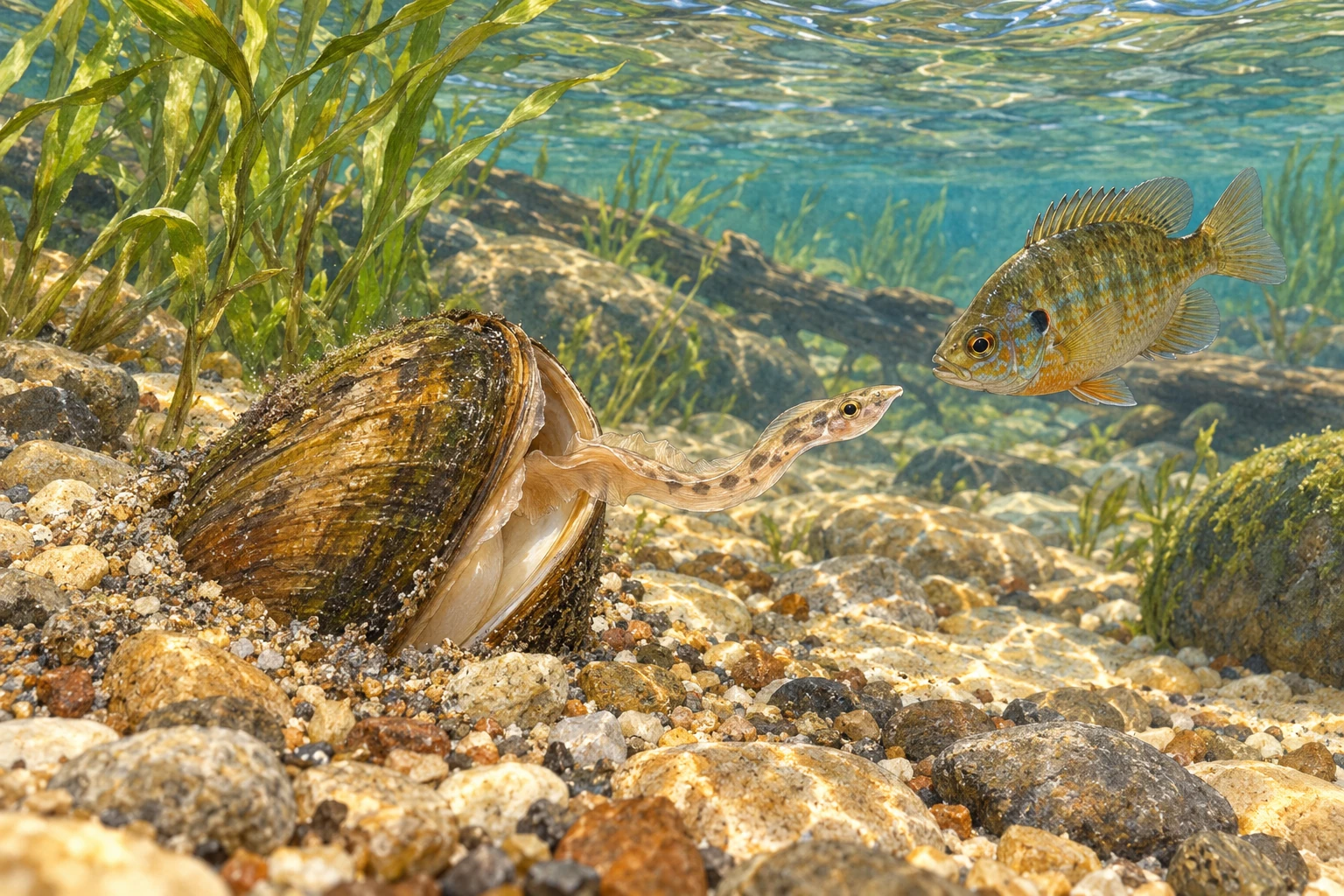
At the riverbed, a small fish-shaped movement appears beside a shell. A real fish approaches what looks like an opportunity to feed. The moving shape can be a mussel's mantle lure, part of a reproductive strategy whose next stage depends on contact with a suitable fish. The adult mussel's stationary life contains a mobile chapter.
Many native freshwater mussels in the unionid group produce larvae called glochidia. These larvae temporarily attach to a host fish and develop before leaving it as juveniles. That stage helps explain why conserving a mussel requires more than leaving adults undisturbed in apparently clean gravel. The life cycle connects the riverbed to animals moving through the water above it.
The host must be more than a passing ride
The USGS host-fish research program emphasizes specificity: larvae may complete their transformation on a particular host or a limited set of hosts. Finding glochidia attached to a fish does not necessarily prove that they will develop successfully there. Contact, attachment, and successful metamorphosis are distinct steps.
This is a subtle but consequential distinction. A fish might encounter larvae often because it occupies the right habitat, yet be physiologically unsuitable. Another fish might be an excellent host in a laboratory but rarely overlap with reproductive mussels in a river. A useful account combines compatibility with opportunity.
A USGS investigation in Texas joined field fish collection and laboratory recovery of larvae and juvenile mussels. Molecular identification can help connect the young stages with adult species that are hard to distinguish at such small sizes. An adult shell, a larva, and a fish carrying larvae are different parts of the evidence chain.
Not every mussel recruits its host in the same way
In a USGS public lecture with a full transcript, fisheries biologist Heather Galbraith explains a range of host-attraction strategies. Some mussels use mantle displays. Others release packages resembling food, and some make more direct contact with a fish. The fish-shaped lure is a striking example, not a universal organ on every freshwater mussel.
A lure does not need to fool a human observer perfectly. Its ecological effect depends on how a relevant fish responds in the water, under local light and movement conditions. An indistinct wriggle can be persuasive enough if it triggers investigation or a feeding strike. The resemblance is tested by the receiver's behavior, not by a photograph winning a human imitation contest.
That also explains why the details vary. A strategy involving one host's feeding behavior may be unsuitable for another. The mussel's reproductive timing, larval release, habitat, and display must fit the opportunities provided by its particular fish community.
A compatible host also has a history
A host-species list is useful, but the name of the fish need not describe every relevant property of an individual. Prior exposure can change the host's response. A fish capable of supporting a mussel's development may become less suitable after repeated encounters with its larvae.
A 2006 experiment with largemouth bass investigated resistance after previous glochidial infections. The researchers measured successful metamorphosis among attached larvae and examined antibody responses. Primed fish supported lower transformation success than previously unexposed controls at the tested intervals. This is evidence for a changing host condition, not simply a failure of larvae to find the right fish species.
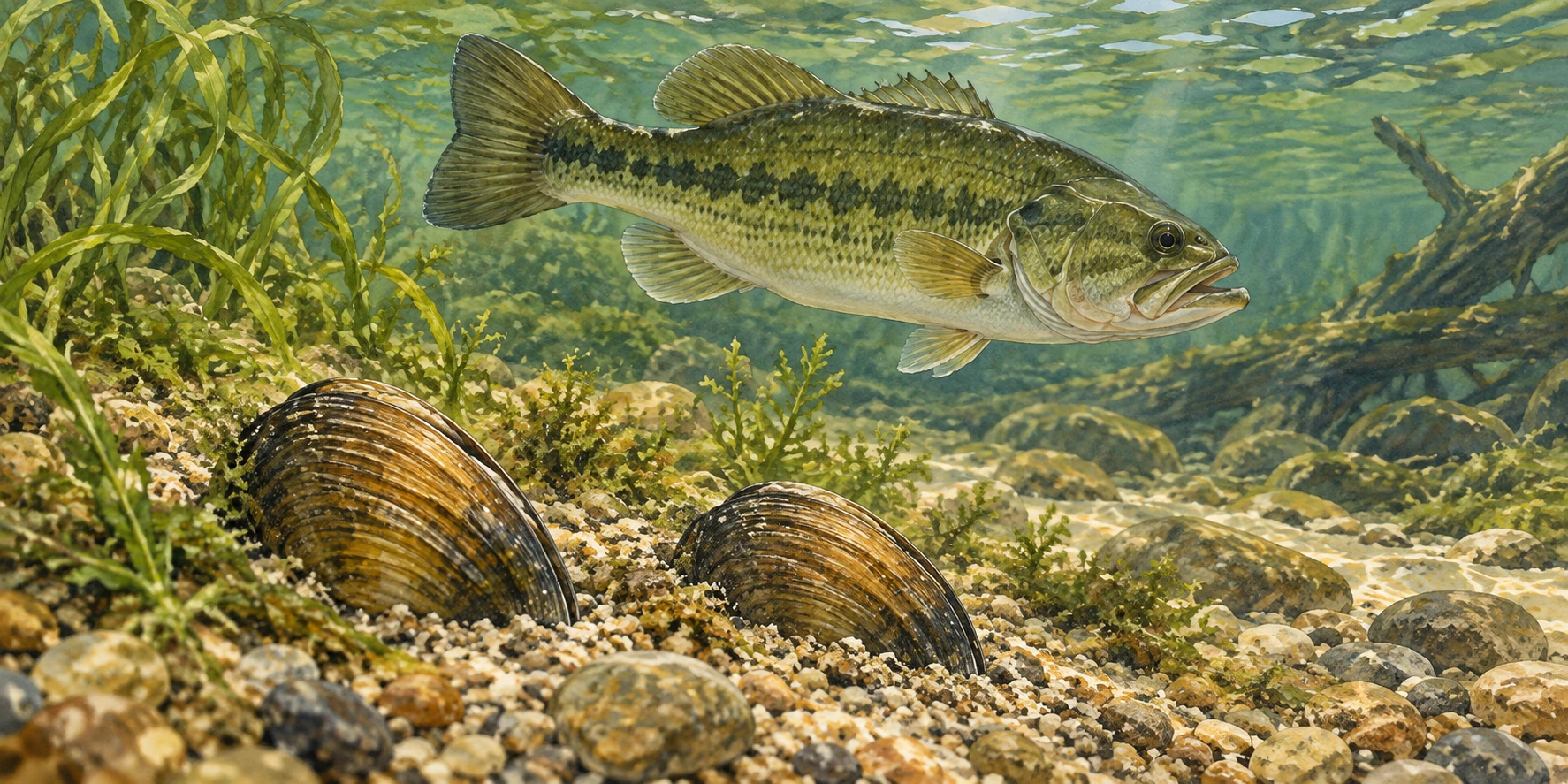
A related 2005 study tested whether acquired resistance extended to other mussel species. Some cross-resistance occurred, with evidence suggesting both specific and less specific components. The result should remain attached to the tested largemouth-bass/mussel comparisons. It does not establish one universal duration or immune response for every river fish.
Keep the denominator attached to the outcome
The worksheet has two fictional trials. Trial A begins with 30 attached larvae and yields 10 live juveniles. Trial B begins with 100 and yields 20. Trial A has a higher transformation proportion, about 33 percent rather than 20 percent. Trial B produces more juveniles overall.
Attachment is not transformation
A fictional two-trial ledger separates transformation percentage from juvenile yield and asks for appropriate controls.
Both comparisons are correct. Neither identifies why the trials differ. Fish history, larval condition, species and recovery methods would need suitable controls before a cause could be assigned. “Better host” is too compressed unless the outcome and conditions are specified.
This is especially helpful when reading conservation propagation work. A successful attachment is an intermediate step. A percentage calculated from attached larvae asks a different question from the number of juveniles ultimately available. The two measures can rank trials differently without contradicting one another.
The moving fish in the illustration now carries another kind of history: its own previous biological encounters. The mussel's mobile chapter depends on an interaction with a living host, rather than a standard transport vehicle. Species compatibility opens the possibility; individual condition and the rest of the life cycle determine what follows.
The temporary association includes nutrition
Calling the fish merely a taxi can understate the relationship. A stable-isotope study investigated nutritional transfer during larval development. Changes in isotopic signatures supported a parasitic relationship rather than a completely passive ride. The host is part of the larva's developmental environment.
Parasitism does not automatically mean every natural attachment causes severe disease in a fish. The effects depend on species, exposure, and conditions. The important point is to identify the biological exchange accurately rather than making it sound either harmless by definition or catastrophic by definition.
Once young mussels leave the host, suitable habitat still matters. Successful transport cannot rescue a juvenile that lands in an unsuitable bed. Conversely, a good patch of substrate may fail to receive recruits if the appropriate host fish cannot reach it. A barrier's effect can therefore propagate through a life cycle without directly touching the adult mussels.
For conservation, that makes a practical difference. Restoring one species may require understanding another's movement, abundance, and compatibility. A hatchery can use host information to support propagation, while river restoration must also consider the conditions under which the whole sequence can occur naturally.
If you find a live mussel, observe it where it is and follow local rules rather than collecting or relocating it. The shell's identity and the river's host relationships are not obvious from appearance. The generated illustration shows a generic mantle-lure interaction, not a guide for identifying a particular species or choosing a fish host.
The adult seems anchored, but its offspring's history reaches into a moving animal. A river mussel's world includes a fish's senses, physiology, and route through the water. That hidden chapter is why a shell on the bottom can tell a larger story about whether a river remains connected.
Follow the evidence: USGS: life-history research and host-fish requirements; USGS: field and laboratory assessment of host relationships; USGS: stable-isotope evidence for larval parasitism; Heather Galbraith, USGS: audio lecture with transcript.
More curious connections, art and independent projects at Incoprea.